Krita > GIMP, absolutely, but unfortunately both of them are centuries behind any proprietary software despite only being decades old. And I'm not even talking about PAID proprietary software. Free apps are also better.
A frequent issue with FOSS is that they can handle a variety of edge cases because some technical person needed it once and went through the trouble of implementing it, but they offer a subpar experience at basic cases.
They'll add a feature because it was in the bug tracker and then say "it's done," and you need to hold a committee for 6 months in the forum to change anything in it. Meanwhile a proprietary app made by 1 person will gain 30 different niceties to the basic feature in 1 week.
It's just very hard to imagine how an application that existed for 20 years can't select multiple layers at once or reorder its brushes. It almost feels like abandonware at this point, despite them getting new features from time to time.
Depending on your use case, fire alpaca, azpainter, graphics gale.
The problem is that Krita/GIMP have many features that very few people use. Like you have digital artists who don't need CMYK, but the entire application needs to support it. Or you have people who want to write text on images. Or people that want to do photo manipulation. Or people who need to make assets for games. Or even doing something weird like saving a PNG without pre-multiplied alpha.
So whenever you compare it with something else, you're able to point out to all these features they accumulated through the years.
But if you started making an app today for a specific use case, in 1 month you would be able to add features that these applications have lacked for decades, and these will be just the first features you'll be able to think of.
So it's always this strange feeling where an application clearly has had a lot of work put into it and yet seems to lack something extremely basic you would expect to find in an application that has had a lot of work put into it.
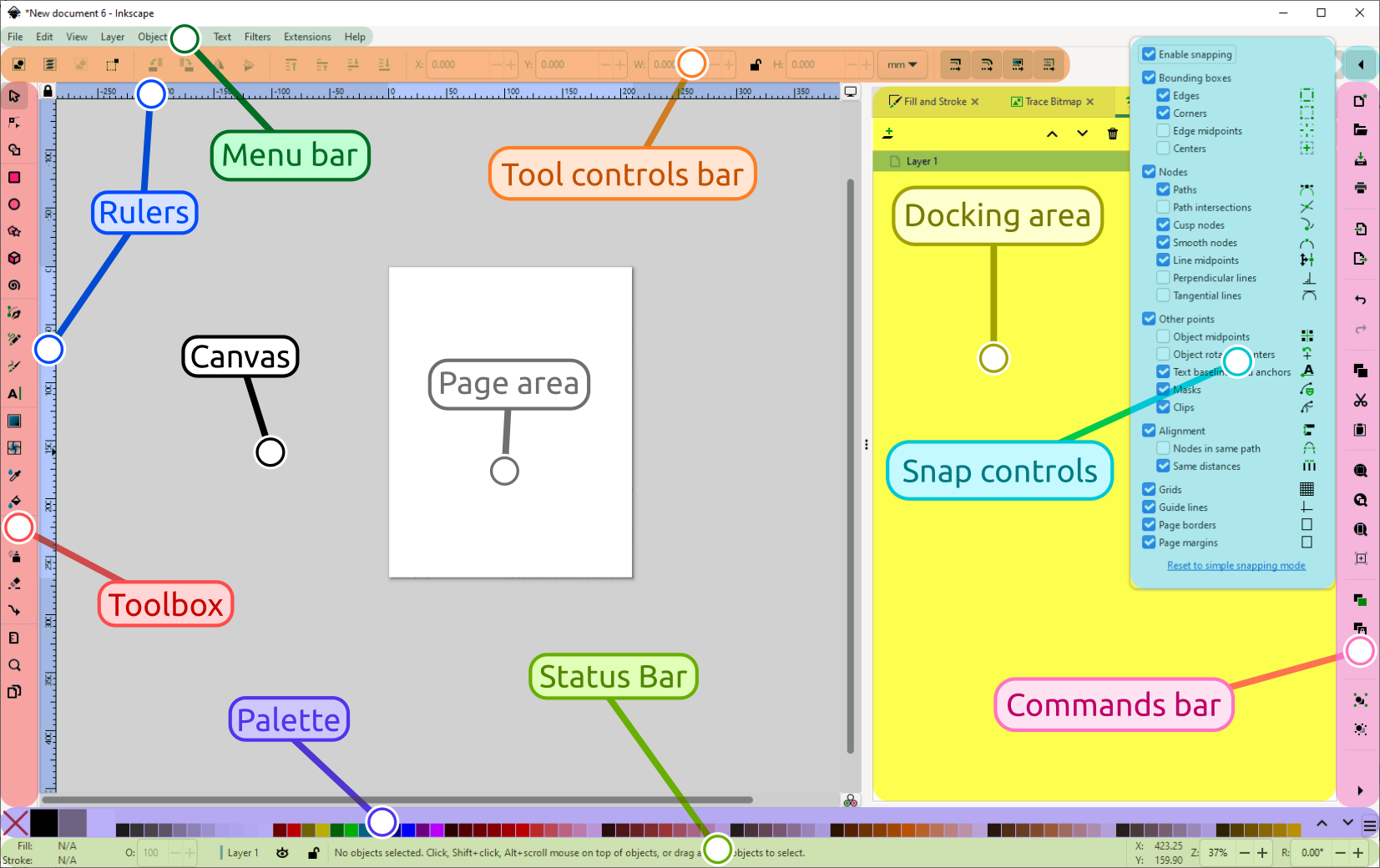
The toolbar is called "tool controls bar," the tool controls bar at the left is called "toolbox," and the toolbox at the right is called "commands bar."
If you asked me I'd say it's 3 toolbars. And why is palette not palette bar?
If a web browser can't access a URL, it won't tell you why exactly because there's a chance it diagnosis the reason wrong and most users will be confused by that. I assume most diagnosis tools work the same way. You need to make assumptions about how the OS, hardware, and network are configured to be able to say "the problem is here."
For example, when you access a website, the first thing that needs to be done is check a domain name server (DNS) to get the IP address of the web server. But where does the web browser get the DNS IPs from? You can configure it in the browser. Or in the OS. Or in your router. Or in your modem. And if you don't, it gets them from the DHCP server the router connects to, which could be your ISP's DHCP server (then you get your ISP's default DNS) or it could also be some other router in an organization's network.
If the DNS seems wrong it's easy to tell the IP is wrong but it gets hard to say where that IP came from.
Even SSL could be a problem with the server having the wrong certificates or it could be your computer having the wrong certificates.
Personally, every time I see chat GPT's output I just skip it. I look at it and I'm not sure it's quoting things literally or changing them, so I can't trust anything the summary says, and if I'm going to click the links anyway, I don't need the summary.
I love dense UIs, but in my experience they're very hard to design. You can easily make an OK design if you add a lot of space and padding, but to make a dense UI look good you need custom borders and textures, and you need a permanent vision so you can add more widgets later that won't look weird. It's sadly not a paradigm that works in many scenarios.
There is no reason why this couldn't exist in the current e-mail technology. In fact, as someone who has written HTML, I'd rather not have HTML anywhere if possible! It's a terrible, nonsensical technology. A simple XML format for display text/images would be much easier to deal with, and also easy to transpile to a HTML/CSS subset. I'd like to hope that e-mail will last longer than HTML!
I think the biggest problem with e-mail is that the lack of inter-provider communication protocols, something that distributed social media (the fediverse) has. For example, there is no way for a provider to know whether or not an e-mail sent was opened, so EVERYONE uses tracking pixels! Like, just put this into a protocol already! The problems you're talking about with HTML support are simply because there is no way for a provider to announce what HTML it supports, partly because this depends on the client that opens the e-mail, not the server that stores the e-mail. But even then, seriously, this should really just be a setting per account and if you use Thunderbird it announces to everyone "hey this dude uses Thunderbird, so don't use fancy HTML!" and if you switched to something else you would just start getting different e-mails. You can see why this wouldn't work with HTML, since HTML is a terrible language that has no actual support for being displayed in a zillion different clients despite what it claims.
Return receipts are already a thing aren't they? But most people don't actually want to be tracked, so the correct thing to do there is not allow any external resources to be loaded from an email, and to make user tracking illegal/codify that stalking millions of people doesn't make it okay; it makes it millions of counts of stalking and harassment.
HTML already gracefully degrades. If you don't support a feature, you just ignore it and continue. It works just fine unless you're shooting for exactly matching some figma design on all clients, which is exactly what HTML is not supposed to do.
iirc this is why the hungarian notation existed. They had ints for columns and rows and they used a prefix on variable names to distinguish which ints were columns and which ints were rows. Though I may be misremembering.


A frequent issue with FOSS is that they can handle a variety of edge cases because some technical person needed it once and went through the trouble of implementing it, but they offer a subpar experience at basic cases.
They'll add a feature because it was in the bug tracker and then say "it's done," and you need to hold a committee for 6 months in the forum to change anything in it. Meanwhile a proprietary app made by 1 person will gain 30 different niceties to the basic feature in 1 week.
It's just very hard to imagine how an application that existed for 20 years can't select multiple layers at once or reorder its brushes. It almost feels like abandonware at this point, despite them getting new features from time to time.