Is this true? Software patent is a gray area in the EU and I would not recommend to take for granted that European companies do not have to pay the h.264 license, even if they only distribute in Europe.
Concerning VLC, their FAQ [1] does not mention the EU aspect: they say that they cannot pay for the license because the software is free and that "the end-user becomes responsible for complying with the licensing and royalty requirements" (whether this would be defensible in court is debatable)
According to article L 611-10 of the French Intellectual Property Code, software patents are not allowed under French law. At the [EEA] level, Article 52 of the European Patent Convention has also excluded the protection of computer programs.
As a result, any software supplied by VideoLAN is not subject to licenses on any software patent, regardless of its origin.
The relevant section of the French IP law states that:
1. New inventions, in all fields of technology, involving an innovative approach with industrial application are patentable.
2. The following are not considered as inventions within the meaning of the first Section of this Article in particular: a) The discoveries of scientific theories as well as mathematical methods; b) Aesthetic creations; c) Intellectual plans, principles and methods in the areas of sport or economic activities, as well as computer programs; d) Presentation of information.
3. The provisions of Section 2 of this Article shall exclude the patentability of the elements listed in the said provisions only to the extent that the patent application or patent concerns only one of these elements considered as such.
4. Subject to the provisions of Articles L. 611-16 to L. 611-19, inventions relating to a product consisting wholly or partly of biological material, or to a process for producing, processing or using biological material, shall be patentable under the conditions laid down in Section 1. Biological material is considered to be material that contains genetic information and can reproduce itself or be reproduced in a biological system.
> the end-user becomes responsible for complying with the licensing and royalty requirements
Exactly. If you're using h.264 without a license in a country that requires it, it doesn't matter that some french people wrote the software for you. That's all they're saying.
While the thesis is interesting and while there is probably some truth to it, the argument doesn't seem fair to me...
Sure if you repeat endlessly a task which is not related to the objective, it may fail to prove successful (without much surprise). However, if I repetitively compare images of one correct coin and one incorrect coin, I am pretty sure that I would improve in some way, without putting so much effort in the process. If every day someone recalls me the position of the nearest fire extinguisher, I will certainly learn this information at some point, once again without much effort.
And this type of wrong arguments can be reversed against the author thesis. Try to learn a new programming language while doing a one armed handstand, the difficulty will be way higher, however I doubt that it will generally improve your learning pace. Does that mean that difficulty is not a key to remembering? Nope, only that it is not per se a sufficient condition to remembering.
This is difficult to express, but that difficulty inherent to my process of describing my perspective to you is a motivator for me doing so. And that's where difficulty/challenge as a component of knowledge acquisition is important.
We memorize and recall within the limbic system. That's the same system that also facilitates our emotional and physical responses to stimuli. And as I see it (keep in mind I'm not a neuroscientist), increasing emotional activity alongside the task increases the overall allocation of physical energy to the limbic system. I believe this is the physical component that defines "flow", or the ability to be so immersed in an activity or series of activities that, as I am at this point in my writing, we forget time. (I need to go stir tea on the stove. One moment...)
Alright. Um, our ability to sustain enough engagement in something to optimize our retention of that activity is, I believe, critically dependent on emotion. Think of reading a law book. Now, think of reading a law book on accounting. Now, think of reading a law book on accounting while referencing the IRS.gov web site for available white papers. The further we venture into emotional detachment from the activity, the more willpower we need to engage, the more energy we deplete through continuous activation and reactivation as we doze off and have to return and restart a portion of the activity.
I agree though that the challenge has to be enjoyable. I'm not interested in learning a new programming language while doing a handstand. I am, however, interested in learning a new programming language if a boy I like also likes it and likes to talk about it, and I want a reason to talk to him more often. (I had a stint learning C++ for that reason. And it's still one of the best things I've done because it expanded my understanding of paradigms and language capabilities.)
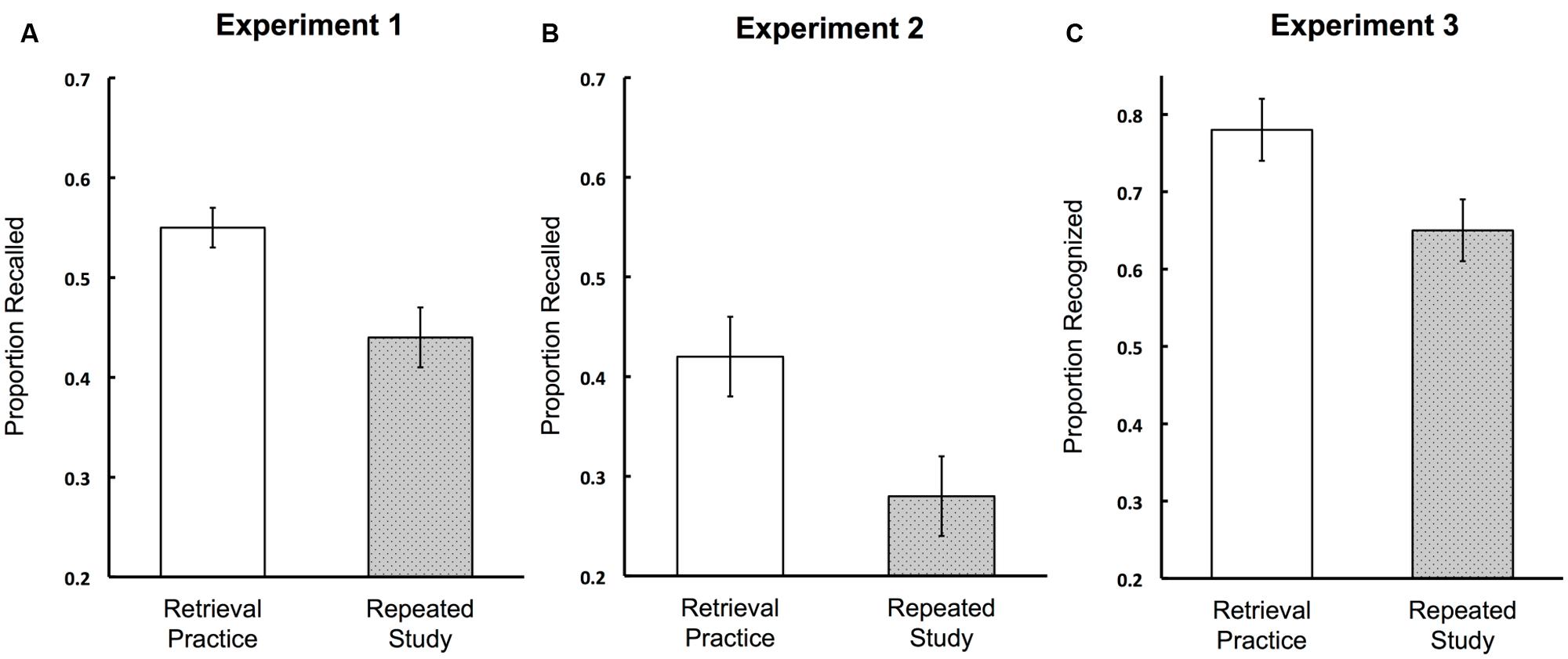
It's not necessarily a question of "will this work at all?" but rather a question of effectiveness. Numerous studies have shown that retrieval practice is generally more effective. I'm not sure I've seen a study yet which shows any other result.
Experiment 2 is free recall (blank piece of paper trying to recall as many words as they studied in the prior phase).
Experiment 3 is recognition (given a randomly sorted list of all the studied words and a bunch of other words that weren't in the list).
I'd also suggest it limits the usefulness of your memory. By only learning by comparing coins, you might successfully get everything correct on a quiz that entirely consists of comparing coins. But if you're ever faced with a different situation, say you don't have a coin at all but you have to reproduce it in some way, it's likely your knowledge won't transfer.
I've been in plenty of situations, and I'm sure others have too, where I've "learned something" and I'm able to answer a multiple choice, but faced with an open-ended question with a free-form answer, I'm screwed because I can't actually recall the information. I've only trained recognition when possible candidates are placed before me.
> if I repetitively compare images of one correct coin and one incorrect coin, I am pretty sure that I would improve in some way, without putting so much effort in the process
Trying to figure out which coin is correct would be cognitive effort through - retrieval practice promoted by article. That is the point of article, it is not enough to see it, you have to work with it.
And now you're ability to exclude reviewers is a significant factor in the acceptation of your paper... Not sure if this is really what we should whish for.
What kind of inner products are defined by the absolute value, cuberoot of absolute cubes, fourth root of fourth powers? I never heard of that and would be glad to learn about it.
You may find it interesting to read about Lp norms, and their relationship to inner products on vector spaces. I think the OP is mixing up norm and inner product terminology. This happens often because you derive an norm from any inner product, but the other way may not exist.
If you plot on the plane the distance = 1 line, then L_1 gives you a diamond, L_2 a circle, L_inf a square. [More precisely, the unit circle under the related metric (distance function) looks like those euclidean shapes]
They don't give inner products, but they do give norms. But inner products are, in some ways, more convenient than general norms, hence squared error as opposed to other things. It's not that squared error is necessarily what you fundamentally care about; it just happens to be so conveniently analyzed, because the mathematics of inner products is convenient.
hah whoops! I did confuse inner products with norms. But it is true that the L2 norm is the only one that survives transformations to arbitrary unit basis vectors.


Concerning VLC, their FAQ [1] does not mention the EU aspect: they say that they cannot pay for the license because the software is free and that "the end-user becomes responsible for complying with the licensing and royalty requirements" (whether this would be defensible in court is debatable)
[1] https://wiki.videolan.org/Frequently_Asked_Questions/#What_a...