>Their ad platform worked exactly as designed: it allowed creepy, microtargeted advertisements. Instead of dish soap, peptides, and dropshipped garbage, it sold a political candidate.
No? The scandal was that random "apps" (eg. quizzes) were able to scrape user and their friends' profile data. The expansion of that into ad targeting as a whole is just a retcon you're doing.
> In the 2010s, personal data belonging to millions of Facebook users was collected by British consulting firm Cambridge Analytica for political advertising without informed consent.
It's a very good point. The further upon appeal Meta goes, the more removed they get from a jury and they'll be more likely to get a favorable ruling due to the company's negative approval rating amongst the public
A jury is involved in the process. If the jury doesn't find violations, the judge can't assign penalties for those violations.
> The jury concluded that Meta had more than 43 million violations of the state’s unfair practices act, with each transgression carrying a civil penalty as high as $5,000.
Note that this is like, 20 violations per resident of New Mexico. And also ~50% of Facebook's total revenue (more than 100% of income) at the time of the CA scandal.
>This dispute has nothing to do with the person whose numbers were fraudulently used. This should be between CashApp and the scammer.
No, because scamming people is a crime, not just a civil dispute, so the police are involved. It's like if someone got drunk and then crashed into you. You could certainly go after the driver for damages (civil), but the police can independently go after the driver criminally (drunk/reckless driving).
>Shouldn't authorities have to prove that this random person did something wrong?
They do, but there's a gap between when someone's arrested and when the trial happens, and in that time the person can detailed, have to post bail, lose their job, etc. When it does go to trial, I suspect even an overworked public defender would be able to raise reasonable doubt for her to get free, but as the saying goes, "you can beat the rap but not the ride".
In taking precautions against thieves who cut open satchels, search bags, and break open boxes, people are sure to cord and fasten them well, and to employ strong bonds and clasps; and in this they are ordinarily said to show their wisdom. When a great thief comes, however, he shoulders the box, lifts up the satchel, carries off the bag, and runs away with them, afraid only that the cords, bonds, and clasps may not be secure; and in this case what was called the wisdom (of the owners) proves to be nothing but a collecting of the things for the great thief.
Trying to make any story too simple makes it worthless.
True or false: LLMs can find security vulnerabilities?
True or false: LLMs can exploit security vulnerablities?
True or false: Any nation with significant resources can make an LLM?
For me these are all true. The last one in specific completely removes the concept of theft and changes it to "enemy nation". Enemy nations can be great thieves, and it's irrelevant, if you don't protect yourself against them you die and everything of yours is stolen.
LLMs are not going away, well, except for you and me maybe. Every state wants to wield digital and informational weapons like this.
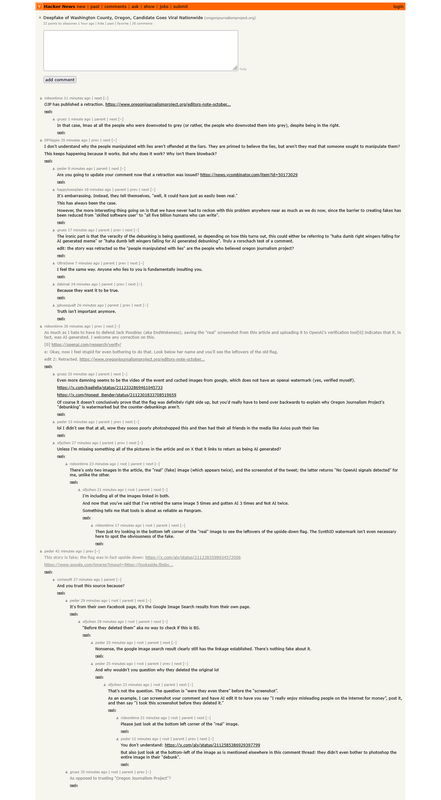
>Do not address people in this way. You are contributing to the exact problem we're talking about (how easy it is for information to turn out to be wrong).
It's pretty obvious the OP is a thinly veiled attack at whoever believed the "lie", dressed up as a question. The only saving grace is that the wording was so ambiguous that regardless of whether it was the debunking or counter-debunking that was correct, the comment would still be applicable.
It's comical because I posted this knowing that the publisher was blatantly lying. You could literally look at the image they posted for 5 seconds and spot what was wrong with it. I just wanted to see how many other people would notice. It's interesting the retraction come shortly after I posted it, though.
Also worth noting at the time of this comment the lovely fact-checking website Axios is also still blatantly lying. Absolutely crazy this is all getting swept under the rug.
It's not unreasonable to expect End Wokeness to be spreading more lies about Somalian immigrants, given his track record. But the truth here was obvious to anybody willing to simply look at the evidence.


No? The scandal was that random "apps" (eg. quizzes) were able to scrape user and their friends' profile data. The expansion of that into ad targeting as a whole is just a retcon you're doing.
> In the 2010s, personal data belonging to millions of Facebook users was collected by British consulting firm Cambridge Analytica for political advertising without informed consent.
https://en.wikipedia.org/wiki/Facebook%E2%80%93Cambridge_Ana...
reply