This comment does seem fairly harsh for something advertised as "a toy." Why would you expect a toy to be state of the art? When I see that phrase, I think of something that is a personal learning experience, might have an interesting idea or two but is not expected to replace anything that already exists.
I expect a toy example to be theoretically sound, but using shortcuts to get a practical realization.
For all the fancy cryptography this uses, I don't see how it provides any more security properties than a central actor having a databases of balances and requiring a cryptographic signature (like RSA, ECDSA etc) to authorize transactions. I don't see an extension path either.
Since the zero-knowledge proof is interactive, I am unsure how the central tracker could even be audited not to spoof transactions.
Read the readme again. The interactive ZKP does not reveal classified information about the actual transaction to the tracker, which is required to authorize it.
In theory, yes, a tracker could be malicious. It could even simply delete its record of all the coins and then refuse all transactions. Or change every coin so it cannot be spent. Actually the one thing it couldn't do is spoof transactions, because it doesn't know the secret key of a single coin it tracks. So it would have to make up a new coin, which would be easily detectable by other trackers because there must be a public consensus on how new coins are created (i.e., their public keys must be prime). So you would, once again, have to compromise every single tracker to spoof a transaction. Then you are right that there is no way to audit, but then you have bigger problems anyway (like people stealing money from exchanges) even before you get there.
Which brings me to the /real/ problem with my implementation, the coins are not worth nearly as much as bitcoin or zerocoin yet :P.
Alice has a secret key. She wants to prove this to Tom the tracker. He issues her a number of challenges until he is convinced she has the key.
Suspicious Simon now wonders if Alice actually had they key. Maybe she didn't and Tom gave her easy challenges? How can Simon be sure Alice has the key?
In the original article here, they discuss how the reason for this feature is that some people get shadowbanned a little too aggressively. "Banned accounts sometimes post good comments, software filters sometimes have false positives, and users sometimes flag things unfairly."
It seems to me the whole point of the vouch features is to have an easier recourse for other commenters to respond to people being shadowbanned (or otherwise dead for mistaken reasons, like tripping a filter or unfairly flagged by other users), rather than actually having to find the mod email and send an out of band message.
The problem is more complicated than that. Many banned accounts' comments aren't all bad. Unbanning them wholesale isn't an option if they're still going to break the HN guidelines. But killing all their comments wholesale isn't great either, if sometimes they post valuable things. So what we want is a mechanism that works at comment granularity rather than account granularity: let the good comments, and only the good comments, through. That's what this is intended to be.
One of the major reasons for being interested in Rust is that it is something that is much easier to convince coworkers of.
OCaml and Haskell have somewhat odd syntax, for someone who is coming from C like languages or even Python. You need to learn a bunch of functional programming concepts to use them effectively. You are still limited in what you can do, such as writing a native extension module for your existing Python code base. And they don't really help on one of the major selling points of Rust, which is to be able to write safe multi-threaded code with shared, mutable data structures. While there may be lots of good high-level parallelism available, at some point for certain problems you really just want to be able to use a shared, mutable data structure, but doing so in almost any language but Rust makes it very easy to make a mistake and have aliased, mutable references to it that can invalidate all of your logic, even if it isn't actually memory unsafe.
I'm coming from having written mostly Python, Ruby, and Scheme for my past three jobs.
I am not looking at Rust merely for replacing C for native extension libraries.
I'm looking at Rust for having a good static type system; I'm getting very sick of dealing with "hashly-typed" data in Python, or all those places where I forget a yield and so never actually block on a deferred, causing errors at runtime rather than just not compiling (sometimes type errors, if I try and access that value, but sometimes just things executing out of order, which are much harder to debug).
I'm looking into Rust for having a good multi-threading story. I've been doing plenty of event-driven programming in Python (using Twisted), which is great for non-blocking network I/O, but there are other ways to block on long computations, disk I/O, blocking in native libraries, and so on. At some point, you really do need good multi-threading, and Python falls fairly short in that department. You can hobble by, but it's not pretty.
Go doesn't solve either of these problems. It has slightly more static typing than Python, but without generics, it's pretty limited. It doesn't really do anything to prevent nasty race conditions with shared data structures in multithreaded code. Sure, if you are disciplined and use only message passing of immutable data structures, you can avoid some problems, but part of the point is that when programming in the large, with multiple people working on something over multiple years, it's easy for some mistakes or bad assumptions to creep in an wind up causing problems.
I've taken a look at Go, and it never really appealed to me as a direction to move in. If I want message passing concurrency in a GC'd language with a runtime, I can use Erlang/Elixir. If I want just simple, pretty code without much multithreading, I can use Python. If I want raw performance and low level access, I can use C or C++.
Rust actually does offer advantages over all of these. It does have it's complexity, so for quick and dirty scripting tasks I'm likely to stick with Python. But especially once Rust gets an easier to use non-blocking I/O story (since event based non-blocking is great for networking), I'm going to be seriously considering it simply as a replacement for Python for any large project that will be worked on by several people over several years, just due to the additional safety and static guarantees it offers.
In this comment I just discussed Go, since that's what the parent comment mentioned.
Haskell and OCaml are both great languages, but to a lot of people, they come off as much more "academic" or "ivory tower," and require a lot more effort to learn to use effectively for people who are not used to functional programming.
Couple that with the fact that they still use GC, so are a lot harder to get consistent low-latency performance as well as being a lot more difficult to use for any applications where you need to embed them in other applications, and they just don't offer enough of a reason to move to them over the current combination of "Python for high-level stuff, C or C++ for low-level, performance sensitive stuff".
Rust, on the other hand, promises to be effective for the low-level, performance sensitive stuff, is good for embedding in other languages, offers the additional benefit of giving statically checked memory safe multithreading with shared mutable data structures, and provides a powerful static type system for effective programming in the large.
> Haskell and OCaml are both great languages, but to a lot of people, they come off as much more "academic" or "ivory tower," and require a lot more effort to learn to use effectively for people who are not used to functional programming.
I think the problem is that people who are used to C++ and Python approach Haskell as if it were just another language, in that category of languages.
You need you learn some new stuff in order to really understand Haskell, but that's hardly a fault. I actually think non-programmers would have an easier time learning Haskell than experienced programmers. There really isn't anything inherently difficult in Haskell. It just requires a different approach.
It can be annoying to write Haskell programs sometimes, because it's so hard to get it to just compile. But that's the entire point: the fact that the compiler can do so much when we restrict ourselves to pure functions. It also forces us to figure out exactly what our program needs to do, before we can implement it, rather than build on top of proof-of-concepts, as is typical with Python.
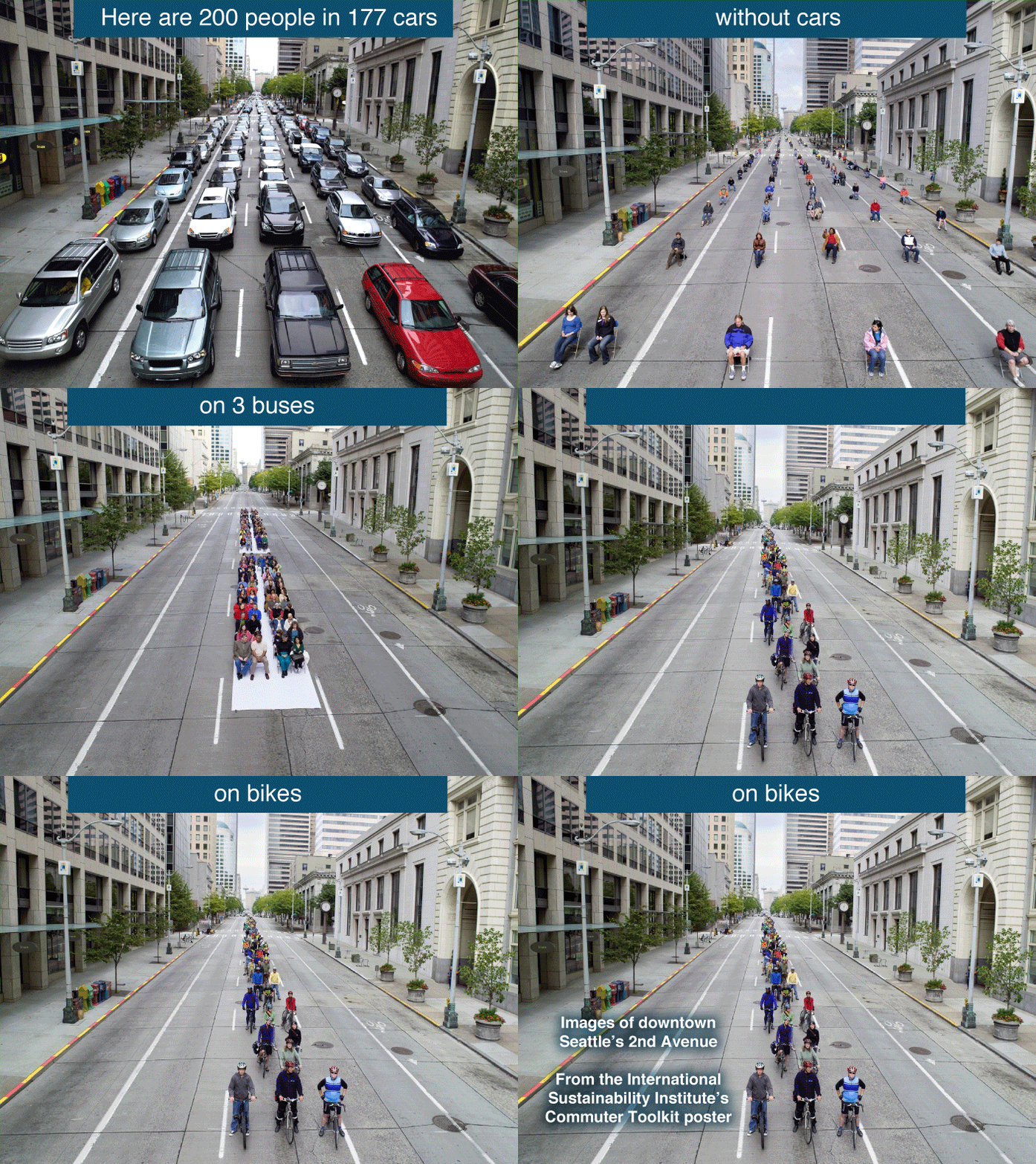
This is not about replacing cars with bikes, but making biking a viable alternative, such that it is actually possible to get from point A to point B by bike without taking a substantial risk of being killed by substantially faster car traffic.
No one actually expects to replace all cars with bikes. But replacing 20% of them would substantially cut down on congestion and emissions; and avoiding further growth in automotive traffic is likewise important.
And yes, I do see parents taking their kids to school by bike; in fact, my father used to do it with my younger brother some 25 years ago, and just yesterday I passed one of my neighbors heading up our very steep hill with her child on the back of her cargo bike.
There isn't a zero-sum game to be played between cars and bikes. Improving bike infrastructure can lead to reduced congestion for cars, fewer bad interactions between drivers and cyclists, etc.
I think the (well-founded) concern is that this expenditure of political capital means mass transit may not get the attention it deserves. Public transit can be ridden by anyone; bicycles are only useful to the able-bodied.
That is situation-dependant. I have seen slow bikes cause backups on roads. I've also seen heavily-used bridge lanes turned into empty bike lanes. Even when fully used, the carrying capacity (people moved / time) of a bike lane can be far less than a lane dedicated to buses or even cars. (It depends on slope and traffic speed.)
> I've also seen heavily-used bridge lanes turned into empty bike lanes.
Why didn't bikers feel safe on these lanes? Why weren't they used, or are they used, you just don't see it because you aren't looking during the right hours?
> Even when fully used, the carrying capacity (people moved / time) of a bike lane can be far less than a lane dedicated to buses or even cars. (It depends on slope and traffic speed.)
I've never been in a bike traffic jam, but I've been in more than my fair share of car traffic jams in high density areas. This is because cars take up more space per person than bikes, bikes are a very viable alternative to single person random access transport over short to medium distances while busses are not if the routes don't line up well. Obviously, for traveling 50 miles, there isn't a substitute for a car, but the point of this is to make urban areas bike and pedestrian friendly for the people that live in those areas, not necessarily to make it easier to drive through them.
Maybe if they biked to and from work, they wouldn't be "disabled" (ie, burdened by fat). The truly disabled make up a miniscule portion of the population, and while accomodating them is important, encouraging more people to bike would solve not just societal problems, but personal health ones as well.
> This is not about replacing cars with bikes, but making biking a viable alternative...
That isn't the rhetoric from bikers in my neighbourhood. They actively campaign for the dismantlement of motorvehicle-related infrastructure. Whether it is turning car lanes into bike lanes, reducing available parking in new constructions, or new road taxes, their avowed goal seems to be to make driving more painful.
> dismantlement of motorvehicle-related infrastructure. Whether it is turning car lanes into bike lanes,
Yes, it turns out we overbuilt streets and under-built bike infrastructure so now we have to reclaim some car lanes to create bike lanes instead. This is not the end of the world.
> reducing available parking in new constructions
Reducing the required parking in construction doesn't eliminate parking in new constructions if parking is actually important, it just allows the free market to actually price parking instead of forcing non-drivers to subsidize parking spots.
> or new road taxes
Are you talking about congestion pricing here? If so, you chose to drive in an area which doesn't have the throughput to handle the cars, and yes, you should have to pay a fair price to use the road.
> their avowed goal seems to be to make driving more painful.
No, the goal is to make biking safe and possible. Driving has too long been the default, so you look at every attempt to claw back some semblance of balance for bikers as an affront to your right to drive.
The infrastructure issue isn't so simple. In my local we are in a real estate boom. There are many groups claiming that cars will not be so prominent in the near future. That view is taken onboard by zoning people when deciding on new buildings. Rather than demand sufficient parking spots and upgrades to roads and mass transit, developers are allowed pretend that a large number of residents will bike to work. That means larger condo blocks with poorer connections, harming bikes, cars and transit. There are a few "green" office blocks around here without any parking spots. So employees park on the street, annoying local business who want those spots used by customers.
This is similar to the "elder housing" theory that assumes that the old people buying the condos will not commute and so do not need parking or transit services. In fact, old people go to lots of appointments, have carers that don't live with them, and are often visited by large numbers of family members. It's just a scam by developers to squeeze more condos into a given space without upgrading infrastructure.
For below: Try actually running a building without parking. Repair people drive vans full of tools. 24/7 employees need to get home at 2am after the bus system has stopped. Tenant businesses need deliveries. A city isn't going to reinvent itself overnight just to accommodate some architect's vision of bike utopia. I responded to a trouble call at one of these buildings ... to great laughter, I parked my motorcycle in the lobby. Art.
The answer to people parking in street parking and annoying local businesses is to charge for street parking. The amount of space wasted so that cars can sit empty on expensive infrastructure in prime locations is staggering;
> So employees park on the street, annoying local business who want those spots used by customers.
The logical thing to do is to then price those street parking spots at a market rate. If there aren't enough, some enterprising developer will build off-street parking to make a profit. If that doesn't happen, it's likely because people in cars aren't actually willing to pay for a parking spot based on how valuable the land is.
> There are many groups claiming that cars will not be so prominent in the near future.
So say we all.
> That view is taken onboard by zoning people when deciding on new buildings.
Good
> Rather than demand sufficient parking spots and upgrades to roads and mass transit,
Define sufficient? Many municipalities have historically had rules requiring 1 parking spot per 2 bedrooms, minimum 1 per unit. This adds a strange externality which changes the types of developments that are built. Upgrading roads isn't under the purview of the developer. Upgrading mass transit is similarly under the purview of the local government, not the developer.
> developers are allowed pretend that a large number of residents will bike to work. That means larger condo blocks with poorer connections, harming bikes, cars and transit.
Again, this really isn't the developers fault.
> There are a few "green" office blocks around here without any parking spots. So employees park on the street, annoying local business who want those spots used by customers.
The local governments should start charging more for parking then. Clearly parking is under-priced if people can park their all day.
> This is similar to the "elder housing" theory
It's really not like that at all. The "theory" here is that people won't buy a car because owning a car will be unnecessary or too expensive.
> In fact, old people go to lots of appointments,
Appointments that they probably shouldn't be driving to
>have carers that don't live with them,
Which if scheduled correctly shouldn't require 1 parking space per resident.
> are often visited by large numbers of family members.
Again, this is more a scheduling problem. Every resident's family doesn't need a dedicated parking spot every day.
> It's just a scam by developers to squeeze more condos into a given space without upgrading infrastructure.
I'd say that drivers and car companies have been running a scam for the past 50 years. Everyone got so used to their underutilized highways and ample parking that everyone bought a car. Unfortunately, as the population grew and got more dense that's not a reasonable status quo anymore, so either, we have to figure out how to fit more cars into less space, or we have to accept that the heyday of cars cars cars is over and learn to live without them.
Upgrades to roads/transit are part of zoning decisions. Where a developer wants to go beyond the current zoning and increase density (most all situations) they are often forced to contribute to infrastructure improvements. Even where they aren't, well-run cities do not allow development ahead of the infrastructure to support those new residents.
One parking spot per unit is no longer a norm. I know of developments with perhaps one per five, with most not coming with any assigned spots. But it isn't really just the parking. It's the lack of buss stops and adequate foot crossing and the increased traffic of all forms on local bridges. Pretending that everyone will just use bikes, or that they are old and won't go out much, is a convenient excuse to bypass good city planning.
Interestingly, closing roads and reducing the number of cars would improve the number and availability of foot crossings. It's funny you mention good city planning, since a lack of good city planning is actually why we are in this situation in the first place.
Yep, I've run into the problems with "expect fork"/"expect daemon" in Upstart first hand. Forking is a terrible readiness protocol, and Upstart is terrible at keeping track of a process that doesn't do exactly what it expects. In fact, if you choose the wrong one, you wind up with Upstart not even noticing the a process has gone away, and not being able to do anything to reset Upstart's knowledge of the world without spawning programs in a loop until the PID namespace wraps around and you get back to the original PID that it's expecting to track, so that Upstart can finally notice it die and properly clean up after it. This is seriously the only recommended workaround for a bug that went unfixed for years: https://bugs.launchpad.net/upstart/+bug/406397
I'm glad that Debian and Ubuntu have finally decided to go with an actually maintained init system, that properly track processes even after arbitrarily many forks and support a reasonable readiness protocol.
I have also had a little mismatch with upstart for a particular application - the app itself spawns new processes in response to user input, but upstart can only track the main app not the children.
I am curious - precisely knowing when an app is running and when its not seems inherently dependent on the app and your definition of "running" for that app. Tracking apps from the system level in terms of processes etc. can only go so far. How do the init systems you mentioned tackle this?
> precisely knowing when an app is running and when its not seems inherently dependent on the app [...] How do the init systems you mentioned tackle this?
In systemd's case, it provides an API so that the app can explicitly say "I am now ready to receive requests", among other things.
(I've also found the related watchdog functionality very useful -- once you tell the init system that your daemon is ready to serve requests, then you can also tell it every time a request is completed; then if you go for say 10 seconds without serving a request, init will assume that your service has hung and kill/restart it. I've seen a small number of daemons do this for themselves, but that number is nowhere near 100%, and even those who do implement it don't do it as well as systemd does.)
Here's a browser for the actual tree: https://tree.opentreeoflife.org. It is a little slow to load right now, as this has been posted to Reddit recently.
For those of you, like me, who may not be very familiar with modern phylogeny and taxonomy, here's the path I charted down to "Homo Sapiens".
Check out under Eukaryota (which includes plants, animals, fungi, and a bunch of single celled organisms), then Opisthokonta. Under that you'll find Nucletmycea, which contains Fungi, finally getting down to a more familiar classification. Another branch under Opisthokonta is Holozoa, which you can then trace down to "Choanomonada + Metazoa", down to "Metazoa", which Wikipedia tells me is another name for "Animalia" (https://en.wikipedia.org/wiki/Metazoa). You can trace down under there to Bilateria (via a few nodes with multiple groups, I've elided those nodes from now on), to Deuterostomia, to Chordata, Craniata, Verbrata, Gnathostomata, Teleostomi, Euteleostomi, Sarcopterygii, Dipnotetrapodomorpha, Tetrapoda, Amniota, Mammalia, Theria, Eutheria, Euarchontoglires, Primates, Haplorrhini, Simiiformes, Catarrhini, Hominoidea, Hominidae, Homininae, Homo, and finally Homo Sapiens.
  #include <stdio.h>

  int main (int argc, char * argv[])
  {
      printf ("defer work on the pid 0 until we have a functioning "
              "service manager\n");
      return 0;
  }
>But then again, if all that appears too simple to you, call it (but never spell it!) System Five Hundred since D is the roman numeral for 500 (this also clarifies the relation to System V, right?)
Oh, come on. You don't need a 3D printer for this. All you need is a piece of sheet metal and a CNC milling machine (or heck, even a manual milling machine and some skill at using it), that every moderately equipped machine shop has on hand.
You can't prevent people from having tools that can be used to manufacture things, and no one is seriously going to try.
Goodness, you don't need a milling machine, you can probably do this work with a dremel, or for that matter a file... You know, like locksmiths made keys decades ago.
Actually, 3d printer is a tool that's currently cheaper and more widely available than milling machines - the whole point of this is "hey, of course anyone with access to CNC or the skill to operate a manual milling machine could do it, but that's only a small niche, but now every idiot with access to a 3d printer can do it".
People and shops that are below the range of a moderately equipped machine shop can do 3d printing; a 3d printer that can make such a key from hard plastic costs less as a cheap manual milling machine that can make a similar key from metal and requires less skill to operate.
That would restrict it to locksmith basically (professional or hobbyist), as opposed to anyone that can find out how to run a 3D printer. Being a locksmith isn't scalable, using a 3D printer is.
No, if you can make a 3D printed model of it, you can CNC mill it. Sure, a CNC milling machine is a bit more expensive than the cheapest 3D printers, but anyone who wants can find a machine shop nearby that will mill something for them, or just send it off to some place online like eMachineShop to get it done.
and actually, it's not even that much more expensive. You can get a CNC Sherline mill for something like a $1500. Sure - the work area is small, they're mainly aimed at e.g. model builders, but it's big enough for something like this, and they're real honest to goodness CNC precision machine centers.
You can't use such a literal-minded interpretation in the real world. The real world is complex and fuzzy.
For instance, in species with sexual differentiation, two males or two females cannot mate, but are considered the same species.
For a more precise definition, you would have to, say, look at the probability that a pair of organisms of the appropriate sex from two different populations would be able to mate, and produce viable offspring (that is, offspring that could themselves mate and produce more offspring).
Asking about a single organism that happens to be infertile, or a single pair that happens not to be able to mate or produce viable offspring, is not particularly interesting, but at a population level you could use a statistical test to get a probability distribution, rather than a yes or no answer.
Note also that it can be the case that two different species can mate, and produce offspring, but the offspring itself is not viable (cannot mate and produce offspring). This happens in the case of mating two closely related species, such as when mating a horse and donkey to get a mule (https://en.wikipedia.org/wiki/Mule), or a lion and a tiger to get a liger (https://en.wikipedia.org/wiki/Liger).