This is great, thanks for posting! I'll definitely take your advice to heart. I've been noticing that finding different data representations of the problem at hand is a big part of finding the "core relations" that describe the problem. My first attempt at the voicing/4 predicate was attempted with a data structure used in a procedural version of the algorithm, and I just couldn't get it to work in Prolog. The second iteration is what you've seen, and I'm working on a third iteration with a simpler data representation that is simplifying the problem even further.
Yeah, I agree that the subject of those commits are far from helpful or descriptive. To be honest, they were written as cheeky subheaders for the generated example article, and don't even do a job there.
I would have loved to throw up the project on a Heroku free tier or something, but it relies on access to a Bitcoin full node. Unfortunately I'm not aware of any publicly accessible JSON-RPC Bitcoin APIs, and I can't route public traffic to my local node.
Here's the project on Github, if you're interested:
Another PSA: SMS and email are both less secure channels than your average https login. My doctor doesn't trust these channels to communicate my test results, so I guess don't use this for anything more sensitive than that.
I just started diving into using Apollo client the an Elixir backend (using Absinthe). It's an amazing combo! I look forward to more releases from the Apollo team.
I definitely understand about how seriously you take privacy. For a personal project, I wouldn't think twice about sending it your way.
Source Code Pro is my usual default for a good looking monospace font, but Fira looks like a good choice. How do you go about finding monospace font's width to height ratios? I had do dive into SVG versions of Source Code Pro and doing some hands-on testing to come up with a ratio of 0.6.
Yeah, I'm not doing anything with a margin. In hindsight, I probably should have.
I actually manually picked the code I wanted to include in the poster. I imagine doing this in an automated way would be a much more difficult problem... Do you just ignore certain files based on filename patterns? e.g. /node_modules/, etc...
Yeah, there are a few places where I can parallalize the process. There's definitely a lot of room there for future work.
3 to 4 seconds is _very impressive_. Congrats!
I'd definitely push others to go with your solution, if it's a possibility. The elixir_poster project is really just a hacked together project to build a one-off (two-off, I guess) poster for myself.
The PDF library I use gives you the dimensions of a certain letter (via FreeType I believe). I just plot 'X' (or any char for monospace) and get it's width, height.
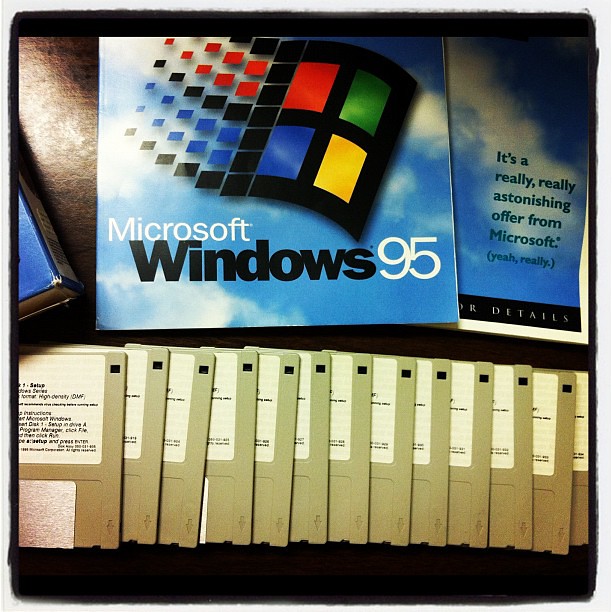
I feel very old now. Traditionally you went to the shop, bought your boxed set of floppies[1] (or later CDs, though networking was becoming ubiquitous at this point) then went home and installed them one by one to your hard drive. I was early among my friends to get a modem in 1990 (along with a Compuserve subscription), but before that every piece of software I had was bought or copied from friends on floppy disk.
I guess I'm surprised there's code to run the floppy drive but not code to run the network card. Especially if the project started in 2003. But then again, maybe with a memory model that permissive, it's not very safe to open yourself up to unfriendly bytes.
This is very very cool. How exactly are you getting the audio from youtube? I'm assuming you somehow pull the audio from youtube in your backend (how?), analyze it, use that analysis to build your display and then sync that with the playing youtube video?