I 100% agree that IFLS should be crediting the artists who make great work and direct traffic to IFLS's page. What I am having trouble understanding is why the general thrust of comments on this page seems to be "This is UNACCEPTABLE!!" when (and please correct me if I'm wrong) the general thrust of comments on pages about, e.g., The Pirate Bay seems to be "There's absolutely nothing wrong with The Pirate Bay!" Aren't both of these sites making money by hawking stolen wares? Why is The Pirate Bay so fiercely defended and IFLS so roundly condemned?
In my Portuguese class we were given this ambiguous phrase as a riddle:
"Maria toma banho porque sua mãe disse ela traga a toalha."
We had to make those words make sense only by adding punctuation and without changing the order of any words. Can you figure it out?
For those who don't speak Portuguese, the phrase above translates to: "Maria takes a bath because her mom said to her bring the towel." Doesn't make much sense!
The trick is that "sua," which means "her" when the following noun is feminine, is also the present third-person singular of the verb "suar," meaning "to sweat." Thus, with a few commas and quotation marks, it suddenly makes sense:
Maria toma banho porque sua. "Mãe," disse ela, "traga a toalha."
=
Maria takes a bath because she sweats. "Mom," she said, "bring the towel."
Not nearly as ambiguous as the "had had had had" example, but a similar lesson regarding the need for punctuation.
Edit: as personlurking pointed out, suar is "to sweat," not (as I put originally) "to smell." Thanks for catching that!
Oh, yes, I remember that one. Portuguese is not my first language, but I am fluent. I've been given that phrase before (and failed on the suar part despite knowing that verb). Tricky, indeed. Just a small correction, suar is to sweat.
I recall a protest sign that said "Veta Dilma!", or "Veto Dilma!" (the President of Brazil), but the protester meant to put a comma in there, as in "Veto, Dilma!" because the protest was about a bill running through congress.
Another one was "Mesmo sujo, governo quer rio Pinheiros sem cheiro" (Even though it's dirty, the government wants the Pinheiros river to be rid of the bad smell). The problem is the wording which makes it seem like the government is dirty, and not the river. Better would have been "Governo quer rio Pinheiros sem mau cheiro, mesmo que sujo" (The government wants the Pinheiros river without the bad smell, even though it's dirty.).
Sounds to me like they provide an API for "5-minute SIS Integration for Educational Applications" (from their home page) and that an SIS is an "information system [that] capture[s] and store[s] data on students — from class lists and attendance to grades" (from the TC article).
One of the major pains in the butt for a teacher is getting students set up on a learning web app. Either you spend a bunch of your own time making an account for each student (which is time you could spend doing something more important) or you spend a bunch of class time having students sign up for the accounts during your teaching period (which is time you and they could spend doing something more important).
If a web app had a secure API to include all of my class lists automatically, I'd be much more likely to use it.
Yeah I guess their target audience would know what those things are. That's why I hedged my comment. I'm glad they're doing well, obviously doesn't seem to be a problem for them.
They provided a "vertical network" for K-12 Education data (your kids' test and homework scores), similar to what companies like Ariba and CommerceOne provided for manufacturers and what Facebook and Twitter provide for Advertisers.
I think the turban example is perfectly consistent with what the author said. You ask "how would rules such as the uniform rule for the police ever evolve?" The answer is: in much the same way! Under this author's understanding of that example, the rule under scrutiny would be: "Every policeman must wear a uniform cap." The Sikhs, wishing to wear dastaars, would petition the chief of police to be able to wear a dastaar instead. The chief of police (or whoever), would then think to herself, "Well, is it all that important that our police officers wear matching CAPS, or is the important part merely that they wear headgear that matches the rest of the outfit and contains a badge?" She would then conclude that the more appropriate rule, which should apply to /everyone/, regardless of his religion, should be that every police officer must wear a hat of the appropriate color and that the hat must contain a badge. A Sikh could wear a dastaar; an atheist could wear a baseball cap or a turban--or a dastaar. The point is that /anyone/, not just a Sikh, can wear /any/ hat he chooses, so long as it meets those standards that /are/ considered too important to change, such as matching color and a badge.
I think another example might be more clear. Back in the 1990s, there was a big hullaballoo about Native Americans out West using peyote, a hallucinogenic, as part of a religious ceremony. Using peyote, however, was illegal in the state of Oregon, so a few members of the Native American Church were fired from their jobs and denied unemployment benefits after they were found using peyote. The Native Americans argued that they should be exempt from this law due to their religious beliefs, and many agreed. I don't, and neither did the Supreme Court (check out Employment Division v. Smith [1990]). And here's the reason: if peyote is "not that bad," i.e., if it's fine for /some/ people to use it (here, the Native Americans), then it should be fine for /all/ people to use it. If peyote is actually /too dangerous/, if it really /must/ be outlawed, then it should be outlawed for /everyone./ What someone believes about peyote should have no bearing on his right to use it. (This is the same reason we wouldn't allow ritualized murder of children even if someone claimed it was central to his religion--it's simply too dangerous!) It's /discrimination based on religion/ (or lack thereof) to say that Tom, who believes that peyote helps him communicate with a higher power, should be able to use peyote, but that Bob, who simply feels that using peyote helps him relax and to paint, should not. Why should Tom's belief be worth more than Bob's simply because a higher power is involved? And what kind of law should involve litigating someone's religious beliefs? Imagine: Q: "Isn't it true that you don't REALLY believe that peyote helps you commune with God?" A: "No, I swear I believe! I pray every day!" Q: "But I have a witness who says he saw you at Catholic mass last week! And here's a Bible we found in your house!" What a horrible mess that would be!
To get back to the dastaar example, then, all the author is saying is this: If a Sikh should be able to wear a dastaar, then an atheist should be able to wear a dastaar on the job, too. In fact, an atheist should be able to wear any hat of the proper color with a badge on it. His beliefs or lack thereof should have no bearing on his right to do something that everyone else can do.
I think the turban example is perfectly consistent with what the author said. You ask "how would rules such as the uniform rule for the police ever evolve?" The answer is: in much the same way! Under this author's understanding of that example, the rule under scrutiny would be: "Every policeman must wear a uniform cap." The Sikhs, wishing to wear dastaars, would petition the chief of police to be able to wear a dastaar instead. The chief of police (or whoever), would then think to herself, "Well, is it all that important that our police officers wear matching CAPS, or is the important part merely that they wear headgear that matches the rest of the outfit and contains a badge?" She would then conclude that the more appropriate rule, which should apply to /everyone/, regardless of his religion, should be that every police officer must wear a hat of the appropriate color and that the hat must contain a badge. A Sikh could wear a dastaar; an atheist could wear a baseball cap or a turban--or a dastaar. The point is that /anyone/, not just a Sikh, can wear /any/ hat he chooses, so long as it meets those standards that /are/ considered too important to change, such as matching color and a badge.
You have an enormously optimistic view of police chiefs. Or perhaps police chiefs where you live are reasonable, inclusive people who are always looking for ways to broaden their force's recruiting.
Whereas up here in Toronto, the opposite was true. The police force remained staunchly Euro-centric until forced by rule to reconsider rules like the requirement that officers wear the prescribed hat. Left to their own devices, police chiefs saw no reason to change their rules about headgear or the minimum height required to be a police officer.
The changes didn't come because Sikhs petitioned the chiefs of police, the changes came because Sikhs petitioned the courts. And that is why we have constitutional democracies: Some portions of our rules and regulations cannot be left up to the "free market" or an executive branch that is concerned with obtaining a plurality of votes in the next election.
Good point--I should have said that the Sikhs would go to the courts when the police chief (almost undoubtedly) said no. Still, the point is the same: under this author's conception of the issue, the courts /should/ come to the same conclusion about uniform color and badges being the only important parts of the police cap. The difference is that this decision should free /everyone/ to wear such hats, not just Sikhs or just the religious.
What the author is trying to imply is closer to, "Come on, people need to wear the right hats on the job. Sikhs can wear dastaars on their own time, let's not exempt them based on 'freedom of religion'."
The government certainly /can/ tell you "how to care for a member of your tribe" if that member is a minor. The ritual circumcision Hitchens references led to a small but deadly outbreak of herpes among recently circumcised babies. The government should let /adults/ practice their religion as they choose, but there would certainly be a rational basis for concluding that this particular practice unnecessarily endangers a third party: children who lack the ability to say, "No, thank you! I'm Buddhist." The same goes for Christian sects that disapprove of medicine. Sure, adults can turn down medical treatment for /themselves/, but if they do so for their children they could (and should) go to jail for child endangerment. A civil libertarian should want to protect everyone's right to liberty, the right to do whatever they wish /without harming others./ In these cases, the religious parents' choices often do harm their children, who are too young to object.
Government can tell you things to or not to do that are by some definitions "immoral" - a legal argument here is moot. You talking utilitarian principles - not libertarian ones.
A civil libertarian would reject the notion that a government should restrict you from a personal activity (which parenting certainly is) - because of society's majority judgment against it. They'd easily call this tyranny of the majority - whether you agree with it or not.
However, a "classic liberal" would come at this from a natural law or humanist perspective and say there is a moral reason to do / not to do such things.
There is a distinction between civil libertarians and classic liberal civil liberties.
I said "in these cases"--turning down medicine and practicing that form of ritualized circumcision. Perhaps "often" is an overstatement, but there have been many cases of children dying when their Christian Scientist parents refused to get them proper medical attention (see, e.g., http://www.theatlantic.com/past/docs/unbound/flashbks/xsci/s...).
Agreed. Even ignoring the vitriol, the format makes this page very unpleasant to read.
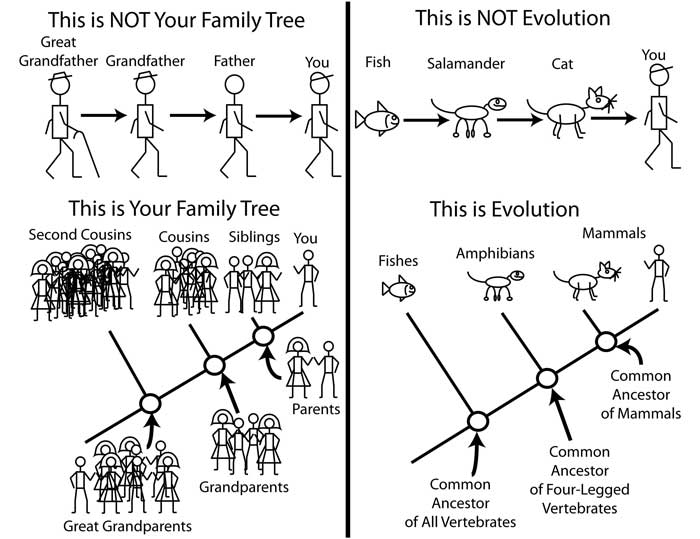
I liked how Florida Citizens for Science did it: they held a contest in which entrants were encouraged to draw stick figure cartoons illustrating a misconception many people have about some aspect of science. Here's one of my favorites:
The way Finder is designed, you often can't simply drag some files from one location to another (e.g. moving to the subdirectory of another directory). You need two Finder windows open in order to accomplish this, whereas Windows Explorer, whose left pane has the directory structure and right pane has the contents of the currently selected directory, lets you do this effortlessly using only one window.
--but I think that it is possible to do this on a Mac by opening Finder, clicking to the file you want to move, and then making sure that the third of the four display modes available (it looks like three vertical bars) is chosen. (These icons are right of the forward/backward buttons on the left of a Finder window.) This changes the display to a directory mode and allows you to drag and drop files from any subfolder to any other. Hovering over a folder's name while dragging a file will open that folder in the rightmost column and allow you to move the file to any subfolder.
I always used to send hand-written thank-you notes, but when I started doing on-campus recruiting I realized that sometimes snail mail isn't feasible. The places I was interviewing were handing out second-round interviews the night of the interview or the next day, so if I wanted my message to reach my interviewer before s/he made a decision, I had to turn to email. Also, this is anecdotal, of course, but the only place I interviewed where I did not get an offer was the one I forgot to send thank-you emails to (I was traveling the whole day and then remembered too late...). Take that as you will! I personally think thank-you notes can only help you if they're well written and sincere.