Maybe motivation is a factor too. Debate and negotiation are not games that I anticipate enjoying, whereas spending intelligence and practice on becoming a better musician motivates me. ;-)
Also, I suspect that Truth isn't always easy to discern, especially in a world where we're immersed in tradeoffs and complex systems.
>Debate and negotiation are not games that I anticipate enjoying
Yes and I think that's because they entail criticism, which is used to attack ideas and people we don't like. Whereas creating something worthwhile is about discovering or perceiving something already inside the mind that we do like (and therefore cannot seriously attempt to criticize). Building a family is an attempt to create something worthwhile.
For a job after university probably, but I meant to speak to a tuition waiver at a foreign university. I doubt tuition waiver plus stipend would approach that in most other countries.
Even for the job scenario, you get a tax credit for foreign taxes paid which in most industialized countries would probably neutralize any US tax burden and then some. If the job is in a developing country, I would think the cost of living advantages would make it worth it if you were above the limit.
However, not a CPA or finance pro. I went to grad school abroad and looked into the implications of staying a bit.
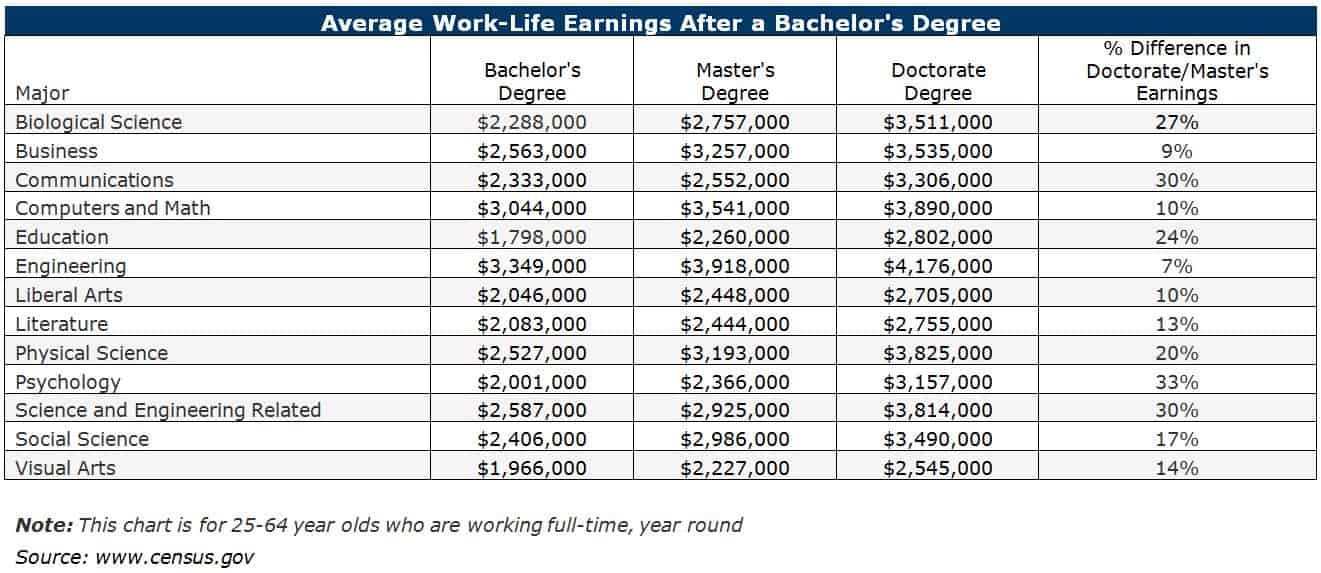
The overall tenor of your post is a bit disingenuous. The data tells us that getting a PhD does not substantially improve your material existence, or at least that the picture is murky.
The data also tells us that the science that comes out of the research performed during those PhDs has an enormous positive ROI for society.
So in other words, phd students are under-paid take a lifelong financial hit to provide large but diffuse benefits to society, benefits that most students won't be able to capture because, well, that's the nature of basic science..
> You can argue that graduate students and universities are just another special interest lobbying the government for a tax exemption that benefits them
Since everything's a special interest, we might as well throw the money at oil executives?
No, of course not. Some of those special interests really are worth investing in. Roads, schools, and labs provide enormous and measurable, if diffuse, value.
> You could further argue that it's unfair to ask blue-collar workers in fly-over states to pay higher taxes because of the impact of such a subsidy.
This bill will most harm the public and low-endowment universities in those flyover states. The schools those workers' children will attend will be less well-staffed and there will be fewer opportunities for funded graduate programs.
> You could easily make the same argument for active-duty armed service members. Frankly, I'd support a tax reduction on those people
Good news: they already receive very large tax exemptions. As they should; the armed services are also an important special interest...
If you don't think earning a PhD substantially improves your material existence, I'd beg to differ. There are plenty of folks who don't have PhD's who would be better positioned in the job market if they had the talent and opportunity to earn one. For every student lucky enough to earn a spot doing research there are plenty that don't have the opportunity and have to go out into the real world and earn a living.
I meet plenty of PhD's in my regular practice. Not every person earns a PhD and stays in academia. PLENTY earn that degree and use it as a stepping stone to a high-paying job in the private sector.
As for oil executives: they're not going to be the biggest winners here. Shareholders likely will be. That repatriated capital is going to lead to a huge share buyback and dividends. Wanna know who's going to get a large chunk of that? PENSION FUNDS for state employees. If you think CALPERS doesn't stand to benefit from this surging stock market you're not paying attention.
I wonder if you realize how much you sound like a lobbyist? Without a tax subsidy, there is a calamity. Every time someone warns that a tax increase will affect investment or job creation or cause a shift in the deployment of capital, people in favor of said increase downplay those fears.
All the folks who said that a $15 minimum wage would kill job creation....were those folks wrong?
And here we are, hearing that the removal of a special tax treatment will massively impact graduate education. Well, maybe. Maybe not. I guess we will have to see.
So the cost to a student to receive a PhD goes up a bit. Big deal. Is that gonna kill research entirely? There is already a glut of PhDs here in the USA. Maybe a few less isn't such a bad thing.
> There are plenty of folks who don't have PhD's who would be better positioned in the job market if they had the talent and opportunity to earn one.
Cool anecdotes and all, but there's data on this question and you're wrong. PhDs do not increase lifetime earnings.
This isn't a case of dueling anecdotes. It's a normal fact we can verify with data.
> As for oil executives: they're not going to be the biggest winners here. Shareholders likely will be.
And I suppose oil executives store their fortunes in bold bars...?
> PENSION FUNDS for state employees
This is such a BS excuse for favoring capital.
It is, in fact, possible to write tax code that differentiates between the two.
The current tax bill does not, in fact, actually do so.
And worse, it even rolls back benefits that did differentiate between "filthy rich" and "working class saving for retirement"!
> I wonder if you realize how much you sound like a lobbyist?
Says the one conflating upper class investment income with pension funds while defending a policy that slashes retirement benefits and dismissing hard facts with personal anecdotes about how well-off people making 30k/yr are...
PhD programs are not full of modal students; what you want to do is compare the average PhD with the average person who did not get a PhD but would've been accepted into a program. On that note, compare students' industry offers after undergraduate to their post-graduate incomes, and account for opportunity cost
Would you please stop posting uncivilly to Hacker News? You've done it a lot, and it's destructive of the community. Also, please don't do flamewars here.
AHEM. As above, it takes work to be as wrong as you are, so this seems like either an amazing amount of ignorance, or deliberate deception.
1. What it shows: Students good enough to get accepted into PhD programs are good enough to get paid more in general. Good we're talking about this -- the market clearly values these people!
2. What it misses: ... But what if a PhD-capable person instead just went directly into industry? What is the opportunity cost of taking a pause of 4-7 years to do R&D for the public?
3. What economists found: By looking at students graduating from a good school and therefore PhD-capable, and then comparing the result of them doing 4-7 years of PhD vs not.. the students who took time to contribute to science lost out on a ton of money. They're quite literally donating their time to society.
Phrasing it as _subsidizing_ these people to do R&D is misleading. The reality is the government is underpaying for the public service of growing the economy, especially relative to market rates for people equally qualified to make a bunch of $$$ working on social media ads and fancy juice machines.
But that breaks the narrative. The actual studies show the salary sweet spot is somewhere between a BS and MS. That means federal institutions must _lure_ PhDs, not drive them away.
> AHEM. As above, it takes work to be as wrong as you are, so this seems like either an amazing amount of ignorance, or deliberate deception
This sort of uncharitable swiping breaks the HN guidelines. So do insinuations of astroturfing, which you did elsewhere in this thread. I realize it can be hard to restrain oneself when someone else is wrong on the internet, but please make the effort and edit such acid out of your comments if you want to keep posting here. You can always set 'delay' in your profile to give yourself time to edit before others see your comment; that's what I do.
This is just getting more bonkers. I just reported on data.. inference is mostly on your end, and as I showed, incorrect.
1. Value: Your census data shows PhDs have a high $ value. Data shows your supposition is wrong: the gov already underpays for PhD-candidate-caliber labor relative to market by 2-3X.
2+3. What if + data: Dropouts have resume stigma, so I'm not sure why that measures what you want. For the "phd or industry?" decision facing BS grads, you can do a back-of-envelope in < 3 minutes. Arbitrarily, I picked Cornell 2010 BS grads, where students chose between a ~$75K salary vs going to a top 10 MS/PhD: https://www.cs.cornell.edu/undergrad/cscareers/placementrepo... . Berkeley falls in that bucket, with stipends being around $30K and MS/PhDs earning ~$105K. Assuming a ~5% annual bonus, 2yr MS and 5yr PhD... MS students out-earn everyone within 7 years, and it takes 20 years for a PhD to start to catch up to a BS, and with a low salary for some of their best years. For fun, also read up on impacts for things like having children. Professors explicitly tell students not to do a PhD for money because of the opportunity cost. HN friendly is ex-Harvard Matt Walsh.
The rest of your comment continues to be bogus:
-- There's underpaid, and there's systemically eating the seed corn.
-- If you're against using the tax code to incentivize behavior... this change without a compensating increase in R&D funding means Republicans are using the tax code to disincentivize American R&D
-- Previous generations, according to _data_, paid way less for their opportunities: https://www.economist.com/news/united-states/21567373-americ... . The trend has been getting even worse since the 90s, as is worsening R&D funding, which is curiously correlated with anti-intellectualism in the Republican party.
-- Students are doing it for charity and thus can take more cuts? As a fun example, UCSF, a top medical program (as in, actively solving cancer), can no longer provide subsidized housing for its PhDs, and has been losing its ability to enroll top students. Squeezing them further will have predictable results.
The one argument I'd agree to, and you aren't using, is that administration costs are increasing. However, cutting grad student wages is evil. It sets fire to seed corn instead of the administrators, so we know who'll burn first.
Yep nope. When you compare people qualified for entering PhD programs (e.g., CS graduates), and the outcome of joining the PhD program vs not, there is clear wage suppression. You cannot argue that the market is right to dissuade this activity, because the people who do go into PhDs are responsible for a disproportionate amount of economic advances.
If you care about economic impact, you should be increasing funding, not eating the seed corn.
And as my above post, it seems you are either unaware of what R&D does and who does it, or are effectively performing the work of a paid Russian troll.
And no: members in the US armed services do NOT receive large tax exemptions. They pay taxes on their income just like everyone else does. That includes state income tax as well.
You're joking right? Have you served time in the military? I did and know a thing or two about how the government taxes service-members.
Combat pay is a tiny portion of a service-member pay. And no, spouses don't get special treatment. You're making things up to justify your argument.
Go ahead and read that list over again slowly and tell me if you think that list compares to the large governmental subsidy that is provided to support non-taxation of tuition for graduate students.
Because I know that list front and back and none of those minuscule allotments compare to treating $50K of tuition per year as tax-free income.
> Combat pay is a tiny portion of a service-member pay.
Yes.
> and tell me if you think that list compares to the large governmental subsidy that is provided to support non-taxation of tuition for graduate students.
From my original post:
>> Additionally, and in direct analogy, GI Bill tuition is not taxed.
It's not just comparative. It's Literally. Identical.
> And no, spouses don't get special treatment. You're making things up to justify your argument
Mind you, I'm not claiming that these benefits should go away, or even that they're enough. But claiming that military members don't receive as many benefits as grad students is absurd.
>> and tell me if you think that list compares to the large governmental subsidy that is provided to support non-taxation of tuition for graduate students.
>From my original post:
>> Additionally, and in direct analogy, GI Bill tuition is not taxed.
>It's not just comparative. It's Literally. Identical.
It's not identical. The GI Bill is a benefit that's conferred on a servicemember FOR SERVICE TO THE NATION. That service includes the possibility that a servicemember will be killed during their service. That's the job. It's not taxed because it's a benefit they earned for selfless service to the nation.
A good buddy of mine is going to law school with his. He did 20 years of service as a Marine.
You want a benefit like that? EASY. Go do 20 years in the Marines. You can have all the tax-free tuition you want.
Again. This act was for the protection of servicemembers against loss of job or loss of home because of a deployment. It doesn't give them special tax treatment. It forestalls things like foreclosure or garnishment of wages because of deployment to a war zone. There is no special tax treatment for spouses. They pay tax. I paid tax. Just like everyone else in the USA.
The justification for the benefit is not identical. In one case we're providing additional compensation to veterans. In another case we're providing an incentive for research.
But the benefit itself really is identical.
> This act was for the protection of servicemembers against loss of job or loss of home because of a deployment
Civilians also lose jobs / are forced to relocate?
Pointing out that someone gets special treatment is not an argument that they don't deserve that special treatment.
> You don't understand the arguments you're making.
You seem to be under the impression that I think these benefits are either unreasonable or sufficient.
I don't believe either.
I'm merely pointing out that there are many provisions in the tax code that are specific to military personnel and families.
Perhaps they deserve those benefits, as you argue. And I agree. But that doesn't mean those things aren't special treatment in the tax code.
> They pay tax. I paid tax. Just like everyone else in the USA.
Including graduate students. Excluding billions of dollars over at Apple.
Maybe if we stopped fighting over who's getting screwed more and started taxing extreme wealth we wouldn't have to choose a winner in this apparent culture war?
And from the student perspective, the recent votes at places like Chicago to unionize (and, more importantly, the justification provided by the student groups that organized those votes)
Far from complicit, faculty and students are leading the charge, and have been since the 1980s.
BTW, if you wanted to curtail administrative bloat/power in universities, there are ways to use the tax code and science funding policy to do so. and lots of serious policy proposals by the people listed above would very likely have great effect.
> And from the student perspective, the recent votes at places like Chicago to unionize (and, more importantly, the justification provided by the student groups that organized those votes)
I'm at a school that underwent a grad student unionisation drive, and pretty much everything that the union proposed would have amounted to further empowering the administration at the expense of the academics (e.g. introducing new mediator officials with extensive compulsive power over advisors if their students should feel wronged in one way or another, hiring more staff to enforce diversity-friendly admissions and hiring outcomes, ...). At least the politicised end of the student body seems to consider the administration, rather than the academics, to be their natural ally.
This is debatable and its own rabbit hole that is beat to death on other recent stories. But anyways, I understand the point, and this is why I stated:
> and, more importantly, the justification provided by the student groups that organized those votes
I'm sorry that I can't provide more details or evidence (lest I leak bits of identifying information), but as far as I can tell, our union has not made any statement to the effect of considering excessive administrative power or even bloat an issue.
Whether the union position on who should be empowered here has merit is orthogonal to the question of whether unions are broadly for expanding or reducing administrative power, no?
Your argument is simplistic and over generalizing... but it is a good example of the ideological battles we see in society. You’d probably find high demand that would justify the hiring of support staff to represent students vs faculty and vs admins in many cases. Whether this expands or decreases an administration is irrelevant. The goal of unionization is a collective voice that is acknowledged.
> BTW, if you wanted to curtail administrative bloat/power in universities, there are ways to use the tax code and science funding policy to do so.
Can you give a summary of your proposals here? Skimmed the Seery article and it doesn't seem to have anything directly related to the tax code, but could be missing it.
no the analogy would be that if a citizen has a request the mayor is obliged to listen, but also the citizen should not run away right after making the request or wear earplugs. i am trying to follow the argument eff is making here and i also see that it leads to absurd conclusions
but i don't like analogies in general, analogies suck
There is a built-in asymmetry in public service - what you describe would certainly be odd, and rude, but the obligation is on the mayor, and the citizen has no corresponding obligation to listen in reply.
Twitter is perfectly free to do that, but is not compelled to do so (and still won't be even if EFF wins this lawsuit).
Also notice that EFF winning this lawsuit will not compel all gov't users to disavow the block feature, because not all forms of gov't communications come with the same free speech obligations. The 1st amendment has different ramifications depending on the purpose of the forum; e.g., the rules for:
  * NOAA emergency announcements,
  * national park service informational billboards, and
  * city council Q&A sessions
This is an issue already dealt with at length in existing case law, and is largely unrelated to the case at hand because @realdonaldtrump is not a place for announcing community events or road closures, and the censorship applied there is not viewpoint-neutral.
Relevant quote from the article: The president has admitted in the lawsuit that he blocked them because he objected to the viewpoints they expressed in replying to his tweets or in their own tweets.
The reason EFF describes that as an "admission", is because it makes the question you raise irrelevant.
It's really that simple. Twitter isn't being compelled to do anything either way! But if Twitter isn't an appropriate setting for a public forum, then the gov't can be forced not to use Twitter for certain things.
This is not about Twitter's rights to provide features. It's about the government's right to use those features.
> Politicians frequently make speeches at private events in hotel ballrooms (e.g. fundraising dinners) that are open only to approved audiences. I don't see Twitter as being much different.
There are strict rules that separate public service from campaigning activities.
So one important factual question in this case is what side of that divide the accounts in question (e.g., @realdonaldtrump) are on.
What if the mall owner or manager felt he knew the official well and assumed that he would prefer the protesters be removed? If he had them removed without any communication with the official would that be a violation?
It primarily depends on who is funding the politician's venture within the mall. If it's the taxpayers then that removal would constitute a First Amendment violation even without direction of the government itself.
Which is why your local reps office isn't inside a mall, because the mall wouldn't want the unblockable distraction of protesters or public events.


You don't even need those things. Intelligence and practice will suffice, even for "purely rational arguments".
Defending Truth makes debates easier to win, but isn't a necessary or sufficient condition.