It's been so stuck in a rut, relative to the demands of what we use it for, that it'd seem utterly magical for it to improve dramatically.
Imagine being able to use a laptop, or a phone, for days without plugging in. Seems completely impossible now, and my mental model of power usage vs battery drain is so set at this point that I think I'd have a really hard time trusting a vastly better battery to really work, even after seeing it work for a few cycles - I'd always be thinking, can this really be happening? When's it going to fail?
Wonder how long it would take for this to go away and just become the new norm? I'd love to look back on this post in a few years and laugh.
Battery energy density is hard to improve. Lithium is already the smallest non-gas atom, and we're within an order of magnitude of its absolute limits. Even though it seems like batteries have improved a lot over the last two decades, the vast majority of that is due to electronics that consume less power, not increased battery capacity.
That said, cost can still be reduced and cycle life can still be improved. And there are exotic ideas for better batteries too.
Imagine being able to use a laptop, or a phone, for days without plugging in.
Can't do it with my laptop but my phone stays on for 1-2 weeks. That's the reason I have a very basic phone, and it does everything I want my phone to do.
I would welcome a smartphone if it could do the same 1-2 weeks between charging. I could easily live with a "dumb phone" mode, that would just basically sleep while keeping 2G on for phonecalls and texts, but with a press of a button it would switch to the big operating system and allow me to check Google Maps or use the browser. Higher current draw using those applications would be justified, but needless activity when left idle isn't.
Xperia z (at least) series devices have an "ultra stamina" mode that does basically that. I have only tested it once, but it works really well and should give you way over a week of mostly sleeping.
Even my cheap Moto G will do something similar without having an "ultra stamina" mode. I've brought it to several hiking trips where it's been lying unused in a waterproof bag with everything turned off except basic GSM so I can receive calls and SMS. After 5 days the battery reports ~ 50% capacity and projects it will last for 4 more days.
I'm surprised there are not phones with two batteries that do this (one for 2g calls etc. about 2 weeks and one for 4g/Apps/Etc.). I guess the battery costs of the screen are too high to bother, leading to a modest 2 day calls only, 1 day full phone situation... it's still not a bad idea in some ways, but might mean that you could never say you have run out of battery...
> Imagine being able to use a laptop, or a phone, for days without plugging in.
A Kindle has a battery life of a couple of weeks (30+ hrs active use), but it's actually a mixed blessing. Daily charging is a nightly routine you get used to. Biweekly charging, you just end up forgetting when it's time to charge and don't have any power when you need it.
> you just end up forgetting when it's time to charge and don't have any power when you need it.
This is just a design problem though. The Kindle should warn you when you only have a few days battery (or, say, a hundred page turns) left, or maybe an LED could light up to remind you, and it'd be fine. I say this as a mildly inconvenienced Kindle user myself, because I too forget to charge it...
> "It's been so stuck in a rut, relative to the demands of what we use it for, that it'd seem utterly magical for it to improve dramatically."
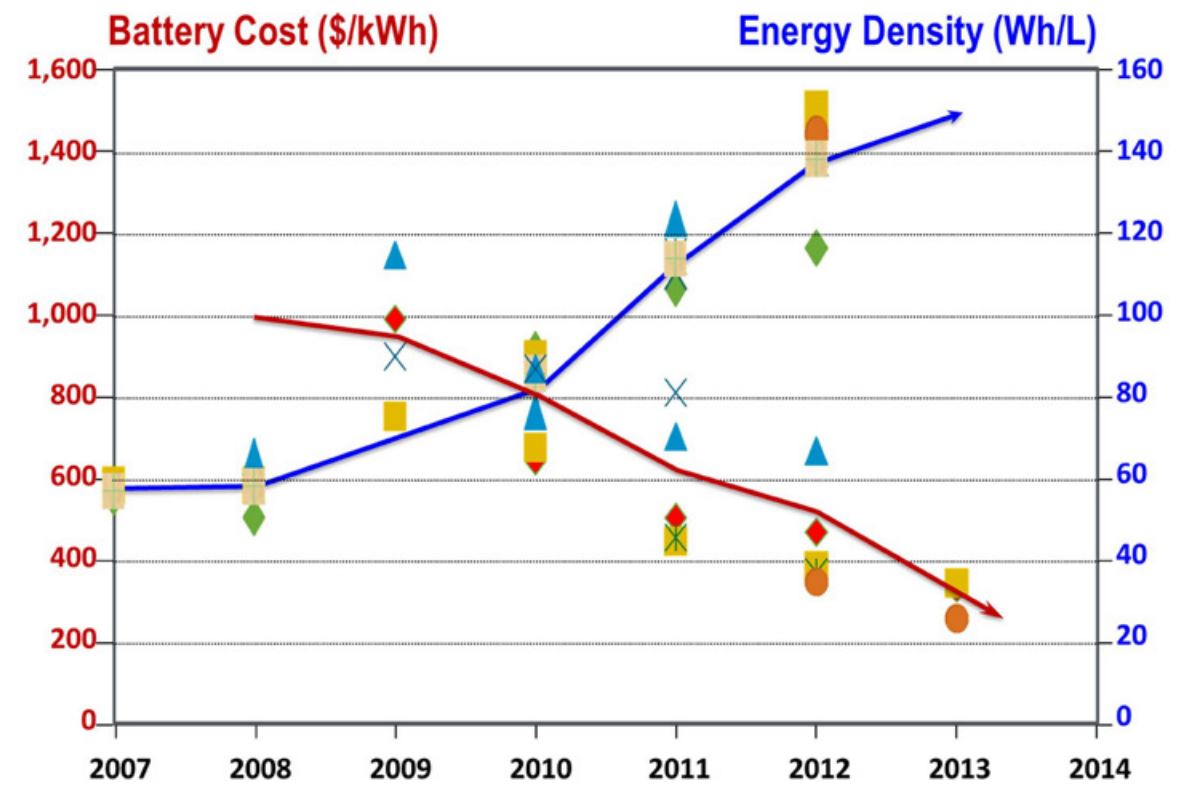
Sure, it'd be nice to have a sudden jump in battery capacity, but I think it's important to recognise that batteries have been getting better, just through incremental improvements rather than big leaps. This graph shows the change in battery density (between 2007 and 2013) and battery cost (between 2008 and 2013):
Sure, smartphones could really use improved batteries, however ultraportable notebooks are really impressive nowadays with decent performance, thin shapes, a weight of sometimes less than 1kg and batteries that last all day.


Imagine being able to use a laptop, or a phone, for days without plugging in. Seems completely impossible now, and my mental model of power usage vs battery drain is so set at this point that I think I'd have a really hard time trusting a vastly better battery to really work, even after seeing it work for a few cycles - I'd always be thinking, can this really be happening? When's it going to fail?
Wonder how long it would take for this to go away and just become the new norm? I'd love to look back on this post in a few years and laugh.