This seems like a junk article. World War 2, especially the European theater, is one of the best studied historical times in existence. Especially since the Russian archives have come to light. It is really not believable to claim that we have gotten the story that wrong -- with such weak evidence.
I don't believe carping about the merits of specific machine guns is substantive, and I think what he said about tanks was incomplete and misleading, although I don't want to spend the time to demonstrate it.
The article really went off the rails in dismissing the significance of the Battle of the Atlantic. TFA claims that U boats only sunk 127 ships during 1940, but Wiki claims that 270 ships were sunk during June-October alone. And it is well known that Churchill himself said that winning the battle of the Atlantic was critical to Great Britain's survival.
In a later phase in early 1942, after America had entered the war but before it understood the threat, German subs sunk 609 ships at a loss of only 22 u-boats. (https://en.m.wikipedia.org/wiki/Second_Happy_Time)
A recent examples of a book that has changed emphases and perceptions about WWII is Timothy Snyder's Bloodlands, on the unique savagery of the Eastern European conflict.
He highlights that the Germans---far from the technical wizards they are often portrayed as these days---won in the beginning despite inferior material. The British and their allies always had material and technological superiority. (Lots of their gadgets just didn't work very well at the beginning.)
I think it's too simplistic to tell who contributed the most. The victory was the result of allies' cooperation. Without the land lease, USSR was unlikely to withstand German invasion. Without USSR on the Eastern front, US and UK forces were unlikely to land in Normandy, and in such a case such an operation would be much less efficient if ever possible. Other countries also played important parts in the war.
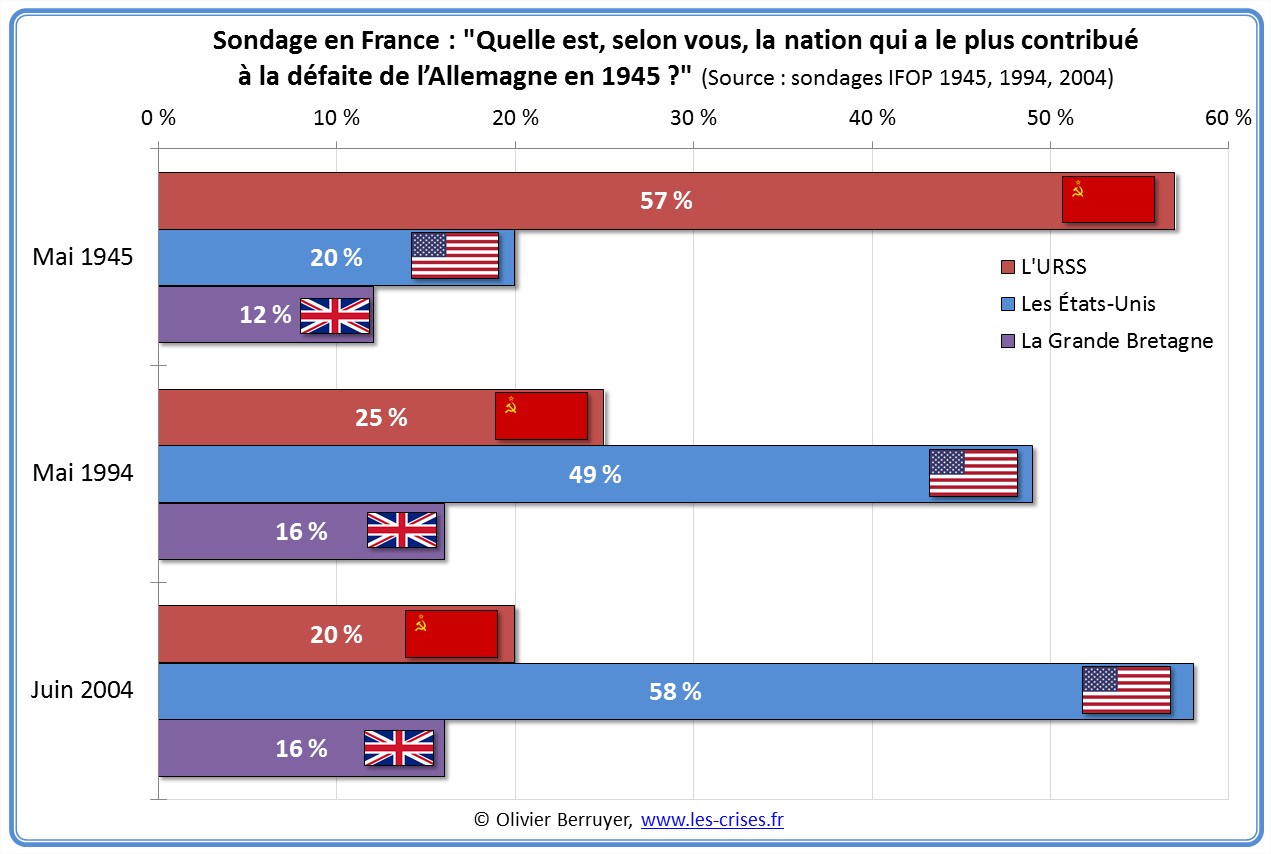
This used to be a widespread perception in Western Europe, too, but changed during the cold war. When people in France were asked in May 1945 which country had contributed most to the defeat of the Germans, the answers were: 57% USSR, 20% USA, 12% UK. But asked again in 1994, the numbers had shifted to: 49% USA, 25% USSR, 16% UK.
Propaganda is powerful... I suspect the USSR's contribution would be perceived as even less if those in the west were asked the same question today... Some recent commentators have even suggested it would have been better if the USSR fell to the Nazis...
This is weird, because it is mostly accepted in American History classes - at least from my school and a few other public school kids I asked when I saw this. Everyone I asked at LEAST thought the USSR contributed as much as the USA in terms of winning the war.
My experience has been the exact opposite. Americans by and large see themselves as the "saviors of Europe" when it comes to World War II. That's where a lot of the deeply rooted hostility towards Europe (especially France) comes from: they shouldn't be giving the USA shit about anything, they should be grateful we saved them from Hitler, etc. etc.
Serious question then: what would Europe look like today if the US had stayed home and not engaged at all in WW2 in Europe or the aftermath? How many more countries would have fallen to the USSR in Europe? Without US supplies, would the UK or the USSR have been able to keep fighting? Would WW2 have dragged out for years longer than it did? And so on.
The US spent a huge amount of money to stand off with the USSR in Europe after WW2 (which was in its self-interest). In fact it's still dealing with Russia in Europe to this day, trying to keep them from reclaiming more former Soviet territory, and carrying the majority of the burden in NATO.
Most Americans I talk to view their country's contribution in WW2 as the push that tipped the scales in the allies favor once and for all (rather than being the savior of Europe). Or allow me to paraphrase Churchill - he believed the war was won, when the US was convinced to fully join the war effort.
Further, what other countries in Europe are we going to claim had a large contribution to defeating Germany? The list is really, really, really short. The UK, Russia and the US carried the radical majority of the effort. It's that simple.
> In fact it's still dealing with Russia in Europe to this day, trying to keep them from reclaiming more former Soviet territory, and carrying the majority of the burden in NATO.
How many foreign military bases does Russia have in other countries ?
How many foreign military bases does USA have in other countries (NATO or not) ?
Since WWII, how many square-kilometers of territory did the US seize from its neighbors, versus USSR (before it broke up) or Russia (after breakup) from its neighbors?
Even if you believe the leases on US bases are somehow secret hostile seizures from their host country (which is unlikely, except for in Cuba)... I'm pretty sure we're talking much less in terms of "taken" territory and people.
Had the US not entered the war, Britain would have eventually been lost, Hitler would have made peace with the Russians, and Japan and Germany would have had years of respite to work out how best to carve up the completely isolated US between them, most likely via friendly South American allies.
What purpose, realistically, would have been served by attempting to invade the continental U.S.? The fall of England would not have suddenly resulted in Nazi possession of Canada or Britain's Caribbean possessions. Trying to launch operations at the bitter end of a trans-Atlantic or trans-Pacific sea-borne supply line would be fraught with risk.
In the Pacific, the U.S. never really faced the bulk of the Japanese Imperial Army, which was largely tied up in Manchuria, China, and south-east Asia. Pacification of China would have been a long, drawn-out affair under the best of circumstances (with regards to Japanese imperialism).
One of the more interesting what-ifs, I think, is what would have happened if the Japanese Army faction had won out over the Naval faction, and an attack was launched towards Siberia, rather than against Hawaii, the Philippines, and Indonesia in 1941. This would have conceivably tied up a significant portion of the experienced Soviet forces that were shifted from the Far East command (including a particular future field marshal) to help blunt the German invasion at the gates of Moscow.
Isn't "saviours of Europe" more than WWII though? It's also the aftermath involved in those words and how the Cold War panned out with a Western Europe under the influence of the USA and an Eastern Europe under the influence of the Soviet Union.
The USSR was highly dependent on rail transportation, but the war practically shut down rail equipment production: only about 92 locomotives were produced. 2,000 locomotives and 11,000 railcars were supplied under Lend-Lease. Likewise, the Soviet air force received 18,700 aircraft, which amounted to about 14% of Soviet aircraft production (19% for military aircraft).[23]
Although most Red Army tank units were equipped with Soviet-built tanks, their logistical support was provided by hundreds of thousands of U.S.-made trucks. Indeed, by 1945 nearly a third of the truck strength of the Red Army was U.S.-built. Trucks such as the Dodge 3/4 ton and Studebaker 2½ ton were easily the best trucks available in their class on either side on the Eastern Front. American shipments of telephone cable, aluminum, canned rations, and clothing were also critical.
While it's good to correct the Hollywood version of WWII this idea has to put it into the perspective of the resources the USA gave to both the USSR and the UK.[0] The USSR was very nearly defeated by the Germans, if you look at the numbers in the Lend-Lease article below it's hard to see how they'd have kept hanging on or launched a counter-attack as strong as they did without that aid. Deaths are the most important thing in remembering sacrifice and the horrors of war but they are not the only thing that's relevant to actually winning a war.
Furthermore these discussions also fall for the eurocentric trap of not discussing the rest of WII. I am continually amazed at how little sense European people have of not only the scale of troops and resources sent to Europe from elsewhere, but of the scale of the conflict in the Pacific.
> The USSR was very nearly defeated by the Germans,
It's actually not that simple. Germans were very close to capturing Moscow and Saint-Petersburg, but the industry had been evacuated to remote locations which would have allowed them to keep on fighting https://en.wikipedia.org/wiki/List_of_World_War_II_evacuatio...
Of course, Hitler with resources of European part of USSR and especially oil fields of Caucasus would have been much more formidable enemy but he was still quite far away from complete victory over USSR.
The winners write the history books. In effect, popular knowledge of WWII often differs from the truth. The German losses on the Eastern front (while known but rarely spoken of) are one example. However, to counter that view slightly, America's late arrival may have tipped the scales against Germany anyway.
My Grandfather fought with the Australian army. While not often spoken about, he referred to the the blind eye of the mass rapes in Germany -after- the war that most of the allies turned a blind eye to,
https://en.m.wikipedia.org/wiki/Rape_during_the_occupation_o...
Or, for those wanting a well documented and extreme view of how bad humanity can be, research Nanking during WWII. I won't provide a link but you have been warned.
We tend to have a very blinkered view of WWII. While most of the truth is known, it is rarely spoken about, misrepresented or ignored. On that basis, the original headline contains truth.
They won. The Germans lost. What else is victory? Yes the Russians lots the most people in the war. Which seems like it only adds to "the Russians won the war". They sacrificed the most to do it. Maybe the problem is the word "won". In this case it's not "won" as in "to receive a prize". It's "won" as in "causing the defeat of the enemy".
I just watched "Back to 1942" which shows a glimpse of WWII from the Chinese perspective. They had to cope with a famine AND a war, and lost ~20 million people during the struggle. To put it into perspective Russia lost around ~28 million [1].
In my opinion it was an excellent film that left me again pondering how much I've really lost in my education by only getting the "Western" version of history.
Word of warning, the movie has no happy ending. It's also in Chinese with English subtitles. Available on Netflix.
"After the failure of the Great Leap Forward and the disruption of the Cultural Revolution, Deng Xiaoping and other leaders took the country on a path of economic development based on a market economy, without relinquishing the party's grip on political power."
"The government resorted to nationalism, including an appeal to the CCP's anti-Japanese credentials, to reassert its legitimacy to lead the country and defuse the inevitable tensions that would accompany rapid economic growth.
Today, surveys have shown that anti-Japanese sentiment in China is higher among the current generation than among the Chinese who lived through the occupation of the Second Sino-Japanese War."
"Anti-Japanese sentiment can be seen in anti-Japanese war films produced and displayed in China. More than 200 anti-Japanese films are made in China each year."
After Nanking, I wouldn't call any of those movies anti-Japanese. How about historical? The Japanese were lucky they weren't completely annihilated from the face of the Earth by the US anyway (considering their tendencies in WW2, I personally wouldn't miss them).
My Grandfather was an Australian Commando assigned to a secret British mission operating within China during the war. It is still the longest overland mission ever undertaken by the British Army.
It was known as Mission 204 [1], or Tulip Force [2].
They were trained in Burma before entering China to help train the Chinese Nationalist Army in Guerrilla warfare, demolition, and try to encourage a resistance movement. The mission had limited success.
Not many Australians, or anyone else, knows that Australian soldiers were under the command of a Chinese general in China during WWII.
Being a Chinese growing up in America, what you said is true and often I feel the Western civilization didn't appreciate the war in Asia until the Japanese had attacked Pearl Harbor, and even then I feel people see America as the sole savior in the pop culture. America's first battle in Africa was a huge casualty (echoes the stuff in the movie Fury). Of course no one is born out to succeed, but the truth is thousands died on the path to victory.
Korean and Chinese had been fighting the Japanese long before Germany declaring war in Europe, way before 1937. For more than a decade, the Chinese had been fighting alone (well with very unpleasant support from the Western civilization like getting weapons at a very expensive rate and siding with the Japanese). Everyone else was still supplying industrial material to Japan, aiding and helping killing millions in Southern-Asia, because the rest of the world wanted to stay neutral. If the Chinese didn't hold back the Japanese, the entire Southern Asia would have fall in the hand of Japan in a few months (what the Japanese generals had promised their emperor). The British and the French armies did not stand a chance in their colonines against the Japanese.
Soon May-in, First Lady of Republic China came to the U.S. and begged the U.S. Congress to help China [1]. I quote: "When Japan thrust total war on China in 1937 military experts of every nation did not give China even a ghost of a chance. But when Japan failed to bring China cringing to her knees as she vaunted, the world took solace in this phenomenon by declaring that they had overestimated Japan’s military might."
It wasn't until late in the war did the Chinese receive air support (and many kind volunteers from the U.S. Army such as the Flying Tigers group) to help stabilize the war against Japan in China. But millions, were poured into the battlefield, untrained, uneducated, with little armor, fought against a modernized elite army from Japan.
Oh not to mention the shitty Commander Stilwell who caused a huge causality of the allies in the Southern-Pacific/Burma...don't get me started there. The British hated him. The Chinese hated him (he seized control of an elite Chinese army division and lost 60% of them - that division stayed and fought the Japanese so hard the Japanese had to surrender).
We had lost so many lives in WWII, including tens of thousands of American (some were recruited from U.S. territories that still don't have voting right in the Congress!). We can definitely improve history class by not just always focusing on American's effort. Even the local rebels in Europe helped the Allies to finish missions. Intelligence that the Chinese had provided to the Allies regarding the Japanese had helped Allies in attacking Japanese later in the war.
You appear to have a view shaped by the Nationalist propaganda. The Flying Tigers were mercenaries recruited from US Naval aviation and Marine corps because the top commanders were more sympathetic to Chinese plight. They were in China before Pearl Harbor, hence so-called "volunteers." Russian pilots, also called "volunteers," helped defend Wuhan before Americans got there. The demise of Chinese Air Force was a direct result of incompetence on Madam Soon, who for political reason had a hand in procurement and wanted to save money until the war started. The Chinese pilots were exclusively recruited from the upper class and generally lacked skills and capabilities to mount effective campaigns or devise innovative tactics. The Kumingdon so mismanaged the war efforts that in 1945 Japanese force could still launch successful drive across China to improve their line of communication, and when American air power failed to stop Japanese advances, the American Commanding general, general Chennault wanted to fly in ammunitions to Chinese ground troops, like general Stilwell earlier advocated, generalissimo Chiang Kai-shek (that is right, the husband of the first lady wasn't the president of China; in fact he lacked legality, but had legitimacy, for his rule during the entire war) refused because he couldn't be certain his troops wouldn't turn their guns on him and replace him with a competent leader. The performance of Chinese force during WWII was abysmal, which directly contributed to loss of the Outer Mongolia as the price for Soviets to open a second front against the Japanese. It is not just that Chinese troops were ill trained, ill equipped, and poorly led; they were ill clothed, ill fed, had no ammunition; the Chinese soldiers were worth more to his commander dead then alive because the commander could forge headcounts and pocket dead soldiers' pay. The entire government and the armed force were thoroughly corrupted.
I just cannot let you cast aspersion on general Stilwell without challenge. He did clash repeatedly with Generalissimo Chiang Kai-shek because he wanted to fight the Japanese and the generalissimo did not. He wanted to equip and train Chinese Army, but the generalissimo only wanted to maintain his control over elite Chinese units because that is how he controlled China. An American once asked the commander of the best artillery unit, after patiently inspecting German made 150mm guns, why he didn't move his unit to the front line and actually fight, he was astounded when the commander replied that he didn't want to suffer loss and no longer being the best artillery unit in Chinese Army. The Chinese Expeditionary force to Burma was remote-controlled by Generalissimo Chiang Kai-shek, who insisted that the entire force go through dangerous mountain range to retreat back into China rather than going to India. The units that obeyed and went back to Chine suffered such loss that they had to be reconstituted, while one brave commander took his troops to India saw his division forming the core of counter offensives later. The same commander, who was trained in US, would later train the main force defending Taiwan. Most of loss suffered by the Chinese Expeditionary force was non-combat causalities.
Madam Soon May-in, as you call her, was greedy, corrupt, clever in PR, and did more than her part in losing China to the Communists. Her meddling in politics made it impossible for Generalissimo Chiang Kai-shek's son to do even minor reforms to cleanse the government. Corruption was so bad that when a top commander correctly outed a Communist spy because the spy was above reproach, the spy correctly fingered another spy (they worked for different branches of Communists) in the Defense department because he was also clean, Generalissimo Chiang Kai-shek chastised his top commander for effectively saying no Nationalists could be clean. I couldn't make this up.
I suggest you carefully read all sides before making your mind. I hate the Communist with all my heart but the Nationalist lost the mainland because they were corrupt, incompetent, and organized themselves on a classical Chinese patronage system, which ironically the Communists are doing their best to emulate. The corrupt but all powerful bureaucracy has reasserted itself, as it has done for two thousand years. The choice is suicide now, by attempting reform, or suicide later, by doing nothing. All the wounds are self-inflicted. The Chinese Communists are wisely choosing to wait, as the Empress Dowager did during the last era of Qin dynasty. It is truly a tragedy. The Chinese revolution, it turned out, wasn't necessary.
That's not really true. Lend-lease, the American Volunteer Group, the embargo against Japan - these all predated Pearl Harbor. In fact, these were the impetus for Pearl Harbor.
This is pretty much the premise of "Brute Force" by John Ellis (1). It argues that Britain, Russia and especially America won the war by sheer industrial capacity, which vastly exceeded Germany's output. Their logistical advantage was reflected in their tactics. If I remember correctly, in the battle of El Alamein, Montgomery had vastly more equipment than Rommel, and won the battle through massive artillery bombardments and by numerical superiority in tanks. In the invasion of Normandy huge numbers of shells were fired, using carpet bombing which overpowered the Germans in the Falaise gap. Germany's "war of movement", with its aggressive advances, which had been so successful at the start of the war, sputtered to a halt before sheer quantity of materiel against both Russians and Americans.
The book also argues that the Allied "brute force" mentality worked against them at times. Patton used a dynamic war of movement against the Germans several times, but was often held back by the plodding methodical approach of his superiors.
I think it's an easy misunderstanding: Germany was ruined after WW1. Europe wasn't surprised because Germany was superior. Europe was surprised because Germany was so much more powerful than expected.
These are old, well-known issues. WWII machine gun designs reflected WWI trench warfare experience - fixed gun positions, fire in the general direction of the enemy. WWII didn't go that way, mostly because everybody had tanks, and could now operate against machine guns.
The most effective tank of the war was the USSR's T-34. More T-34s were produced than any other tank, including Shermans. The T-34 had a good gun, a decent Diesel engine, and an adequate transmission. The Sherman was a lighter tank, and early Shermans had a rather weak gun and some strange powerplants. (One version had five V-8 car engines arranged in a circle around one crankshaft. Chrysler had a good plant for making V-8 car engines, but the specialized machinery could not make a bigger engine.) The Sherman's big strength was simply that it was a good driving machine, and tens of thousands of them were driven from the French coast all the way to Berlin. Patton's "War as I knew it" talks about this, in the chapter "Touring France with an army". Many of the heavier German tanks would wear out on a long road trip; within Germany, tanks were often moved by rail. Basic truth: the tank that makes it to the battlefield beats the tank that doesn't.
(The overly complex Tiger tank transmission thing is real, but confusing. Tanks steer with the transmission. The Tiger tank had a steering wheel, which controlled the relative speed of the two tracks. The Sherman had two foot clutches which disengaged the left or right track, and turning was more of a lurch than a smooth turn. The Sherman could not turn in place. There was a Tiger variant with an electric drive, like a Diesel-electric locomotive, but that was harder to keep working than the hydraulic/gear system. Modern tanks steer like the Tiger, but now the technology works.)
The article author's info about the U-boat was is totally bogus. There was a big worry that Germany would be able to starve out the UK. Liberty ships, convoys, "jeep" carriers, periscope-spotting radar, and Ultra intercepts reduced the effectiveness of U-boats. The US Merchant Marine puts the number of ships lost to U-boats between 2,742 and 2,919.[1] The figures for 1940 are from 470 to 520, compared to the author's 127.
Yeah, this sentence, "Almost every narrative history of the war ever published almost entirely concentrates on the strategic and tactical levels, but gives scant regard to the operational," either suggests the author hasn't read much or is a really poor reader.
the history that I got about WWII was that Germany built wunder-weapons that individually were of far superior quality to anything else, but couldn't be built at any kind of scale. their tanks were initially technologically superior, but not much else about their mechanized infantry stuff was. the bismark was probably better than any individual ship in the british navy (when they finally found the wreck they determined that british main gun shells literally bounced off of the armor), but it wasn't better than all of them and the germans could only build one.
the story I have heard is that some things about french tanks were superior to german tanks - they had more armor and a more powerful main gun. however, the french had a 2 person crew, a driver and a commander/gunner, while the german had a 3 person crew, a driver, a gunner, and a commander. so the french had a more overloaded crew driving a superior tank and that didn't work out.
The Germans built just fine at scale - remember that it took the resources of Russia, the British Empire, and half of the US industrial juggernaut to take them down.
That's not * really * accurate. The Germans had a big head start, because they started the war, of course. But by the time the US and USSR had ramped up to full military production, by 1943-44, they could have rolled through Germany 3 times over and had hardware to spare.
The US was by no means at the end of its resources by the end of the war, running on fumes (the Germans were of course, out of fumes).
Everyone in Europe was ramping up in the 30s - it's an utter myth that factories only started really getting going in '39.
Germany could build at scale just fine - however it was also facing three resource powerhouses, and had no allies that could compensate. Germany couldn't build at a scale to compete with the Allies, but it could "build at scale".
> by 1943-44, they could have rolled through Germany 3 times over and had hardware to spare.
... and yet they waited until halfway through '45? :)
Edit: I've hit my 'make comment' limit, but in counterpoint to adventured:
The parent said that "by 1943", the Allies had enough to "roll through" Germany 3 times over. Never mind that the Allies couldn't organise an effective coastal invasion for another year and a half, nor that the war in the east had only just reached tipping point.
My point was that if it was so easy ("roll through", remember?), then why wasn't it done in 1943?
> Why not sit back and bomb the hell out of Germany prior to rolling over them?
You have the cart before the horse - "bombing the hell out of them" was a major part of being able to defeat a tough, tenacious foe.
I remember one WWII veteran complaining about the film Saving Private Ryan, in that while the opening scene was realistic, the rest of the film had Germans acting like idiots, running into machine-gun fire and across open areas for no reason. He hated it because not only did it not do the Germans justice for being excellent soldiers, it also didn't do the Americans justice for being able to take out this difficlt foe. Painting the taking of Nazi-occupied Europe as a form of cakewalk doesn't do either side justice.
They didn't wait until half-way through '45. Hitler was dead at the end of April '45. Germany had already been smashed well before that date.
Of course they 'waited' somewhat. Priority #1 was taking back France and bringing an ally back online. That single outcome by itself guaranteed the end of Nazi Germany. Why would any sane commander do it differently?
Why not sit back and bomb the hell out of Germany prior to rolling over them? Again, the only smart choice, and that's exactly what the allies did.
By '45 Germany was exhausted and obviously defeated. The only thing left was to cap it off. Nothing Germany could possibly do could turn the war around at that point. Why would you choose to do anything but wear Germany down in an optimal fashion? You win when it's most convenient for you, when you can lose as few soldiers as necessary, not when it's best for the Germans to inflict casualties upon you.
The Tigers were heavy tanks plagued by manufacturing problems. The Sherman was a medium tank more comparable to the Panzer line - the Germans built around 45,000 of those. The American M6 was comparable to the Tigers, of which few were built and 0 saw battle.
Panzer is just the German generic term for tank (or more literally, "armor".) Everything from the tiny, machine-gun armed Panzer I, to the Panzer VI Tiger.
The standard, 75mm Sherman was roughly equal to the long-barreled Panzer IV (~6000 built).
Sherman: 33-ton tank, Tiger: 60-ton tank; Sherman: mainstay of US armor, Tiger: heavy tank. You're comparing apples and oranges.
The Sherman's counterpart was the Panzer - which the Germans still only built roughly 15k of - but then again, the Germans also made heavy use of tank destroyers and assault guns - the Stug III by themselves were another 10k worth of hulls.
But, again, just because someone has more capacity than you doesn't mean you're not building at scale.
"Panzer" just means "armor", and was the label used for all German tanks. Everything from the tiny Panzer I to the Panzer VI Tiger. Presumably you're thinking of the Panzer IV? But only about 8000 were built, of which only about 6000 were the long-barreled version which could match the Sherman.
> In truth, there were never enough U-boats to more than dent the flow of shipping to Britain. In fact, out of 18,772 sailings in 1940, they sank just 127 ships, that is, 0.7 percent, and 1.4 percent in the entire war.
I thought this was partly thanks to Turing et al's breaking of Enigma. The allies had a window into tons of "secret" Nazi communication.
If you look specifically at the Spandeau machine gun mentioned in the article, Is the US using the same damn process with the F-35 Strike Fighter? A plane that is over designed, clunky and extravagantly expensive?
From War is Boring: No, the F-35 Can’t Fight at Long Range, Either — Stealth fighter can’t see, shoot or survive.
I don't find the comparison particularly compelling.
The MG 42's issues were more logistical. It was designed for an idealised situation (e.g. shooting range). Not as the article describes it "total war" where you have to carry everything you need to the battlefield. That meant issues like weight, complexity (for field repair), and replacements became a real headache. Arguably the real issue could have been bad feedback/communications between lower ranks and engineers/designers (and something we still see today with field equipment failing e.g. see the M16's long history, and how long it took for some of the changes).
The F-35 is more "too many chefs in the kitchen." The F-35 likely is over-engineered, but not because of too little feedback like the MG 42, but too much. Every major US military arm tacked on their own little requirements here and there, until the aircraft was so loaded down with toys and gadgets that it could barely fly. For example, the entire airframe is designed around a lift fan that the vast majority will never be fitted with.
The MG 42's issues were more logistical. It was designed for an idealised situation (e.g. shooting range). Not as the article describes it "total war" where you have to carry everything you need to the battlefield. That meant issues like weight, complexity (for field repair), and replacements became a real headache.
But the whole idea of the General Purpose Machine Gun (GPMG), which I'll note everybody adapted after WWII, was to make a lightweight "heavy" machine gun. No water cooled barrel, no requirement for a heavy tripod, in the light machine gun use case it was fired from a bipod, and could be put into use quickly.
Those extra, quick change barrels were a feature, not a bug, such a German infantry unit was organized around the GPMG, one guy would carry it, others would carry spare barrels and ammo, their job was in part to keep the machine gun running and protected from the enemy.
Issues like the high rate of fire were a tactical choice the Germans made, shared by no others to my memory (I believe the theory is that you would seldom have a good target for long, so you had to make the best of it while it existed). E.g. I see in the Wikipedia page that the post-WWII Austrian version has a much heavier bolt to reduce the rate of fire: https://en.wikipedia.org/wiki/MG_42 And the Germans are still using it in the adapted for 7.62 NATO MG 3 variant.
Accuracy is also a tradeoff, there are many modes of machine gun fire like plunging where you want a degree of dispersion.
That said, yeah, feedback from the front is slow, can take a whole war to result in real changes. These things don't get put to the real test until real war; e.g. aside from the earliest M16s, none of these issues are a patch on the string of problems that initially crippled our Mark 14 torpedo used in WWII: https://en.wikipedia.org/wiki/Mark_14_torpedo
War is Boring has put out numerous hit pieces on the F35. Most of what they write is poorly researched, empty statements without any factual backing, or the equivalent of straw-man arguments.
This is about as sophisticated as their arguments get:
"Can the F-35 really engage, shoot and kill its enemy from long distances? There are reasons to believe it can’t."
The argument attempt they make in that section isn't an argument at all, it's hollow. They say something as though it's factual, without ever backing it up.
For example, that F35 dogfight outcome was with a very early F35, that was carrying a fraction of its final technology package. War is Boring intentionally ignores that completely because they're trying to defraud the reader and spin some propaganda.
"The F-35's technology is designed to engage, shoot, and kill its enemy from long distances, not necessarily in visual "dogfighting" situations. There have been numerous occasions where a four-ship of F-35s has engaged a four-ship of F-16s in simulated combat scenarios and the F-35s won each of those encounters because of its sensors, weapons, and stealth technology."
You appear very knowledgeable about the plane but I counter the above with a pentagon report that summarily states (second paragraph) the F-35 circa July 2015 is falling short and it is not operationally effective for military combat. The following paragraphs thereafter contain a "shopping list" of mods the F-35 would need to have to be combat effective.
The plane's 400-billion cost is too extravagant and to bring up a point that the 'War is Boring' article made when comparing the inexpensive, 4-speed, Sherman tank versus the Porsche-engine equipped Tiger tank in World War 2, the Tiger was outnumbered by a preponderance of force that was more manageable.
An "outdated" F-18e (still in use) can defeat an F-35 in a dog fight and costs about half or $55-million each. (An F35 $100-million-plus) In my opinion the F-18 would be more valuable and effective in regional conflict than an F-35. YMMV
War is a racket, some lesser acknowledged operation information of WW2:
a) IG Faben and Standard Oil and the supply of TEL (Tetraethyl Lead) to Nazi Germany. [0],[1]
b) Production of Ford (and GM) engines by German subsidiaries for motorised transport was directly used against the Allies.
"Mel Weiss, an American attorney for Iwanowa, argues that American Ford received "indirect" profits from forced labor at its Cologne plant because of the overall increase in the value of German operations during the war. He notes that Ford was eager to demand compensation from the U.S. government after the war for "losses" due to bomb damage to its German plants and therefore should also be responsible for any benefits derived from forced labor. Similar arguments apply to General Motors, which was paid $32 million by the U.S. government for damages sustained to its German plants."
This came out from a law suit (class action) by Elsa Iwanowa in 1999 (IWANOWA v. FORD MOTOR CO) for being rendered from Belgium to work in Nazi Germany for a Ford subsidiary in Cologne. [3]
It could be argued, more effective control of TEL to the Nazi war machine would have resulted in a halt or severe reduction in Nazi air power. And Ford did sue the US Government post-war for $32M USD for bombing their factories in Germany during WW2. [4]
I think the most important fallacy about WW2 is that nobody entered the war for a noble cause. It was all self-serving. It's often held up as a just war. Now of course I agree Hitler had to be defeated once 1939 came around, but it was also preventable, like most wars. The extent of appeasement was really an eye-opener to me. I'm 1937 the US state department still said Hitler was a "moderate" and should be supported! The background to the Pacific war by Noam Chomsky also tells of an economic war among empires which led directly to the Pacific war.
The indescribable savagery of the war, particularly near the end is hard to imagine.
Lastly one of the biggest fallacies concerns Hitler's invasion of the USSR, and speculation as to whether he could have won. The truth is the Germans were incredibly fortunate to do as well as they did! In fact the USSR was a world leader in tank production and tank strategy, before the 1937 purges they had the best and most innovative tank commanders and the most advance tanks. They should have crushed the Germans from the beginning!
I think I get what you mean, but your wording is just slightly off.
The Fallacy: That anybody was a noble actor.
Your wording makes it sound like there's a wrong-headed perception that war is not noble, and that the correction to the fallacy is to find ALL participants VERY noble, valiant and in high regard.
Then, your next sentences:
It was all self-serving. It's often held up as a just war.
These clarify what you meant to say, and contradict the preceeding statements.
The words "fallacy" and "nobody" inadvertently constitute a double negative.
Well France tried to avoid confrontation and the U.K. was trying to hold on to its empire and contain the German threat, but also had many business interstate in Germany. The allies thought they could diplomatically outmaneuver Hitler.
France and the U.K. then caved to Hitler's demands repeatedly and essentially sold Czechoslovakia and Poland down the river to Hitler at Munich 1938, and during the "phoney war". France was then surprised by the swiftness of the German attack but capitulated very quickly. Her armies were still mostly intact when France fell.
It must also be remembered that the extent of collaboration in France under occupation was very great and the French resistance was always very small.
Yes, it is. Captain America is a fictional character, the US didn't 'win' the war, and yes, all 'winners' engaged in war crimes that were just as heinous and cruel as the losers.
I agree with you, except that the USA very much did win the war. The problem with winning wars is that the victor gets the learns that military power violence is a solution to problems.
After being downvoted for a completely innocuous comment on this thread it is apparent that people only want to hear 'textbook' history, so I won't bother adding anything other than to say politics runs roughshod over history all day long. If humans survive another 70 years, I wonder how the history of the War OF Terror's 'coalition of the willing' will be written(whitewashed is probably a more suitable term), tyrants and criminals or liberators?
What I was taught in public school is that the Germans used slave labor and POWs to work in factories to make their weapons, tanks, planes, rockets, etc and this led to a quality control issue while the USA and Britain had well paid and well fed people who made better quality weapons, tanks, aircraft, etc.
The Russians had an advantage because of their AK-47 rifle and a lot of fighting was done at the Russian front as Hitler tried to take over Russia. People forgot that Russia did a lot of fighting as well as had better weapons and stuff as well.
The USA has military superiority because we have better technology and better trained people. For example our fighter jets are better designed and our pilots are better trained than their Russian counterparts. Most of the USA's enemies buy fighters and stuff form Russia, but they end up being no match for the USA stuff.
In AK-47, the 47 comes from the year the design was finished, design work didn't even begin until 1945, so the AK-47 certainly didn't help them win WW2.
As others have mentioned, this all occurred before the AK-47 was put into production. I believe the Mosin-Nagant 91/30 was standard issue for Soviets in WW2.
The US is in fact the pinnacle of education, in several regards. For example it has by far the best university system. No other country comes even remotely close. On any list of the top 50 universities on earth, the US will routinely take the top 40 or 45 slots. If you make a list of the top 20 universities, it's going to be dominated by 19 from the US, with Oxford thrown in for good measure.
The US won the math olympiad this year, and is pretty much always near the top. You might want to check out where certain highly praised European countries tend to come in every year by comparison.
The US has one of the highest GDP per capita levels, at $56,000 (#5 for 2015, behind only a few tiny nations), to go with one of the highest median incomes - you don't accomplish that without some amazing education output. The US leads in nobel prizes globally. The US leads in general innovation, R&D, and sheer scientific output. Its universities are productive in that regard in ways nobody else comes close to. Its economy is also one of the most productive.
The US leads in space, space tech, aerospace, medtech, biotech, pharma, software, Web, Internet, mobile, agriculture, entertainment, defense tech, is one of the leaders in computing hardware, and is also one of the leaders in pretty much every type of energy technology. It's also the world's #2 manufacturer.
So yeah, the US does a lot of things really really well. You don't accomplish all of that, and manage to produce such a massive economic engine for over a century, with extremely high output levels per capita, without at least a decent education system to go with it - which is why so few countries can match up to the US economically or scientifically.
FWIW, 33/50 are in the US. The breakdown is 16/20, 33/50, 51/100, 78/200, 102/300. The US and UK systems are roughly of equal rankings, assuming I can simply scale by national population.
(That is, if they are the same, then I would expect the US to have more occurrences in the highest levels simply due to statistics.)
Where are the guidelines about down voting orionblaster unfairly? I don't see those.
The guy was merely corroborating the original post, sharing some of the absurd things he was taught in school, and was downvoted for it. Doesn't seem like a very friendly thing to do to someone who's engaging in the discussion.
Shall we stand by mute while someone is bullied? Either that or be bullied ourselves for speaking up to stop it? If that's it, then I don't like your policies. I re-edit the post to conform to your policies. Then I'll show myself the door, thanks.
Apparently what I was taught was wrong. The AK-47 was made after WWII not during it.
HN members usually downvote when something is incorrect, even if it was not my fault but the teacher who taught me that.
I usually make mistakes and get downvoted for them. What I was taught about Windows NT had some inaccuracies in it and got downvoted for that. If you look at my history every once in a while I got downvoted and get used to it. But I get upvoted more than downvoted so it averages out.
We ban accounts that post like this here, so please don't do it again. Comments need to be civil and substantive, and personal attacks are not allowed.
All histories of wars that are still in living memory or close are going to be grossly distorted because people want to hear stories that pander to their own emotions.
As a prime example, historians are often legally (and certainly professionally) forbidden from freely studying some aspects of WWII in case the come to conclusions that are still politically sensitive. I'm talking here about the Nazi concentration camps. This is a research no-go-zone where only the officially sanctioned results are allowed to be published and people can go to prison in many European countries for making false or unpopular claims about 80 year old history.
Then there's the opposite problem in Japan where the official and popular history paints them as the good guys and hides from their killing 10's of millions of Chinese. Americans fall for this too and feel bad about the nuclear bombing of Japan, despite the enormous good it did to the whole of south-east Asia.
I know that Nazi imagery has been banned in Germany, but I've not heard of professional historians being legally bound to avoid research into the topic of concentration camps, on threat of imprisonment no less. Do you have a source for this?
Edit: Have hit comment limit, so replying to AC__ here
I've been through all the sections in your link, and a total of 3 people have seen prison time. The only one that could be called a professional historian would be James Keegstra, who wasn't convicted on holocaust denial per se, but due to violating hate-speech laws by teaching his high school history class: "During class, he would describe Jews as a people of profound evil who had "created the Holocaust to gain sympathy.". Keegstra was convicted in Canada.
Ernst Zündel was convicted in Canada and Germany under hate speech laws. Having had a look at his website, it's about politicking his views, not history. But he's been in and out of court for decades on hate speech violations.
David Irving could theoretically be called a professional historian, if it wasn't proven that he used known fabricated documents as source - during the libel case he brought against someone else. Irving was convicted in Austria.
None of the above are professional or dispassionate historians taking the topic seriously. All of them are politicking.
It is more that such a historian would be immediately shunned and made into a "hack". That puts a limit on how far you can go, regardless of whether or not there's a "legal bound".
You can't publish holocaust denial material. That means if you find a new discovery that seems to challenge the legally sanctioned story, you can be breaking the law by publishing it. I don't think that politicians should decide what research is "right" and what is "wrong". This is completely against the American concept of free speech.
Austrian law seems quite clear on holocaust denial being a crime:
§ 3g. He who operates in a manner characterized other than that in § § 3a – 3f will be punished (revitalising of the NSDAP or identification with), with imprisonment from one to up to ten years, and in cases of particularly dangerous suspects or activity, be punished with up to twenty years' imprisonment.
§ 3h. As an amendment to § 3 g., whoever denies, grossly plays down, approves or tries to excuse the National Socialist genocide or other National Socialist crimes against humanity in a print publication, in broadcast or other media.
Imagine if he US criminalized downplaying the crimes of the Vietnamese Communists or any other group the government decided was "bad". This should be a matter for public discourse, not an imposed official history.
The Austrian law you're quoting isn't a law sitting all by itself. It's part of a law saying "No Nazis, and no bullshitting about what they did"[1]. If you look at your own quote, you'll see it says "grossly plays down". The scale of the Holocaust was large - there was a heap of physical evidence, and tens of thousands of eyewitnesses. And it's not a topic that has had little research - to characterise the story of the holocaust as springing forth from the mouths of politicians is grossly misleading.
Denying the holocaust altogether is not research - it's an attempt to stifle research for political gains. It moves the needle from 'what actually happened' to 'did it happen at all', wasting resources - the same needle-moving tactics are seen in intelligent-design and anti-climate-change arguments, stopping productive conversation on a topic to further a political goal.
Finally, note that these laws limiting freedom of speech around holocaust denial are particular to that topic and nazism. The 'slippery slope' argument hasn't taken hold; it's not these laws that are limiting freedom of speech (hell, even with "the American concept of free speech" you still have Free Speech Zones, National Security Letters, and copyright that lasts for author's life + 70 years). The laws don't stop you from doing research into the shitty things the Allies did. They don't stop you researching Nazism in general or the Holocaust in particular. They only stop you playing politics from pretending that something does't exist when it has tens of thousands of eye-witnesses, troves of physical evidence, and heavy existing research on the topic.
Europe has a problem with violent nationalism; cutting off this particular avenue helps alleviate that, and doesn't do harm in return. These laws make Nazism (and it's trappings) less able to be used politically, something Europe is serious about - see Merkel's recent chiding of Netanyahu for him claiming that it was Palestinians who started the holocaust. How often do you see a head of government declare "Those atrocities, they're on us, not anyone else"?
Many countries have problems with violent political extremism of different sorts. When they outlaw free speech for supporters of those ideas, we call them violators of human rights. When China locks up dissidents because they spread anti-government messages, we say it's bad. But Germany and Austria do the same.
Would you really be happy if the US outlawed climate change denial and intelligent design? It's one thing to not like them but a massive step to imprison people for talking about them.
If intelligent design itself was responsible for drawing a demographic from all across a continent and destroying an estimated 6 million of them in an attempt to exterminate them completely, and was associated with a larger movement that was ultimately responsible for the deaths of 50 million people, then yes, I wouldn't have a problem with outlawing it to prevent a resurgence.
> But Germany and Austria do the same.
Yeah, one each according to that WP link. Irving was imprisoned for all of 13 months in Austria. Compare to the recent HN article on Rikers Island in New York where 400 people have been imprisoned for more than two years without being charged, and suddenly the extremly low conviction numbers of these "political dissidents" comes into focus.
Also, classing holocaust denial as 'anti-government messages' is a pretty gross mischaracterisation.
Seperatist muslims in Xinjang, anti-government rebels in Egypt or Nazi sympathisers in countryside Germany. They're all people sharing ideas that can lead them to violence. It's not reasonable to pick one of them and class it as "truly worth suppressing their speech" while accusing governments which suppress the others of violating human rights.
I dislike that this is getting downvoted. While the claim is certainly debatable, the comment itself is civil, grammatical, links to a non-crank source which is indisputably relevant to the claim, and appears to be made in good faith.
> Americans fall for this too and feel bad about the nuclear bombing of Japan, despite the enormous good it did to the whole of south-east Asia.
We may feel bad with access to the information we have now, but, in interviews with people from that time, it's not so clear cut.
First, very few people really understood what a nuclear bomb was or could do. We're used to instantaneous communication. I seriously doubt we even had pictures in the US of Hiroshima before the Nagasaki bomb dropped.
Second, the US suffered terrible casualties in trying to retake Japanese islands before the bombs. Any effort to avoid that was welcome.
Third, people in the US were VERY tired of war. Anything which could bring that to a close sooner would be welcomed.
Fourth, the average person in both the US and Japan had no idea what the leaders were talking about or knew.
There are lots of What-If's? for not dropping the atomic bombs. However, there are just as many the other direction. One could just as easily point out that the hardline faction in Japan might have attempted a coup without the example of the devastation that the bombs caused and that it was the bombs that allowed the emperor to surrender.
> One could just as easily point out that the hardline faction in Japan might have attempted a coup without the example of the devastation that the bombs caused and that it was the bombs that allowed the emperor to surrender.
The hardline faction attempted a coup even with the example of the bombs.
Another angle is that in hindsight, it was probably a good thing that nuclear weapons were first used in their infancy. Fast forward a decade or two to the depths of the cold war - a lack of knowledge about the actual effects of bombs on cities might have made a larger exchange between the superpowers more likely.
Unless, of course, there actually were good guys and bad guys in that war.
As far as real-world wars go, within the constraints of the real world where nobody is ever purely good or purely evil, World War 2 is about as close as we're ever going to get to a good guys vs bad guys war.
Sure, my idea of good guys and bad guys might be wrong. And so might the idea that Nazis were bad guys and allies were good guys. This is the same concept that we choose the history we want to believe, myself included.
You could even make the argument that the allies should not have resisted the Nazi invasions of Europe/Russia because the cost in lives ended up greater than what might have happened if they'd easily taken control. Though we can't know that "what if" scenario, we can at least try not to fool ourselves too much by assuming it would be unimaginable worse forever.
> Americans fall for this too and feel bad about the nuclear bombing of Japan, despite the enormous good it did to the whole of south-east Asia.
That's definitely a claim I would need to see substantial evidence for. The traditional defenses of the nuclear bombings that I have heard could not be more unconvincing.
I found your last sentence hard to parse. Are you saying that all of the justifications you've heard for the bombing were absolutely unconvincing?
I have strong feelings both ways, but I find it hard to deny that it probably saved a lot of allied lives. It doesn't mean that it was the "right" choice, but I don't see how it can be possibly dismissed (put yourself in Truman's shoes).
OP1: >> "...the enormous good it did to the whole of south-east Asia."
OP2: >> "...saved a lot of allied lives..."
The atomic bombings of Japan had nothing to do with the military campaign in the Pacific theater, which by 1945 had been decisively and indisputably won by the Americans. They had literally run out of targets to bomb in the Japanese home islands. [0-1] An argument could be made that the Atomic bombings saved some American lives by accelerating VJ day and thereby precluding some unpleasant island-hopping, though I've never been terribly convinced.
The atomic bombs were about scaring the Soviets, plain and simple. By '45 the American military was perfectly aware that it had won the Pacific, would soon win the European theater, and had long since turned its attention to preparing for the cold war and plundering German technology and other assets.
[0] See for example Sec. of War Henry Stimson's diary and papers, which are excerpted here among other places: http://www.doug-long.com/stimson5.htm It might help to command-F down to this quote: "I was a little fearful that before we could get ready the Air Force might have Japan so thoroughly bombed out that the new weapon [the atomic bomb] would not have a fair background to show its strength."
> I find it hard to deny that it probably saved a lot of allied lives.
That's true if the Japanese would have fought a land invasion tooth and nail for every inch of ground, civilians charging at GIs with kitchen knives, etc, etc. That's what the Western propaganda of the time predicted; East Asians in general and the Japanese in particular were broadly understood as hive-mind insects yearning to sacrifice their lives and families for the glory of the nation.
The reality is considerably more doubtful, especially now that we know about the government factions that were desperately eager to surrender even before the A-bombs fell. And even if we discount that, there's no excuses made for why the nuclear show of force had to be targeted against civilians, nor why the second bomb was dropped only three days later.
For me, there's a fuzzy line where enough time has passed that actions need to be judged based on what was known, or should have been known, at the time.
The question for me isn't: Did it actually save lives.
The question for me is: Did Truman and Churchill really believe they were saving millions of lives (and, was that a reasonable belief). Which really comes down to: do you believe Truman and Churchill?
My parent said (if I understood correctly) that all the justifications he or she has heard "could not be more unconvincing." That you and I are now talking about how many lives did it really save?, does not change the fact that saving American ( / allied ) lives, is not a wholly unjustifiable (or incomprehensible) thing for a US President to consider. Maybe I was just put off my his or her hyperbole.
Indeed, I mean that the justifications I have heard for the bombing are unconvincing. That includes the claim that it "saved a lot of allied lives." Not only do I doubt that it did save a lot of allied lives, I also don't believe that this would be a sufficient justification for the bombings.
Neither is it true that "any claim, however small, about the Holocaust" is "a research no-go-zone where only the officially sanctioned results are allowed to be published and people can go to prison in many European countries for making false or unpopular claims"
The German law says so. Perhaps they don't enforce it much but it's still the law:
" Whosoever publicly or in a meeting approves of, denies or downplays an act committed under the rule of National Socialism of the kind indicated in section 6 (1) of the Code of International Criminal Law, in a manner capable of disturbing the public peace shall be liable to imprisonment not exceeding five years or a fine."


I don't believe carping about the merits of specific machine guns is substantive, and I think what he said about tanks was incomplete and misleading, although I don't want to spend the time to demonstrate it.
The article really went off the rails in dismissing the significance of the Battle of the Atlantic. TFA claims that U boats only sunk 127 ships during 1940, but Wiki claims that 270 ships were sunk during June-October alone. And it is well known that Churchill himself said that winning the battle of the Atlantic was critical to Great Britain's survival.
In a later phase in early 1942, after America had entered the war but before it understood the threat, German subs sunk 609 ships at a loss of only 22 u-boats. (https://en.m.wikipedia.org/wiki/Second_Happy_Time)
A recent examples of a book that has changed emphases and perceptions about WWII is Timothy Snyder's Bloodlands, on the unique savagery of the Eastern European conflict.