Even if you follow all that advice, it isn't necessarily sufficient. Probably not even close. If you figure you need roughly $1.5 million to retire without drawing down principle, then that means you're by definition in the top 5% of the United States by wealth.
And in order to get $1.5 million from $0 by age 65, well there are a lot of ways to get there assuming unrealistic stock market returns. But over twenty years, the S&P 500's returns vary wildly [1].
If you start at age 25 and aim for retirement at 65 then that's 40 years. If median return after inflation is 4%, you still have to save over $1000 / month, and that's banking you'd hit median returns. If you figure 3%, then that's around $1500 / month. If it dips into negative returns like it did for a few 20-year periods in the S&P-500 history, then good luck, you'd need to save over $4000 / month.
Over 40 years you get quote a bit of dollar cost averaging going on which helps returns significantly. Including dividends 4.5% after inflation. Though fees may easily reduce that to under 4% for many people.
I honestly believe dollar cost averaging is somewhat of a crock, because it assumes that you have a slush pile of money set aside that you invest on a set schedule.
I just thought of a way to test my thought:
For instance, I ran a study on my own finances. I have a complete record of dates and amounts of every sum I've put into retirement. I'm able to "pretend" I bought the S&P-500 (VFINX) on those dates (rather than the investing choices I actually made), and am able to calculate an APY from that date until today. (I do this by looking up dividend-adjusted historical prices.)
Given that, my all-time APY would have been 6.69%. Meanwhile, using an S&P 500 Return Calculator [1], the Annualized Inflation Adjusted Reinvested Dividend performance is 6.67%. So, almost exactly the same - maybe dollar cost averaging isn't a crock, but in my case, not the advantage it is usually purported to be. And this is a 20-year period that has been reasonably strong.
I believe the reason this happens is that people (me included) will tend to have more money to invest when times are good (and prices are high), and less to invest when times are bad (and prices are low) - so this basically eliminates any dollar-cost-averaging advantage. I'm just one data point so I might be an unlucky outlier, but the theory makes sense to me.
It's less about maximizing returns as it is a reversion to the mean, there are clearly better times to get into the market, but the point is it minimizes the risk of starting in a bad year. Granted, as you say people often have less money to invest in bad years. However, even in the great depression ~50% of workers had a job.
EX: Rerun those numbers and start in 1999.
Or consider "By mid 1932, the Dow had lost 89 percent of its pre-crash value" Few people are going to have 10 times what they need for retirement saved up. On the other end retirees are probably not selling all there stock at the bottom either even if people generally need to sell more in a dip than in good times.
Granted, 1970 was still a terrible year to get into the market.
The limit to greater financial literacy isn't in the lack of availability of short "tip lists" like this. It's in the willingness of people to research, learn, and change behaviors.
It doesn't help that you'd be lucky to encounter any financial literacy education in public schools (in the US).
Discipline. As a full-time employee, I more than doubled my take-home pay between 2006 and 2015. In that period, my spending didn't go up. Actually, it went down, because I paid off my car.
In the process, I paid off credit cards, student loans, and managed to increase my standard of living.
I remember after a big pay bump (job change), noting that my take-home pay going into my primary checking account was unchanged from what it had been 6 years prior, because, almost without thinking about it, I went from single-digit 401k contribution to maxed out, and doubled the amount that went into my medium-term savings/investment accounts. It just seemed natural; I'll be making more, time to save more. It was essentially a coincidence that the take-home number remained the same.
This is not to say it's so easy for everyone; everyone has different circumstances. My point is more that there are so many people NOT doing this for whom it WOULD be easy.
It's taking me about 10 years but the last time I got a significant increase I did not actually increase my spending/lifestyle, which is a first. It's strange. I used to always imagine if I had X amount of money I would never be able spend it. Then when I got there it was so easy to spend it. I'm hoping to be in your position after I get some of my debt paid off.
Once you get in the habit of spending too much or god forbid run up a large credit card debt I can see how it might be hard to return to a lifestyle of frugality akin to the difficulty of quitting smoking or a morning coffee habit.
I do agree that discipline is the name of the game though.
Absolutely. Habits are hard to quit. For me, it's the "time to spend" habit. I put off making a big purchase, but once I do (say, building a home theater system or something) it becomes easy to just keep spending on it because you've already mentally committed to the project. All fine and good so far. But then you notice something else you 'need' or that's wearing out, and you buy that without thinking about it. Then you buy another thing without thinking about it, because you're in the habit. Sometimes you need to do a spending detox after those splurges.
I know there is a personal responsibility part of this but banks end up prying on the financial illiterate. Somehow my wife has a student loan with 12% interest. I'm not even sure how that happens. I also don't understand how interest rates are so low but CC interest is so high. They are basically borrowing free money and then charging people 29% on it.
CC interest is high because:
1. Most people pay off the balance each month; the people who don't _really_ need the credit.
2. The default rate of those people is probably (very) high. Given a default means a bank loses their capital, they need to make it back somehow.
Also, a student loan with 12% interest? If the loan still carries a significant balance, she should refinance at a much lower interest rate (pledge some collateral if you have to, like a car/house/existing share portfolio).
From my limited knowledge of such things, I think it would be possible to set up a credit union where the "common bond" among members is the ability to spot banking practices hostile to banking customers.
If all the members know how to spot a scam, it is unlikely that anyone would vote that everyone should try to run one on themselves.
Excerpt from the membership application exam:
      ...
      B) Take the lower rate with the higher monthly payment.
      C) Buy a used car that is about 2 years old instead.

  22. Your bank offers to upgrade your debit card such that, for a fee,
      a transaction that would ordinarily be declined--or a check that
      would have bounced--is instead approved.  How do you react?

      A) Wow, that sounds convenient.  I'm in.
      B) If I wanted credit, I would have used a credit card.
      C) If I can't opt out, I'm closing my account.

  23. You need $40 in cash.  Your bank does not have any no-fee ATMs
      in the area.

      A) A fee is no big deal.  Withdraw $40 and pay $3.
      B) Withdraw the maximum, to minimize the percentage lost.
      C) Buy a pack of gum with debit and get $40 cashback.
      D) As in C, but also return the gum for a refund.

  24. Your bank offers...
The Credit Union would end up with so few members and so few persistent deposits (since all your smart members would immediately transfer assets into investment accounts, muni bonds, and ETFs), that the Credit Union would operate in the red... costing all the founding members dearly, both in time and money, when the Credit Union goes into bankruptcy. It turns out that the smartest folks, who saw through the charade, were thrown out with the bath water by not joining to begin with. ;-)
Obama's Consumer Financial Protection Bureau [0] and related initiatives provide an advocate in disputes with banks, limits and disclosure requirements on fees, etc. The CARD Act of 2009 also standardized credit card rate and fee disclosures.
On the non-regulatory side, there's not much meaningful pushback against the big banks, but you can choose to opt out of them by banking with a local credit union (university, employer, city, etc.) or potentially an internet bank like Ally or Simple.
It's not just fine print and fees. That's the least of our worries. It's more about the misuse of debt (line of credit for a vacation), taking on too much debt (furniture and appliances on layaway, and other such things), and inappropriate investment vehicles.
But that's the thing: research and learning are unnecessary. Just change your behavior. Which is easier than people think. Just do it.
As far as this card goes, it's spot-on. I would put "pay off your credit cards" at the top of the list. You should not invest a nickel until you've paid off all your credit cards (and any other debt where you're paying more than 10% interest).
They may be investing indirectly, like with their 401(k).
People with significant credit card balances may be paying 15%, 18%, 25%, or more on them. Even with the tax advantage of the retirement account, it's better to suspend contributions and pay off debt.
Assume you're in the 25% tax bracket. If you have a $100 debt accruing interest at 24.99% for 10 years, you end up owing $931. If you have $133 in a pre-tax account earning at 7% for 10 years, and withdraw it and pay 25% in tax on the $262, you have $196 left. You don't have to be a genius to figure out that still leaves you $735 in the hole, which is far worse than paying the tax on your $133 paycheck up front and using the $100 to pay off your debt instead of investing it.
As it turns out, your interest on debt doesn't need to be nearly that high. If you owe at 10% and invest pre-25% tax at 7%, it still makes sense to stop investing entirely until paying off the debt.
There are tons of people who carry credit balances who also have money in stocks, bonds & mutual funds. They don't equate paying off 15% credit card balances with a 20-25% stock gain.
I disagree with the statement that you should not buy individual stocks because others know more than you. This is only true if you buy stocks for companies outside of your area of expertise. If you work in tech you know more than the average wall street trader about tech companies especially the one you work at. If you work in medicine you know which medical insures are shit and which are great, etc.
Now this does not mean you should buy multiple stocks all in one sector but it does mean if you know a company well and you know they are doing great and will be doing great in the next year you should buy their stock. You should never have more than 20% of your portfolio in a single sector but it is perfectly safe to have 80% of your portfolio in vanguard funds and 20% you invest in one or two companies you truly believe in.
> If you work in tech you know more than the average wall street trader about tech companies especially the one you work at.
I have never met a group of people less able to correctly assess a firm's proper value or more capable of self-delusion than the engineers working for that firm.
If you work in tech you know more than the average wall street trader about tech companies especially the one you work at.
If you work there, it means you're likely to have blind spots about what actually drives the stock price. Hint: it ain't necessarily the tech. Personal example: AAPL. I make most of my money these days working on Apple tech. The fact that I've made possibly a majority of my retirement money off AAPL has nothing to do with my knowledge of their tech. It has more to do with watching what makes it go up, what makes it go down, and a raft of other factors that have little to do with the technology.
Let's take a look at some of their tech that drove the price up. iPod: no wireless, less space than a Nomad, lame. Oh, we laugh now, but Cmdr Taco had a solid point. iPad: just a big iPod touch. I said the same thing until FedEx dropped it off. New iPhone comes out, people stand in line for hours or days, Apple can't keep up with demand. Stock price goes down. Less on the technical side, Apple crushes earnings; stock goes down (whisper numbers and all that).
A sibling comment said 99% of people shouldn't own individual stocks, a sentiment I agree with despite holding a majority of our money in individual stocks. Sometimes folks are too smart for their own good, and they even if they work at the company they ignore what really drives the price because of an intimate knowledge of irrelevant pieces, thinking knowledge of those irrelevant pieces gives them a leg up ("<I> know more than the average Wall Street trader." Not about trading stocks, you don't.)
(So why do I own so many individual stocks? Because I'm a special snowflake? No, because I'm an idiot who thinks previous success means I know what I'm doing. I really should start diverting to index funds.)
I always thought people misjudged CmdrTaco's comment, particularly here in HN, where everyone seems to think they're professional analysts. He was giving his personal opinion, not predicting the response of the market.
>if you know a company well and you know they are doing great and will be doing great in the next year you should buy their stock
This is a truthy-sounding and extremely common belief about the stock market, but false. Buying stock is not a bet that the company will do well, it's a bet that the company will do better than other market participants currently think it will.
99% of people should not buy individual stocks. If you're in the 1%, good for you. Having subject matter expertise can be dangerously misleading because company stock trades on financial performance, not product/technology/etc.
This is a perfect example of fighting the urge to listen to folks like you and instead, just go with the index card.
If you understand what the catalysts of a stock are (both long term and short term), buying individual stocks isn't a bad idea. And it's still possible to beat the market. But yes, most of your money should be invested in low fee index funds.
As an example: a few years back, I owned some yelp stock. At the time, it was a growth stock driven by usage numbers. The quarter before, iOS6 (or 7? cant't remember) was launched, which included yelp support in every iPhone. A few days before yelp's quarterly earnings, Apple announced they sold 15% more iPhones than expected. Guess what? Yelp's numbers for the quarter were up significantly. I made 20% on my money the next day (and sold my shares). If I didn't have subject matter expertise, I might not have seen that.
> If you work in tech you know more than the average wall street trader about tech companies especially the one you work at.
Whoa, be careful with the one you work at. There are often insider trading rules governing when and how you can buy/sell shares of your own company and derivatives involving them.
In addition to the legal considerations, note that if your employer goes through layoffs, your investment is likely to tank right at the moment you need it most.
You're already have natural long exposure to your employer's performance. Be aware that investing in your employer is a doubling-down on their performance.
You also likely have some emotional investment in your career, which likely biases your judgement.
On the other hand, you may have industry insight that the market simply doesn't have. While working for Google, shortly after Google announced Android, I wasn't sure if HTC, Apple, or some third manufacturer was going to become dominant in the smartphone market, but I was sure Intel was going to be playing catch-up in the mobile space for at least 5 years and smartphones were going to eat the world. I also knew the huge amounts of money per year that my employer was spending on datacenter electricity and saw that for many server workloads, watts/SPECINT and watts/flop aren't terribly important. The CPU largely (oversimplification) configures DMA between the disk controller and the network card, and there was a window of opportunity for ARM to get significant market share in the server space. This was before HP or Dell announced any of their ARM server projects or I had heard of Calxeda. The server thing didn't work out for ARM, but my investment in ARM Holdings still went up over 8x over 5 years or so. I no longer think I have any more insight than the market into ARM Holdings's share price, but I was able to profit from insight I had at the time that the average trader did not.
A stock's current price already reflects all public available information including its future value. You're assuming that "the average wall street trader" knows less thus causing the stock's price to not be accurate. Would love to hear a counter argument to that.
A stock may be priced accurately by the market according to a typical risk profile, but an individual investor may have a higher-than-average tolerance for risk.
You can't reliably beat the market. People who say they can are saying so out of some combination of:
  1) lying (to others and/or themselves as well)
  2) cheating (insider trading, boiler rooms, etc)
  3) drawing conclusions from too small of a sample size
Also I also disagree with the statement to not buy individual stocks because others know more than you. It might be true even, it doesn't matter, because it's not the reasons not to buy individual stocks for retirement.
You don't buy individual stocks for retirement because your risk exposure is a lot higher compared to indexes and just riding the market (x10 for every dollar spent like this before taking maximum advantage of tax deferred retirement options).
If you have enough money that you are able and willing to lose some % of it for the chance of better gains, then buy individual stocks with that money (or play in derivatives if you're into stronger risk-seeking behavior). If you are trying to avoid living off of cat food in your winter years, it is far smarter to surrender the marginal chance for larger gains for a very highly likely chance at modest gains. If you don't have a retirement planned out, then every dollar you get towards it needs to be spent with the retirement goal in mind, and for that goal, the risk profile of individual stocks, historically, is prohibitively high.
You might know the tech better, but do you know what people will buy? That management will take care of the tech well? That they've hired the right accountants and lawyers to deal with financial and legal issues?
I don't think people as a whole should avoid buying individual stocks...but I think it's probably a good rule of thumb for people. Sort of "don't buy individual stocks unless you actually know what you're doing. And 50% of you that think you do are wrong."
The big problem with investing in your sector is too much specialization.
I realized one day that investing large sums of money in my employer's stock is essentially putting all my eggs in one basket- both my investments & my paycheck depend on the same company.
I extend that to my market sector, too. I avoid investing in my market sector now.
This is very misguided. You might know that razer makes absolutely terrible products (and they do) but do you know their financials? Do you know their distribution and their profit margins? You can buy their shitty equipment all over the world.
The technology is not what drives the stock price of a company. What does drive it? It takes years of studying finance to learn. Your statement is akin to a trader telling another trader that, since they specialize in studying Apple, they could probably be great at being iOS app developers.
"[...] if you know a company well and you know they are doing great and will be doing great in the next year you should buy their stock"
This is an example of a very common fallacy. Even if I tell you that e.g. Apple will be doing great as a company in the next 5 years, that's not a reason to buy their stock. The reason would be if I tell you that their stock is undervalued!
This is one of the first rules you learn in finance - if I can guarantee a future payout stream (e.g. $1000 in 1 year, $2000 in 2, $1500 in 3, $4000 in 4...), I can calculate how much that payout stream is worth now. This is what a companies' stock essentially is - a promise of a future payout stream. So if the stock is trading higher than that stream is worth, then the stock is not a good investment.
I work at a hedge fund. The people who evaluate companies aren't traders, they're called analysts. A lot of them have MBAs from highly ranked programs, but aside from that they have fairly diverse backgrounds. One of the guys who works with health care companies is an MD. One of the guys who works with tech companies was a VC. They have almost limitless resources for research, meaning that they read a lot of third party analysis. They meet with company management. They talk to people at other funds and exchange ideas. We also have a team that does proprietary quantitative analysis to supplement the fundamental process. And of course analyzing companies is a (more than) full time job for the analysts.
Hedge funds struggle to outperform the market. The vast majority of amateur traders underperform it by a lot.
It can help but it doesn't even begin to cover it.
I didn't realise how big the gap was until my sister (liberal arts major) asked me (finance) for guidance on her personal finances.
Now she is bright & got a high end education - probably more so than me in both regards but dear god entirely ignorant about personal finances (budgeting, investments, retirement etc).
Its a pretty basic failing in the schooling system globally as far as I'm concerned. This is a make or break skillset for +- all people out there yet people walk into life having zero clue what their doing. Predictably a decent chunk get caught in debt traps etc.
Maxing out retirement accounts is the common piece of wisdom thrown around. However, instead I try to put as much money into a liquid fund for entrepreneurial reasons. For the YC crowd, I'm surprised this isn't a more suggested route.
I think a lot about this. But note that if your employer matches contributions, you can come out ahead even if you withdraw those funds immediately and pay the penalties.
In reality, I have to trick myself into saving so that I don't spend on non-entrepreneurial things. :)
Exactly that. The government of the country where I currently live constantly fiddles with taxation rules retroactively. I'm quite sure it's the same most everywhere.
I'd rather put my money in places where I am in control to the max. No special tax advantaged retirement funds for me, thank you. They are not that lucrative anyway around here, and the conditions under which one can use them (retirement age, taxation, ...) change all the time, for worse.
The last creative change by the government was it taking an advance on future taxation from my current retirement fund savings, in exchange for "not taxing it anymore in the future". Hah, /me does not believe a single word of that!
I'd rather invest my puny savings into my own little maker company. With the proceeds, I rather buy productive assets that I 100% understand. Things that are as close to physically under my control as possible. Anything but government incentivised savings. Those will bite one sometime sooner or later anyway!
You are absolutely correct when you say the money is not given to the government, but to third-party entities.
The government can dictate terms to those entities, however, and they will comply.
For example, when the government made the ownership of gold illegal, they instructed the banks that it was illegal to open a customer's safe deposit box unless a federal officer was present. When the box was opened, any gold (save for certain kinds of coins) was confiscated and the owner of the gold was reimbursed for a fraction of its value.
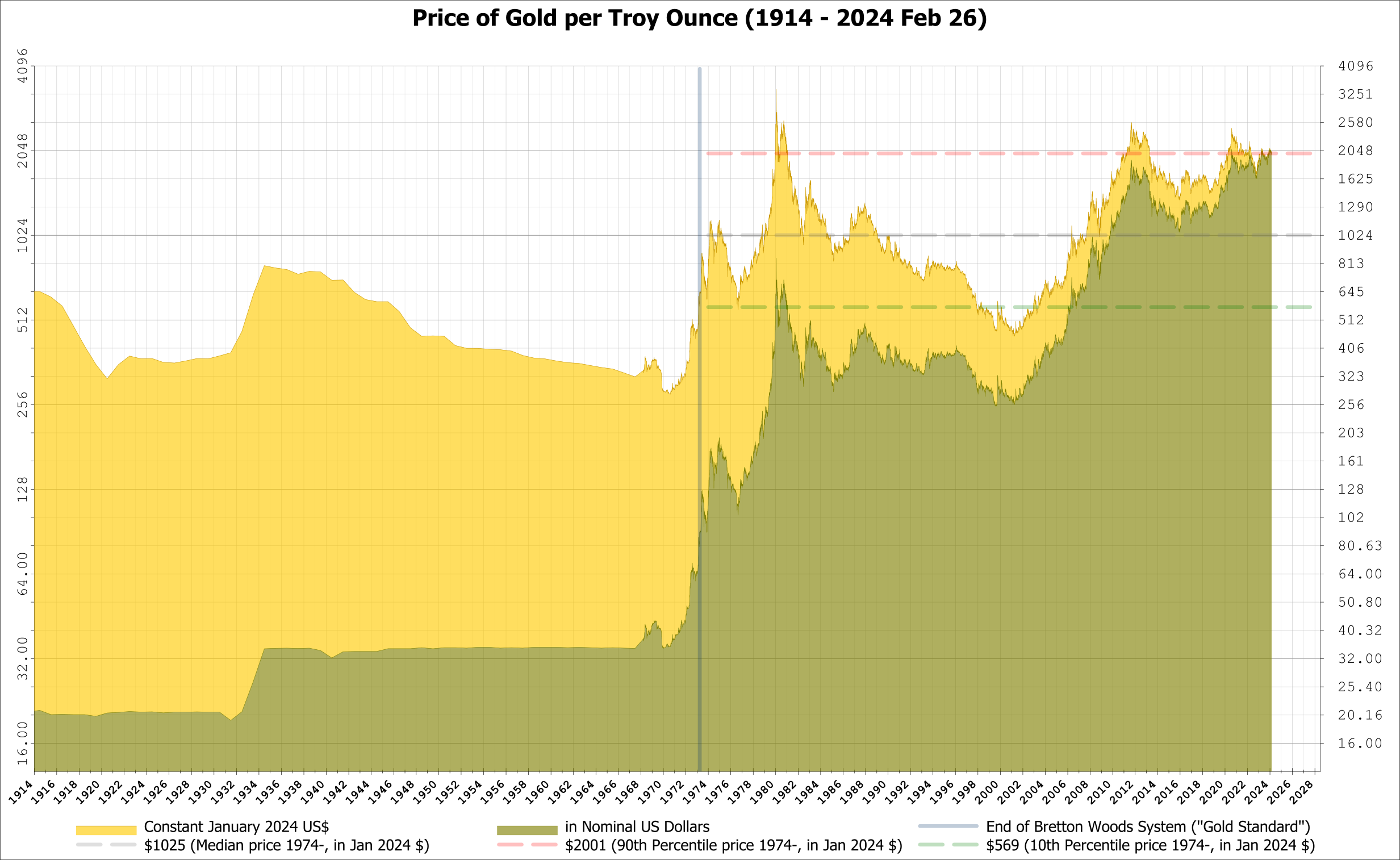
It's not true that the government sized privately owned gold in that manner [1]. Additionally, when the government made the private ownership of gold illegal, they bought back gold from people at $20.67/troy oz, which is about what the price was at the time [2].
I think your concerns about the security of retirement accounts is unfounded.
I don't take offense to your comment regarding paranoia.
The question, I think, is this: If you have worked all your life, and played by the rules that existed at the time, how do you protect what you have earned from theft by others?
One aspect of the answer, I think, is that you put it out of their reach.
There are many other things a person can do. As an aside, whenever someone implies that a set of options is very limited, I try try broaden my focus a bit, in order to see a bigger picture, and thus, additional alternatives.
I hope that doesn't sound condescending, as it's not meant to be.
Well, for a lot of engineers in SF and the Valley maxing out retirement accounts would still leave them with funds leftover to save for entrepreneurial reasons. I'm in an entry level position and this holds true for me.
Quote: "That said, both Pollack and Olen say a good, reasonably priced financial adviser can sometimes be helpful — especially when life gets too complicated to fit on an index card."
But the long-running WSJ dartboard contest proved repeatedly that financial advisers cost more than their advice's value. Maybe that fact should be on the metaphorical index card.
Here's my index card:
1. Don't borrow money.
2. Don't be in debt to anyone for anything.
3. Learn about compound interest, then either burn your credit cards or learn how to use them.
4. Invest only in no-fee or small-fee market index funds -- in the long term they outperform the majority of fee-based mutual funds.
5. Never engage the services of a financial adviser.
One second - there are a few different meanings for "financial advisers".
I believe that what you're talking about are financial traders, to whom you give money to invest for you. In that case, I agree that (but see caveat below).
But there are many other forms of financial advisers. A good adviser can help you to diversify your investments, help you to mitigate and control tax liability, help you match your risk profile to investments, etc. These are valuable things that the average person cannot do on their own, and they are worth paying for.
Note: A caveat to the 'don't use advisers' approach. I generally believe in a relatively efficient market, although I think you can get higher returns in some situations (e.g. some hedge funds do appear to get higher returns).
However, even if I didn't, sometimes it is worth paying for an financial trader to work on your behalf, for the same reasons as above, namely, you'd like to invest a bulk of money, but aren't sure how best to invest it and want to diversify. As much as the advice fits on an index card, it's still a complicated and technical field. I'd rather someone pay some small amount of money to financial advisers and actually invest money than be too scared to do any saving.
> One second - there are a few different meanings for "financial advisers".
Not really. They all tell you how to invest your money, by definition.
> A good adviser can help you to diversify your investments, help you to mitigate and control tax liability, help you match your risk profile to investments, etc. These are valuable things that the average person cannot do on their own, and they are worth paying for.
Yes, and the same information can be gotten from the Web for free. There are any number of advisory articles that describe personal strategies for efficient investment and financial management. The only exception I would make to this rule is tax accounting, which really is too complicated for the average person to manage on his own, and an activity fraught with risk (tax judges often refuse to accept ignorance as an excuse for tax mismanagement). But a tax accountant's costs are easy to manage, compared to the erosive overall effect of a financial adviser.
> However, even if I didn't, sometimes it is worth paying for an financial trader to work on your behalf, for the same reasons as above, namely, you'd like to invest a bulk of money, but aren't sure how best to invest it and want to diversify.
What? You just agreed with the uncontroversial advice to avoid financial advisers. I should add that many mainstream publications including the Wall Street Journal and others, and Warren Buffett, have given this same advice for decades, even (in Buffett's case) to his own relatives.
As to "diversify," what's the point of diversifying if the point is to invest in index funds? An index fund is by definition a diversification -- that's its purpose, its reason for existing.
> I'd rather someone pay some small amount of money to financial advisers and actually invest money than be too scared to do any saving.
To a person with an IQ above 80, the truly scary prospect is to allow a financial adviser into your life and your portfolio.
> I generally believe in a relatively efficient market, although I think you can get higher returns in some situations (e.g. some hedge funds do appear to get higher returns).
Yes, I agree -- about half of funds do better than the market indexes, and half do worse (and their ranking is random and unpredictable over time). Want to know why? Because that's how the index is calculated -- based on the overall market. But once you include the adviser's fees, you lose any advantage, and compound interest does the rest -- you end up way behind the buy & hold investor, as explained in this article:
What you're saying is true of typical workers in the 20s and 30s, where the best advice is to put a part of their paycheck every month into an index fund.
However, there are other situations. In our field, you can have plenty of situations where people have more money, for example:
1. You're an employee (or founder!) at a startup that had an exit event, you suddenly have lots of cash.
2. You've been saving up for a long time, you're now 50 and have considerable net worth.
In these kinds of situations, the conventional wisdom isn't enough, because you probably shouldn't just sink $Xmil into index funds and be done with it:
1. You might want to diversify by e.g. not buying into one index fund, tracking one country, but rather will want a few different funds in different countries.
2. You might not live in the States, but you probably do want to buy an index fund that tracks american exchanges, not just your local ones. But then, you have to deal with fx risk.
3. You might want to not only own stocks, but put money into real estate as a diversification mechanism (and because it might have other desirable properties, e.g. might be anti-correlated with the general market in some situations, might give you depednable rental income, etc).
4. Especially in the example where you're older, index funds might be too volatile for you, considering you might be needing to pay for children's educations and other things
Bottom line, there are lots of situations where you have higher net worth which lots of high tech employees eventually reach! And in those situations, there really isn't a one-size-fits-all policy of how to handle your money, and you usually do need advisers.
I would add: develop a philosophy of life that enables you to enjoy the simple things so you don't get caught on the hedonic treadmill, and try to save even more than 20% of your income. Sites like Mr. Money Mustache explain how it's done.


And in order to get $1.5 million from $0 by age 65, well there are a lot of ways to get there assuming unrealistic stock market returns. But over twenty years, the S&P 500's returns vary wildly [1].
If you start at age 25 and aim for retirement at 65 then that's 40 years. If median return after inflation is 4%, you still have to save over $1000 / month, and that's banking you'd hit median returns. If you figure 3%, then that's around $1500 / month. If it dips into negative returns like it did for a few 20-year periods in the S&P-500 history, then good luck, you'd need to save over $4000 / month.
(Rough numbers based off of monthly interest)
[1] http://www.nytimes.com/interactive/2011/01/02/business/20110...