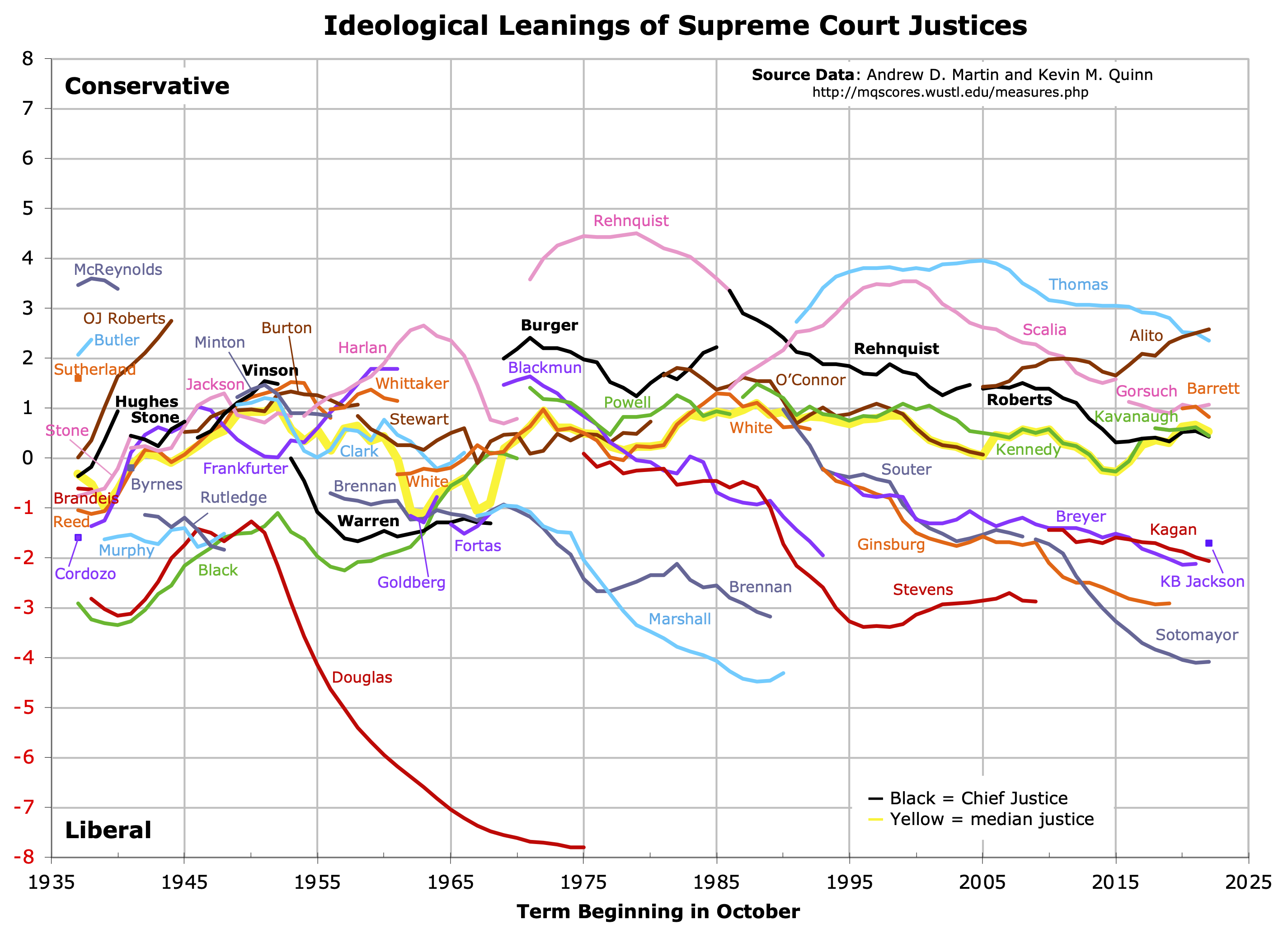
This will likely result in a major political shift of the court. Even if Obama places a staunch centrist, it will be a net left swing, as Scalia was perhaps the second most conservative justice beside Thomas.
There have been a great deal of 5-4 decisions since Sotomayor's nomination that in the future could easily fall the other way.
It would be interesting of Obama did nominate a staunch centrist right out of the gate, as a gambit to get in a new justice confirmed before the likes of Donald Trump gets to make a nomination.
There's a precedent to replace 'like with like', so knowing that Scalia was very right-leaning, (if he gets the chance) Obama will very likely nominate a centrist, if not a right-leaning one. At least that seemed to previously be the case... In this new world of scorched earth politics, who knows..
He's a Stanford guy, Indian, already sailed through the Senate for a DC Court of Appeals position, disliked by Unions, and by all accounts a brilliant legal mind. He's successfully represented corporate clients (e.g. Skilling in Skilling vs. USA) and had a successful career in the private world.
This somewhat contradicts my first paragraph, but he's definitely to the right of Kagan or Sotamayor.
While there is a tendency to replace like with like, that's because Supreme Court justices usually time their retirements to coincide with presidencies that share their views.
In this case, I doubt it applies. In theory Obama could pick a nominee closer to the center to avoid a tiresome confirmation battle, but I suspect there's a bigger bang for the buck in nominating fairly left-wing candidates and making the Republican Senate choose between looking obstructionist to the general public or looking weak to their base.
Could you explain why this might cost the Republicans votes? Their core voters would absolutely love them standing up to the "tyranny" of Obama. Even independent/undecided voters would understand that its reasonable enough to postpone considering how close the Presidential election is.
To be clear, I think it would be best to have it completed within 3 months, like the previous 10 nominations to the court but I don't think it will cost the Republicans at all to postpone it till next year.
You might very well be right, and I agree that the Republican base would prefer that the Senate just doesn't bother to consider a nominee until after the election.
However, my impression is that independent voters prefer action to inaction and typical behavior to atypical, and will be susceptible to 'the Senate is refusing to do its job' arguments from the President and the Democratic presidential nominee, as well as 'Supreme Court appointments are usually approved in XX days' arguments from the press.
It can be a good call to arms for the Democrats though. If the nomination is withheld long enough, lobbies like EMILY's list will get more donations and will raise more noise. and rightly so because more is at stake.
A liberal would never elect a conservative and vice versa, but there's an expectation to maintain the court's approximate balance (which is why Scalia's death is such a big deal). So if a very right-leaning justice stepped down under a liberal president, he'd elect a center / center-left justice. If the most left-wing justice in the world stepped down, then a left-wing president could elect the most left-leaning person.
As tptacek said, political labels aren't necessarily objective, so this graph would differ depending on the methodology. It's also a little harder to measure justices' leanings because there are so few data points.
Bush had cover since Rehnquist (pretty far right) had just been replaced Roberts (a much more moderate candidate). Even then, it was controversial for that exact reason.
So between the two justices, Alito + Roberts is definitely to the right of Rehnquist + O'Connor, but pretty moderate considering the possibility of two far-right justices.
I've never heard of that and have reason to think otherwise: Presidents see the Supreme Court appointments as a chance to leave their mark on the judiciary. Could you provide some evidence?
Well, consider: You're a Senate Republican. Obama nominates a guy who is certainly no Scalia but legitimately isn't the worst. You can hold out and hope that a Republican gets elected, but there's a good chance that'll be Donald Trump, and what kind of a judge is that weirdo going to nominate? You hate that guy and think he's a blemish to the name of the Republican party. Also, there's still a real risk Hilary/Sanders will win instead. AND you can expect to face more than half the media harassing you over any delay. In fact, the harassment has already begun today, Feb 13.
So a real compromise candidate might be possible. It'd likely depend on Obama and the senate Democrats as well, though.
it's actually pretty unlikely. Fivethirtyeight has a bunch of good articles about this, but the simplest piece of information pointing to it: Trump is intensely disliked by about 60% of the voting public. He's got a vocal and enthusiastic following, but once you go outside that bubble, he simply doesn't have room to grow.
I voted for Bush twice, McCain, and Romney, and I'll vote for either Hillary or Bernie (two candidates I can't stand) over Trump, and I'm far from alone.
Trump said he'd nominate his sister. I doubt he'll get the nod, and I doubt we'll see anything until after the election since it will energize both sides. It's too good a fund raising tool for red and blue to pass up.
I don't follow. It doesn't matter how much Obama wants to replace Scalia (I'm sure: a lot). He can't. The Senate must consent to his nomination, and is entitled to advise it. And advise it they have: they've decided it should be an issue for the election this year, and the voters should decide.
Which is really a shame. With the entire lot of candidates on both sides ranging from bad to awful, it seems likely to me that this will be one of, if not the, deciding issue in the election.
That's bad, because it will perpetuate party politics. No matter how much people dislike the candidate nominated by their party, they'll think they've got no recourse but to vote for him/her lest they lose the Court.
All the Republicans I know who say they'll vote for Clinton before they'd vote for Trump - and there are plenty of those - won't follow through. The chance we might have had for an olive branch, reaching out of the viper pit of party politics, is now gone.
It was always going to be, now it's just become apparent to those who don't pay attention. Next POTUS will nominate a replacement for Notorious RBG as well. This is probably the most important Presidential election in a long time.
Maybe, because Kennedy is getting old (and Kennedy is probably the most important justice on the current court), and so the next President might get 3 seats to fill. But if it's just RBG and Scalia, that'll be the same number Obama, Bush 2, and Clinton got.
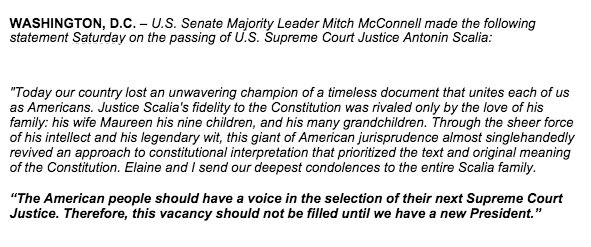
He's the Senate Majority Leader and the official spokesperson for Republicans in the Senate. The fact that he said it right away, after two GOP Senators who are also viable Presidential candidates said it as well, is a pretty strong indication of what's going to happen.
McConnell is a blow-hard, and is looking for a rally-point for the party. I'm sure he believes this is what Scalia would have wanted.
But the idea that the "American People" wouldn't have a say with an Obama appointment is absurd. He was elected with a clear majority and Presidents are elected for four years, not four years minus whenever the next presidential race gets going.
I know you've expressed elsewhere (edit: in this thread) that Republicans have already made it clear that they won't do an appointment this presidency (and you're probably right that they're trying to set themselves firm in this as quickly as possible), but I can't imagine a scenario where Obama doesn't put forth a nomination post-haste. I also cannot imagine 11 months of blocking a SCOTUS nomination and leaving the court with 8 members.
<I also cannot imagine 11 months of blocking a SCOTUS nomination and leaving the court with 8 members.>
But that's exactly what the Democrat-controlled Senate did after Justice Abe Fortas resigned in disgrace in 1969. They knocked down Nixon's first two nominees, and Fortas wasn't ultimately replaced by Blackmun until a year later[0][1][2].
The president can use a recess appointment. It would probably end up looking worse than blocking a nomination for 11 months so it seems unlikely, if technically possible.
A recess appointment would make it an ironclad certainty that a Republican would be elected president. It would make enough voters, including moderates, angry enough that a Democrat would stand no chance.
I don't know. I used to think I was a moderate, and I'd vote for almost any Democrat to keep Republicans from getting two SCOTUS appointments. It's an excellent point though, it would give Republicans a huge issue propaganda win.
Sure, and, of course, that itself was subject of a recent Supreme Court decision. But it's piling a hypothetical on my already silly hypothetical. He'll just make an appointment as he's already said and reasonably argues is his duty, the Senate will just stall him out, as the majority leadership has already said.
I like to imagine he and the Democrats in general might actually end up looking better if that's how it plays out.
No, they have been using a pro forma procedural motion for years that effectively means they are never in recess, but there are untested ways that the President can force a formal recess.
Senators leave Washington, there are time limits on debate, they may not be able to return in time. Or, if a potential recess appointment is suspected, the Republicans will be spending their holidays in DC.
Good luck with that with 1/3 of Senate going for re-election. Summer is the best time to campaign but if they choose to stay in D.C., that's up to them.
The parliamentarian is an advisor to the presiding officer of the senate, which is either the vice president or in his absence the president pro tempore (by tradition the senior member in years of service of the majority party) or his designee.
In any event any parliamentary ruling is appealable to the floor where it is subject to a majority vote. The is the basis of the so-called nuclear option.
McConnell's hand can be forced if there is a majority willing to do what it takes to force it. If he has the procedural support of his caucus (even if they disagree on the ultimate question) he can prevent a vote from coming to the floor.
Thanks. I know what a parliamentarian is and in any case could've found the dictionary definition. I was hoping for suggestions as to what kind of sneaky tricks and shenanigans we could expect if the opportunity presented itself.
The right-winged politicians are posturing to make this a presidential election issue, maybe even a big one.
Electing a president who will in turn appoint a SCOTUS Justice may sway more people to vote. Perhaps the the politicians believe that they can use the normal wedge issues (abortion, death penalty, guns, etc.) to have a strong showing on election day.
I would tend to agree that an open SCOTUS seat would motivate more conservatives to vote. But, these things have a way of back firing for politicians and a lot can happen between now and November.
> Senator McConnell has announced that the Senate won't take up a Supreme Court nomination this year.
Of course. The question is, why do the Democrats let the GOP get ahead of and frame every debate? Will they roll over this time or draw every bit of blood they can and make this position cost the GOP more and more politically until they give in.
Unfortunately, I would not be surprised if they roll over. You'll know they did if they don't respond soon to McConnell, or not with an effective message, and Obama nominates someone as far to the right as he can stand.
I doubt they roll over on this one. Reid had already said as much. Plus, the Republicans play dangerous game if they want to delay. They may not retain control of the Senate, and most consider them unlikely to win the presidency. At least right now, they're guaranteed a strong say in the process.
I hope you're right, but notice that all the headlines on the issue present the GOP side; the Dem side is included only in responses in the body of the article. Again, the GOP is ahead of the debate and frames it.
A quick look over http://politicalgraveyard.com/offices/pdio3.html says nobody has died in office in a presidential election year in the last century, so the circumstance is itself unprecedented in modern times.
Anthony Kennedy was nominated in November 1987, and confirmed in February 1988 (he replaced Lewis Powell, who retired in 1987). So a couple months earlier, but still very much in an election year. If Saint Reagan did it, it'll be difficult for the GOP to make an argument that this president can't (even if you ignore that the constitution says he can).
It will be interesting to see whether the Republicans will be as obstructionist to an Obama SCOTUS appointment as they have been to almost everthing else he proposes.


There have been a great deal of 5-4 decisions since Sotomayor's nomination that in the future could easily fall the other way.