Side-by-side, comparing VMS to UNIX, and VMS's approach to a few key areas like I/O, ASTs and tiered interrupt levels are simply just more sophisticated. NT inherited all of that. It was fundamentally superior, as a kernel, to UNIX, from day 1.
I haven't met a single person that has understood NT and Linux/UNIX, and still thinks UNIX is superior as far as the kernels go. I have definitely alienated myself the more I've discovered that though, as it's such a wildly unpopular sentiment in open source land.
Cutler got a call from Gates in 89, and from 89-93, NT was built. He was 47 at the time, and was one of the lead developers of VMS, which was a rock-solid operating system.
In 93, Linus was 22, and starting "implementing enough syscalls until bash ran" as a fun project to work on.
Cutler despised the UNIX I/O model. "Getta byte getta byte getta byte byte byte." The I/O request packet approach to I/O (and tiered interrupts) is one of the key reasons behind NT's superiority. And once you've grok'd things like APCs and structured exception handling, signals just seem absolutely ghastly in comparison.
Since we're going into the history of Windows NT, VMS and Dave Cutler. I'd like to highlight this classic book on the history of all three of the above[1]
It follows the same line of narrative as The Soul of a New Machine
I've never met a single person who understood what they were talking about and referred to a "UNIX kernels". It may be true that Linux was once less advanced than NT - this is no longer the case, despite egregious design flaws in things like epoll. It has simply never been true (for example) for the Illumos (nee Solaris) kernel.
Which design faults do you think epoll specifically has?
I know there are lots of file descriptors not usable with epoll or rather async i/o in general and that sucks (e.g. regular files).
For networking, I find epoll/sockets nicer to work with than Windows' IOCP, because with IOCP you need to keep your buffers around until the kernel deems your operation complete. I think you have 3 options:
1) Design the whole application to manage buffers like IOCP likes (this propagates to client code because now e.g. they need to have their ring buffer reference-counted).
2) You handle it transparently in the socket wrapper code by using an intermediate buffer and expose a simple read()/write() interface which doesn't require the user to keep a buffer around when they don't want the socket anymore.
3) You handle it by synchronously waiting for I/O to be cancelled after using CancelIo. This sounds risky with potential to lock up the application for an unknown amount of time. It's also non-trivial because in that time IOCP will give you completion results for unrelated I/Os which you will need to buffer and process later.
On the other hand, with Linux such issues don't exist by design, because data is only ever copied in read/write calls which return immediately (in non-blocking mode).
The cool thing is that by gifting buffers to the kernel as policy, the gets to make that choice.
In Linux, you don't, and userspace and kernelspace both end up doing unnecessary copying, and it means with shared buffers, something might poll and not-block, but actually block by the time you get around to using the buffer.
This is annoying, and it generally means you need more than two system calls on average for every IO operation in performance servers.
As a rule, you can generally detect "design faults" by the number of competing and overlapping designs (select, poll, epoll, kevent, /dev/poll, aio, sigio, etc, etc, etc). I personally would have preferred a more fleshed out SIGIO model, but we got what we got...
One specific fault of epoll (compared to near-relatives) is that the epoll_data_t is very small. In Kqueue you can store both the file descriptor with activity (ident) as well as a few bytes of user data. As a result, people use a heap pointer which causes an extra stall to memory. Memory is so slow...
> something might poll and not-block, but actually block by the time you get around to using the buffer
On Linux if a socket is set to non-blocking it will not block. I don't really understand your point with shared buffers. You wouldn't typically share a TCP socket since that would result in unpredictable splitting/joining of data.
> In Linux, you don't, and userspace and kernelspace both end up doing unnecessary copying
I'm not so sure the Linux design where copies are done in syscalls must be inherently less efficient. I'm pretty sure with either design, you generally need at least one memcpy - for RX, from the in-kernel RX buffers to the user memory, and for TX, from user memory to the in-kernel TX buffers. I think getting rid of either copy is extremely hard and would need extremely smart hardware, especially the RX copy (because the Ethernet hardware would need to analyze the packet and figure out where the final destination of the data is!). Getting rid of TX copy might be easier but still hard because it'd need complex DMA support on the Ethernet card that could access potentially unaligned memory addresses. On the other hand, I also don't think you need more than one copy, if you design the network stack with that in mind.
> you need more than two system calls on average for every IO operation in performance servers.
True but it's not obvious that this is a performance bottleneck. Consider that a single epoll wait can return many ready sockets. I think theoretically it would hurt latency rather than throughput.
> As a rule, you can generally detect "design faults" by the number of competing and overlapping designs.
On Linux, I think for sockets, there are only: blocking, select, poll, epoll. And the latter three are just different ways to do the same thing.
On Windows, it's much more complicated - see this list of different methods to use sockets (my own answer): http://stackoverflow.com/questions/11830839/when-using-iocp-...
> One specific fault of epoll (compared to near-relatives) is that the epoll_data_t is very small.
Pretty much universally when you're dealing with a socket, you have some nontrivial amount of data associated with it that you will need to access when it's ready for I/O, typically a struct which at least holds the fd number. Naturally you put a pointer to such a struct into the epoll_data_t. I don't see how one could do it more efficiently outside of very specialized cases.
> I'm not so sure the Linux design where copies are done in syscalls must be inherently less efficient.
Windows overlapped IO can map the user buffer directly to the network hardware, which means that in some situations there will be zero copies on outbound traffic.
> especially the RX copy I also don't think you need more than one copy, if you design the network stack with that in mind.
When the interrupt occurs, the network driver is notified that the DMA hardware has written bytes into memory. On Windows, it can map those pages directly onto the virtual addresses where the user is expecting it. This is zero copies, and just involves updating the page tables.
This works because on Windows, the user space said when data comes in, fill this buffer, but on Linux the user space is still waiting on epoll/kevent/poll/select() -- it has only told the kernel what files it is interested in activity on, and hasn't yet told the kernel where to deposit the next chunk of data. That means the network driver has to copy that data onto some other place, or the DMA hardware will rewrite it on the next interrupt!
If you want to see what this looks like, I note that FreeBSD went to a lot of trouble to implement this trick using the UNIX file API[0]
> On Linux, I think for sockets, there are only: blocking, select, poll, epoll. And the latter three are just different ways to do the same thing.
Linux also supports SIGIO[1], and there are a number of aio[2] implementations for Linux.
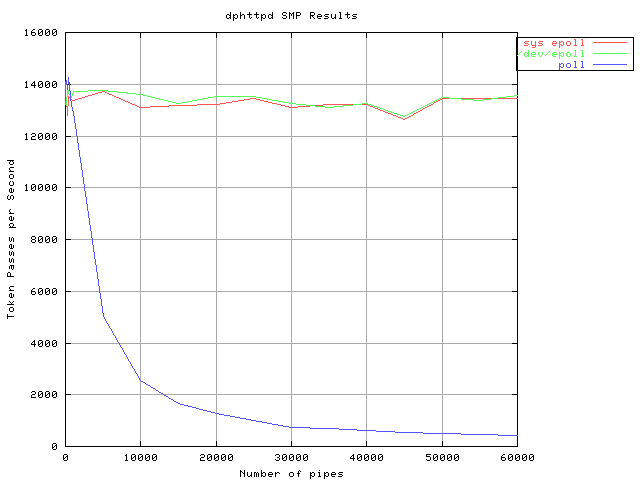
epoll is not the same as poll: Copying data in and out of the kernel costs a lot, as can be seen by any comparison of the two, e.g. [3]
Also worth noting: Felix observes[4] SIGIO is as fast as epoll.
> I don't see how one could do it more efficiently
Dereferencing the pointer causes the CPU to stall right after the kernel has transferred control back into user space, while the memory hardware fetches the data at the pointer. This is a silly waste of time and of precious resources, considering the process is going to need the file descriptor and it's user data in order to schedule the IO operation on the file descriptor.
In fact, on Linux I get more than a full percent improvement out of putting the file descriptor there, instead of the pointer, and using a static array of objects aligned for cache sharing.
For more on this subject, you should see "what every programmer should know about memory"[4].
Thanks for the info. Yes I suppose zero-copy can be made to work but surely one needs to go through a LOT of trouble to make it work.
I'm curious about sending data for TCP through, don't you need to have the original data available anyway, in case it needs to be retransmitted? Do the overlapped TX operations (on Windows) complete only once the the data has also been acked? Are you expected to do multiple overlapped operations concurrently to prevent bad performance due to waiting for ack of pending data?
Windows was designed for an era where context switches were around 80µsec (nowadays they're closer to 2µsec), so a lot of that hard work has already paid for itself.
> don't you need to have the original data available anyway, in case it needs to be retransmitted? Do the overlapped TX operations (on Windows) complete only once the the data has also been acked?
I don't know. My knowledge of Windows is almost twenty years old at this point.
If I recall correctly, the TCP driver actually makes a copy when it makes the packet checksums (since you have the cost of reading the pages anyway), but I think behaviour this is for compatibility with Winsock, and it could have used a copy-on-write page, or given a zero page in other situations.
And Solaris, (unlike Linux historically at least), supports async I/O on both files and sockets. Linux (historically) only supported it for sockets. I have no idea if Linux generally supports async I/O for files at this point.
Let me rephrase it: there is nothing on any version of UNIX that supports an asynchronous file I/O API that integrates cleanly with the file system cache -- you can do signal based asynchronous I/O, but that isn't anywhere near as elegant as having a single system call that will return immediately if the data is available, and if not, sets up an overlapped operation and still returns immediately to the caller.
They're called threads. Overlapped I/O on Windows is based on a thread pool, which is why you can't cancel and destroy your handle whenever you want--a thread from the pool might be performing the _blocking_ I/O operation, and in that critical section there's no way to wake it up to tell it to cancel. Just... like... on... Unix.
The difference between Windows Overlapped I/O and POSIX AIO is that on Windows it's a black box, so people can pretend it's magical. Whereas on Linux there hasn't been interest (AFAIK) to merge patches that provide a kernel-side pool of threads for doing I/O, and the decades-long debates have spilled out onto the streets. If you view userspace code as somehow inelegant or fundamentally slow, then of course all the blackbox Windows API and kernel components look appealing. What has held Linux back regarding AIO is that Linux (and Unix people in general) have historically preferred to keep as much in userspace as possible.
This is why NT has syscalls taking 11 parameters. In the Unix world you don't design _kernel_ APIs that way, or any APIs, generally. In the Unix world you prefer simple APIs that compose well. read/write/poll compose much better than overlapped I/O, though which model is most elegant and useful in practice is highly context-dependent. As an example, just think how you'd abstract overlapped I/O in your favorite programming language. C# exposes overlapped I/O directly in the language, but doing so required committing to very specific constructs in the language.
As for performance, both Linux and FreeBSD support zero-copy into and out over userspace buffers. The missing piece is special kernel scheduling hints (e.g. like Apple's Grand Central Dispatch) to optimize the number of threads dedicated per-process and globally to I/O thread pools. But at least not too long ago the Linux kernel was much more efficient at handling thousands of threads than Windows, so it wasn't really an issue. That's another thing Linux prefers--optimizing the heck out of simpler interfaces (e.g. fork), rather than creating 11-argument kernel syscalls. IOW words, make the operation fast in all or most cases so you don't need more complex interfaces.
The difference between Windows Overlapped I/O and POSIX AIO is that on Windows it's a black box, so people can pretend it's magical.
No. The difference is that in Windows you can check for completion and set up an overlapped I/O operation in one system call. Requiring multiple system calls to do the same thing means more unnecessary context switches, and the possibility of race conditions especially in multithreaded code. That and, as trentnelson stated, the Windows implementation is well integrated with the kernel's filesystem cache. Linux userspace solutions? Hahaha.
Supplying this capability as a primitive rather than requiring userland hacks is the right way to do it from an application developer's perspective.
As load increases, polling in Unix asymptotically approaches one additional syscall per thread for any number of sockets. That's because a single poll returns all the ready sockets--you're not polling each socket individually before each I/O request[1]. That means if your thread has 10,000 sockets, the amoritized cost per I/O operation is <= 1/10,000th of a syscall.
As for IOCP being "well integrated", what does that even mean? In Windows when file I/O can't be satisfied from the buffer cache, Windows uses a thread pool to do the I/O (presuming it just doesn't block your thread; see https://support.microsoft.com/en-us/kb/156932), just like you'd do it in Unix. There's nothing magical about that thread pool other than that the threads aren't bound to a userspace context. Maybe you mean that the kernel can adjust the number of slave threads so that there aren't too many outstanding synchronous I/O requests? But the Linux I/O scheduler can implement similar logic when queueing and prioritizing requests. It's six of one and a half-dozen of the other.
[1] At least, assuming you're doing it correctly. But sadly many libraries do it incorrectly. For example, I once audited for a startup Zed Shaw's C-based non-blocking I/O and coroutine library. IIRC, he had devised an incredibly complex hack to fallback to poll(2) instead of epoll(2) because in his tests epoll(2) didn't scale when sockets were heavily used; he only saw epoll scale for HTTP sockets where clients were long-polling. But the problem was that every time he switched coroutine contexts, he was deleting and re-adding descriptors, which completely negated all the benefits of epoll. Why did do this? Presumably because to use epoll properly you need to persist the event polling. But if application code closes a descriptor, the user-space event management state will fall out of sync with the kernel-space state, which is bad news. He tried to design his coroutine and yielding API to be as transparent as possible. But you can't do that. Performant use of epoll requires sacrificing some abstraction, similar to the hassles IOCP causes with buffer management.
The benefit of IOCP isn't performance--whether it's more performant or not is context-dependent. The biggest benefit of IOCP, IMO, is that it's the defacto standard API to use. You don't need to choose between libevent, libev, Zed's Shaws library, or the other thousands of similar libraries. On Windows everybody just uses IOCP and they can expect very good results.
The myth that IOCP is intrinsically better, or intrinsically faster, is a result of what I like to call kernel fetishism--that things are always faster and better when run in kernel space. But that's just a myth. IOCP nails down a very popular and very robust design pattern for highly concurrent network servers, but it's not necessarily the best pattern. And sticking to IOCP imposes many unseen costs. For example, it makes it more difficult to mix and match libraries each doing I/O because when you're having to juggle callbacks from many different libraries your code quickly becomes obtuse and brittle. It also demands a highly threaded environment with lots of shared state, but that likewise leads to very complex and bug prone code.
It's only the right way to do it from an application developer's perspective if the behaviour of the official OS-approved interface matches what their application needs, which is unlikely to be the case here. For example, according to https://support.microsoft.com/en-us/kb/156932 there's a fixed-sized pool of threads used to fetch data into cache to fill async I/O requests. If you try to have too many async I/O requests for the number of threads (which can be as small as 3) the excess are automatically converted into synchronous, blocking requests. This renders the API useless for something like an event-driven web server, because any file I/O call could block the main thread until it completes.
(Also, curiously when the data's in the cache that page shows a performance penalty for async reads that complete synchronously from the cache compared to sync reads. Wonder why.)
I've never had a single issue with "async things suddenly becoming synchronous which blocks the main thread" -- if you architect things properly that just never happens, blocking operations are off the hot path, and when you absolutely must block, IOCP's concurrency self-awareness kicks in and another thread is scheduled to run on the core, ensuring that each core has one (and only one) runnable thread.
> (Also, curiously when the data's in the cache that page shows a performance penalty for async reads that complete synchronously from the cache compared to sync reads. Wonder why.)
Because a synchronous operation is always faster than an overlapped operation if it can be completed synchronously.
Lots of stuff happens behind the scenes when an overlapped operation occurs.
Your rephrasing still doesn't matter, Solaris event ports are not signal-based.
My understanding is that Solaris event ports were intended to offer equivalent functionality to Windows' I/O completion ports, so this should not be surprising.
Solaris also has its own native async I/O API in addition to supporting POSIX async.
Heh, 10 years old, original link doesn't work, image is tiny. And it sounds like they were comparing Linux and Apache to IIS and Windows.
It's hard to evaluate this in any way more than "yeah that's a cute spaghetti diagram". If I wanted to drag Linux through the mud visually I'd depict how much time every socket I/O op spends in vfs/fsync stuff. (i.e. you can depict anything to make your point)
That might be a cool diagram to show! I honestly know nothing about kernel programming, just happened to come across that a long time ago and bookmarked it.
The second image is of IIS running on Windows, not Apache. Different software on different OSes. Regardless, it doesn't seem like parent is making the argument that the NT kernel isn't complicated - just that it is superior.
It is more complicated because -- surprise -- I/O usage patterns do not fit in one neat little box, and you have to provide special handling of special cases that do occur frequently in the real world.
I was fascinated by BeOS in the late 90s when I had a lot of enthusiasm (and little clue). All their threading claims just sounded so cool. I was also really into FreeBSD from around 2.2.5 so I got to see how all the SMPng stuff (and kqueue!) evolved, as well as all the different threading models people in UNIX land were trying (1:1, 1:m, m:n).
NT solves it properly. Efficient multithreading support and I/O (especially asynchronous I/O) are just so intrinsically related. Trying to bend UNIX processes and IPC and signals and synchronous I/O into an efficient threading implementation is just trying to fit a square peg in a round hole in my opinion.
As for reading list... I've bought so many old books lately. Here's my "makes the short list" bookshelf: http://imgur.com/DfTUVQx
Lol, I've been saying something like this for some time.
Thanks for the answer. I guess what I'm interested is somewhat obscure/historical operating systems and also HW that are in some way superior to currently popular solutions. The more comparative the better.
Also your reading list has quite a few Oracle SQL entries so I'm guessing it's your preferred DB of choice. What features are you using that aren't available in MySQL or Postgres?
As far as commercial vendors go I really preferred SQL Server from about version 2000 onwards. I got into Oracle again recently for a consulting project with a finance client (who basically have unlimited Oracle licenses) and really quite enjoyed it since the Oracle 7/8 days.
You can do some phenomenally sophisticated things... I extensively leveraged things like partitioning, parallel execution (dbms_parallel_execute!), lots of PL/SQL using the pipelined table cursor stuff, data mining stuff (dbms_frequent_itemset!), index-organized tables, and my god, bitmap indexes were a godsend, direct insert tricks for bulk data loading, external tables were fantastic (you can wrap a .csv in an external table and interact with it in parallel just like any other table -- great for ingesting large amounts of janky .csv data from other parts of the business).
The parallel execution and robust partitioning options were probably the most critical pieces that have no particularly good counterpart in open source land.
They also have a text mining engine which lets you dump almost any filetype in the database and do sophisticated full text queries, including generating html snippets with highlighted matches. And they have a native column type for storing geometry, so you can do geometric queries and aggregates, for which they then also have a web viewer engine with tiled maps support, so you basically have the core of a GIS engine. There's a ton of cool stuff in there, I haven't even looked at half of it.
Oh man how did I forget the geo stuff! I used that extensively! The custom indexes that could do lat/lon proximity joins! And yeah the text mining stuff is great as well. (Ugh, I've forgotten so much already -- such a shame.)
I always thought the external table functionality was a terrible idea, but if the use case is just for import that's more reasonable. Don't you like SQL*Loader or something ;)
It's great when you need to whip something up quickly. My workflow was to create foo_ext, poke around at the data and get some sensible column defaults, then `create table foo select * from foo_ext`. Worked really well, especially for once-off or infrequent stuff.
For batch-oriented stuff where you're getting pretty consistent data at a regular interview I'd go with SQL*Loader.


Side-by-side, comparing VMS to UNIX, and VMS's approach to a few key areas like I/O, ASTs and tiered interrupt levels are simply just more sophisticated. NT inherited all of that. It was fundamentally superior, as a kernel, to UNIX, from day 1.
I haven't met a single person that has understood NT and Linux/UNIX, and still thinks UNIX is superior as far as the kernels go. I have definitely alienated myself the more I've discovered that though, as it's such a wildly unpopular sentiment in open source land.
Cutler got a call from Gates in 89, and from 89-93, NT was built. He was 47 at the time, and was one of the lead developers of VMS, which was a rock-solid operating system.
In 93, Linus was 22, and starting "implementing enough syscalls until bash ran" as a fun project to work on.
Cutler despised the UNIX I/O model. "Getta byte getta byte getta byte byte byte." The I/O request packet approach to I/O (and tiered interrupts) is one of the key reasons behind NT's superiority. And once you've grok'd things like APCs and structured exception handling, signals just seem absolutely ghastly in comparison.