The difference is a little less shocking when you adjust for crime rates. E.g. we have about 8-10x higher incarceration rate of Germany, but we also have more than 4x the murders per capita. (And the chicken came before the egg here. Violent crime started going up in the 1960s, but it wasn't until the late 1990s that the incarceration rate had gone up by the same proportion as the violent crime rate.)
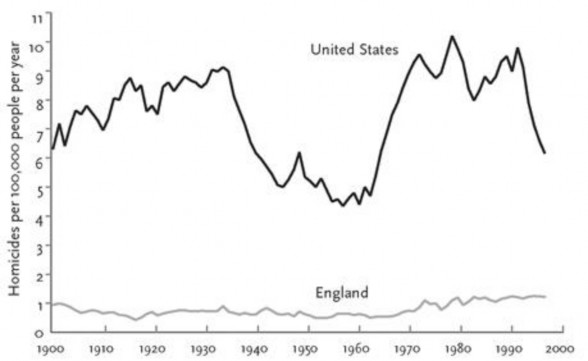
Americans aren't very generous when it comes to crime. In many European countries, even murder carries only about a 10-15 year sentence. On the other hand, I wonder if that's a product of our situation. The United States is fantastically violent in comparison to Europe, and always has been: http://ourworldindata.org/wp-content/uploads/2013/03/homicid....
E.g. Berlin is slightly bigger than Chicago. In a typical year, it might have 60-70 murders. Chicago in comparison had well over 700 this year. You can't look at the criminal justice system in the U.S. relative to our more enlightened European counterparts without keeping in mind that difference.
> The United States is fantastically violent in comparison to Europe, and always has been
Homicide != all violence. The US in fact is not fantastically more violent than Europe outside of the murder rate, which is primarily made possible by the mass distribution of guns. Europe today has twice the non-homicide crime rate that the US does. Europe's largest nation - Russia - has a homicide rate over three times that of the US.
"Contrary to common perceptions, today both property and violent crimes (with the exception of homicides) are more widespread in Europe than in the United States, while the opposite was true thirty years ago."
"In 1970 the aggregate crime rate in the seven European countries we consider was 63% of the corresponding US figure, but by 2007 it was 85% higher than in the United States."
> (And the chicken came before the egg here. Violent crime started going up in the 1960s, but it wasn't until the late 1990s that the incarceration rate had gone up by the same proportion as the violent crime rate.)
Did the incarceration rate for violent crime go up, or was it the total incarceration rate due to e.g. increased prosecution of drug arrests? If it's the former, then it's great that more violent criminals are being caught and sentenced, but if it's the latter then it's just compounding the problem.
Even if we released all drug prisoners, the incarceration rate would only be about 15% lower: http://fivethirtyeight.com/datalab/releasing-drug-offenders-.... Meanwhile, it's about 6-7 times higher than what it was in the 1960s. Thus, almost all of that growth was not from drug offenses.
It's not necessarily "great" that more violent criminals are being caught and sentenced. Many European countries manage just fine having e.g. 10-15 years maximum even for murder. Which is why I find the drug thing to be so frustrating. Drugs are not the major issue in the prison system. The real issue is whether just locking people up as a response to high crime rates actually works or not.
That's true, but the story is not that incarceration still exists, but to dispense with the argument that increased incarceration is necessary to reduce the crime rate.
I know, I'm just pointing out that the article said the opposite, ie not that longer sentences will lead to less crime, but that shorter sentences don't lead to more crime. Just picking nits.
Perhaps a measure way out on the tail of a distribution can revert most of the way toward the mean without significantly affecting other, nonlinearly correlated measures? In that case, even the grimmest nightmares of racists and prison guard unions could still come to pass, just not yet...


1. https://en.wikipedia.org/wiki/United_States_incarceration_ra...
2. https://www.washingtonpost.com/news/fact-checker/wp/2015/07/...