I can believe that's their goal: I see little reason to believe they'll succeed in it, beyond making the market a bit bigger than the current taxi/minicab market.
Just because they're very good at supplying an unlicensed minicab service (apparently subsidised by VC money in many areas) doesn't mean they can (i) run a minicab business at a profit so much more efficiently than every other minicab business in history that the average American decides they can sell off their four-wheeled status symbol and commute in a surge-priced Uber or (ii) compete with the manufacturers in supplying self driving cars on demand, whilst likely operating at a huge disadvantage in vehicle acquisition and maintenance costs
I just signed up for the 4 weeks of flat rate uber pool in NY. $89 and you can use Uber Pool as much as you want for free between 6am and 8pm inside Manhattan.
Previously I would spend $117 in a monthly metrocard.
I know several friends in San Francisco that got rid of their cars for Uber. They spend about $500/month on Uber. Owning a car in SF is more expensive than that: monthly parking, insurance, parking where your destination is, gas, etc.
at the very least their drivers will still own cars.. if buying a car is all of a sudden not normal, then it would cost A LOT to become an Uber driver.
Car ownership is already not necessary. Both Uber and Lyft offer a car "rental" or leasing program where you will be given a car to use for the job for a fee which will be waived or reduced if you drive enough and do enough business with the car. They profit off of this or at least recoup money if you fail to hold up your end of the contract or in certain cases, you pay for the mileage you drive outside of work hours. This drastically reduces the capital necessary to start driving for these companies.
either way this drives up cost because it raises the amount a driver must make a month. obviously we dont have concrete numbers but if people are switching to uber only they probably would want to save a lot every month versus owning a car.
Can't say I speak for everyone but I mostly walk to get to places and drive when I have to. I live close enough to an ALDI to get most of my groceries by walking and I can walk to work too.
Owning a car means always needing a parking space, going out to get gas, paying for insurance, inspections, etc, having to be capable of driving (because when I'm sauced on a Saturday night I really want to get greasy food, but I can't drive soooo...).
If an autonomous car-share program cost about as much as the car payments and gas alone for the the amount we would use it, we would sell our car in a heartbeat. A car isn't much of a status symbol when most of your friends can't afford a nice one either. Kinda makes you look like a dick, in comparison.
The thing is that this is really only true for people in dense urban environments. For instance, parking is not an issue in suburbia. There are use cases, like getting from your home to the train station, but it's not nearly as universal as it is for people who can currently get by with no car at all.
I think you're being too kind to the parent. This is true for a very small subset / archetype of people. The majority of the country has much different situations and desires than just walking to ALDI.
Had to lookup ALDI on youtube.
Their logo looked familiar to Hofer brand, then I found the wiki explanation. Aldi Süd operates as Hofer in Austria and Slovenia.[1]
They're a different branch of the family that owns Trader Joe's. In the US they're a super-discount food store--think in terms of a strategy for a limited inventory of canned goods and things in that vein intended to undercut Walmart.
I agree - car ownership is expensive. So we get by mostly on our bikes. Reasons we still have a car:
- Moving big things
- Shopping for big things
- Camping
- Driving out for the weekend to visit family 1.5 hours out of town
- Baby in baby seat
None of these things can easily be targeted by Uber. I rarely use taxis and uber, and my friend's that do, use it as replacement for public transport and not their car.
> A car isn't much of a status symbol when most of your friends can't afford a nice one either. Kinda makes you look like a dick, in comparison.
Isn't that exactly what makes it a status symbol? Keeping up with the Joneses, and all -- it's one thing to not play the game, but that doesn't mean a lot of people don't, and this seems to just be agreeing with what makes it a status symbol.
Most American cities are sufficiently un-dense that things like "always having to look for parking" aren't big deals. Laws ensure places have enough spaces (these policies are very pedestrian-unfriendly, but such places are more car-friendly than the dense coastal cities). Traffic is slower at rush hour but a non-issue any other time in these places.
The average car these days lasts 10+ years. Perpetually renting cars is going to be seen as disadvantage for a lot of people who take out ~5 year loans and then can keep the cars for quite a while after finishing off their payments. Anecdotally I'd wager that people buy new cars more for the status, or for the change of having something new, than to replace something that just doesn't work anymore, nowdays.
> > A car isn't much of a status symbol when most of your friends can't afford a nice one either. Kinda makes you look like a dick, in comparison.
> Isn't that exactly what makes it a status symbol?
To be an effective status symbol, something has to be of higher status, but not too high a status. Gold chains are just gauche, despite how valuable they are. So too, once upon a time, having a cell phone.
I think the tricky part there is social context. There are social groups where gold chains are absolutely status symbols. You'd be hard-pressed to find an NFL receiver without one, for instance.
Conversely, there are groups where being able to afford _not_ to own a car is a status symbol. Think "I live in a neighborhood where everything is walkable", or "I just throw money at Uber because it's easier and I can afford it".
Anything is a potential status symbol, if a group subconsciously agrees that it is. If your group doesn't value humility then too-high-status isn't really a thing.
New cars and executive cars and ludicrously thirsty sporty models sell well enough and secondhand Korean superminis badly enough to suggest manufacturers don't have too much to fear from people switching to alternative modes of car use on the ground of price. (I'm sure you could find a cheaper-to-run vehicle if you really wanted to too)
And for commuters that need a car to get them to work at 8-9am and home around 5-6pm, the chance of a car sharing scheme working out cheaper than ownership is minimal, whether the cars drive themselves or not.
What about when your commute, without any concern for parking, is 10 minutes, max? I doubt it would be that expensive. Besides, I would only opt for transport if the weather was shitty or I was tired (which is the current case today).
> What about when your commute, without any concern for parking, is 10 minutes, max? I doubt it would be that expensive
If you want a car at the precise time everybody else happens to be commuting and commuters are the principal users of on-demand car services, it doesn't really matter whether your commute is shorter than some of the others. It's one extra car needed to be available every day at the time when all the other cars happen to be in use and (like most of the rest of the cars in the commuter pool) it'll spend the rest of the day sat in a parking spot, costing little in mileage but plenty in depreciation.
Of course if commuters needing to be around for the start of a normal work day aren't the principal user of the service, then cars can be used more efficiently throughout the day, but then they're not "competing with private car ownership" to any significant degree.
For edge cases like you whose car use consists of occasional ten minute drives, it might already be cheaper to just take taxis/Ubers
I'd think self driving cars would kill busses. I'd much rather nap / work / watch TV / do hobbies in my car (where I'd keep stuff for doing all that), then in a bus.
If the car is electric, it isn't so bad on the environment, and it can park itself in a no humans allowed garage (so little chance for breakins). As for rush hour, I'd hope swarm scheduling lowers congestion substantially (though this and making longer commutes tolerable really just means I'll live further from work).
Lol, that is highly unrealistic. Where is this magical secure garage going to come from? Underground parking costs $40k per spot to build, above ground is similar. Add in the cost of security and the long term costs of parking are extremely high. The parking minimums in most places force parking to be heavily subsidized, which isn't a sustainable model when it comes to long term matienece of suburban areas, unless we can heavily increase taxes to pay (5x to 6x) for road, water, sewer, and all other maintenance needed.
> high bandwidth vehicles will do the bulk of the work, and seamlessly trade off to "last mile" self driving small vehicles.
Still doesn't solve the problem - just moves it. If everyone in my office complex needs a ride to the bus around 5pm, and everyone at the other end of the bus line needs a ride home at 5:42pm when the bus arrives in SuburbTown, there will still be unmanageable shortages of self driving small vehicles - unless you own your own.
You can fit 4 people in a self driving car pretty easily. Most people currently drive by themselves because it's too difficult to arrange on-demand carpools on your way to/from work.
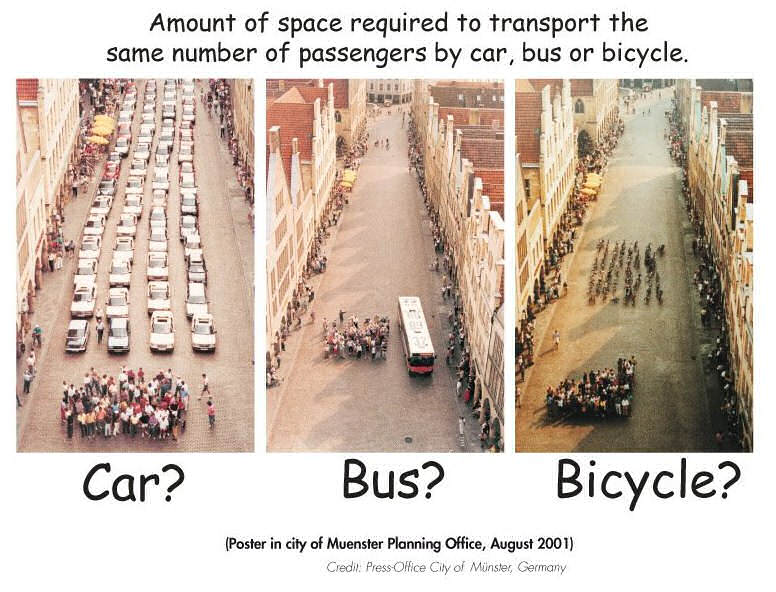
Space on the road is the limiting factor in this scenario, not number of vehicles. What would the point be of making another vehicle available, if traffic is bumper to bumper all the way?
> In a self driving world, peak traffic will be served by buses
Huh? If suburban Americans aren't opting to share rides into work now and don't have or want bus services now, particularly not connecting bus services, what difference is non-human drivers going to make?
>what difference is non-human drivers going to make?
That's really the key point. Not that roboTaxis are on the near horizon but, if you believe they'll change everything when they arrive, you basically need to point to all the cases that today are almost (but not quite) enabled by Ubers driven by minimum wage drivers.
Do Zipcar and Uber make a difference on the margins? Sure. I know people in fairly dense non-NYC urban area that probably would still have ended up with a car 10 years ago who can get by without one today. But there's a big difference between change at the margins and fundamental shifts.


Just because they're very good at supplying an unlicensed minicab service (apparently subsidised by VC money in many areas) doesn't mean they can (i) run a minicab business at a profit so much more efficiently than every other minicab business in history that the average American decides they can sell off their four-wheeled status symbol and commute in a surge-priced Uber or (ii) compete with the manufacturers in supplying self driving cars on demand, whilst likely operating at a huge disadvantage in vehicle acquisition and maintenance costs