"... While it is true that various factors contributed to phenomenal growth of the suburbs between 1945 and 1960, historians have thus far paid little attention to policymakers' fears of atomic attack as a significant factor in population dispersal. ..."
The Reduction of Urban Vulnerability: Revisiting 1950s American Suburbanization as Civil Defence K. Tobin, Pages 1-32 | Published online: 06 Sep 2010
I work in tech/finance. I am old enough to remember that, after the 9/11 attack in 2001, banks were required to set up their datacenter/DR sites at least 50 miles away from their main offices to avoid a complete wipe-out in case of nuke attack.
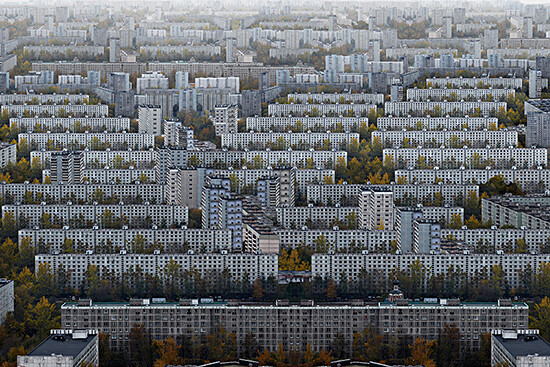
Moscow is also tremendously dense. It's sprawled out because it has so many people in it, but the vast majority of those people are packed into apartment buildings. The same goes for all other major urban centers. A typical Russian (or rather, ex-Soviet) cityscape looks like this, and can go for miles:
Now imagine an airburst nuclear explosion over this, just low enough to maximize the blast wave.
There's a reason why Soviets heavily invested into protecting the populace from such attacks - the entire Moscow Metro system doubles as a nuclear bomb shelter, complete with blast doors.
Federal Highways in the US are designed to increase national security. The best example is certain bridges are in certain places so that their destruction would cut off the easy path for mobilized enemy armor. They're designed to be easily blown up on purpose.
You got any credible sources on that? It sounds like one of those urban legends that people like to repeat. The Eisenhower interstate system was built in a post-nuclear world, and in a post-nuclear world it's hard to imagine there ever being a mainland invasion of the United States. The bombs would be flying before that, and there wouldn't be anything left worth invading (on any side in the conflict). Being able to utterly destroy the other nation and its military forces within minutes by launching thousands of ICBMs is a much more credible plan of war than blowing up some random bridges on your own turf, and indeed that is the logical course of action that we did go down.
I don't know about the bridges specifically, but that the interstate system had an explicit national security purpose is not just well-documented, it's literally right there in the name of the law that created it: National Interstate and Defense Highways Act.
My issue with the bridge thing is that it's easy enough to blow up bridges, especially as you're retreating from the territory they're in, regardless of their location or construction. It could cost billions of extra construction dollars to unnecessarily site a bridge in anything but its obvious ideal location (e.g. the shortest possible span).
My understanding was that it was created to mobilize the military and transport resources across the continent, not to make it easy to cut off enemy routes.
Now this is a lot more true, and the military value of having good transportation within the boundaries of your own land has been known since at least Roman times, and likely much farther back.
It doesn't explain the bridge blowing up thing, however.


Sounds like a completely made-up justification after the fact.
Surely someone would have raised the point that the soviet union could just launch it's missiles in the middle of the work day.
Also, Moscow is tremendously sprawled out.