It should scare you. The EU just used their regulatory power to force the world's biggest search engine to make their user experience worse in order to benefit other companies. Before Google penalized all the vertical search sites, doing a Google search for certain kinds of products was a terrible experience; page after page of crappy information-free autogenerated sites hoping to make $$$ from ads and referral fees that were SEO-optimized to the gills, making it impossible to find actual information.
Not only that, but the specialized infoboxes at the top of Google's search results were an almost direct response to their competitor Microsoft doing exactly the same thing and promoting it at the main advantage of their search. Microsoft's comparison shopping subsidiary which they used for their search results was one of the companies complaining to the EU about this. Now that Microsoft have convinced the EU to ban Google from doing this, they can once again point to the fact that they offer this extra contextual information as a reason for using them and Google cannot compete.
There's a clear difference between what Bing and Google are doing. Please don't mistake the facts:
1. The EC is not asking Google to make their user experience worse.
2. The EC does not have a problem with sponsored search results.
Google's user experience is the generic algorithm that determines what is the most relevant result. Google deliberately did not subject its own comparison shopping service to that algorithm while subjecting competitors' to it. Furthermore, Google took the FIRST result position.
Why would they do this if they have the best user experience and it should come up first anyways?
Contrast with Bing, when I search for "baseball bat": The first 3 results above the fold are organic unpaid SERPs. (Nothing from Bing in the top three spots.) And their shopping ads are displayed to the right of the organic search results.
If Google would've treated these products like ads, then the EC wouldn't have had a problem. But they didn't. And they have a dominant share of the general internet search market.
Google deliberately tried to exploit its market dominance to enter into another market in which it was not competitive.
I worked at Bing in a previous life. As far as I know it was official policy that internal results would not be artificially boosted but had to be subject to the same ranking algorithm as anything else.
The problem with these rules that they are not precise. The right approach would be to let the court order a company and give enough time to comply and if they still don't, then fine.
Or you should be happy, that the EU actually uses their regulatory power to benefit the consumer no matter how big the company they're going against is.
Does it benefit the consumer though? I fail to see how showing links to search results pages from other companies in response to a product query is better for consumers than just showing them a listing of the products they actually searched for.
[Google's response][1] to this ruling suggests they have data which confirms this:
> While some comparison shopping sites naturally want Google to show them more prominently, our data shows that people usually prefer links that take them directly to the products they want, not to websites where they have to repeat their searches.
As a consumer, I have (much) more trust that my interests are advanced by the EU than google.
This is an opinion which I don't feel the need to convert anyone to but I really don't understand the opposite view. Can someone explain why they believe google and other "emerging" power centers saveguard their interests better than the EU?
This. Google's data just shows their interests happen to align with "what people usually prefer" this time, but we know that is not what motivates google. Not at all.
They have acted against "what people usually prefer" many, many times before when it was beneficial to their own interests.
Additionally, "what people usually prefer" is completely orthogonal to the EU antitrust ruling, which is about holding companies responsible for the power that comes with market dominance.
Companies don't really have ethics or humanity (the way people do), unless we force them to. "We" in this case refers to the whole of society, including the people making up the company. In particular as companies grow very large, even if the people making up the company are ethical, humane and good, THEY are still tasked to wrangle a wild beast that is mostly just hungry for profits, and try to steer it to do Good and not Bad because it doesn't see there is a difference. But even then, they can use help from the rest of society, and regulations can be part of this help.
Personally, as an EU citizen, I don't believe that Google is advancing my interests and rights, but I also don't believe that the EU commission dictating what Google can or cannot do based on who is lobbying and how much money is at stake has the consumer's best interests in mind. To me these fines seem motivated by money, not consumer rights.
+1. While adding billions to their coffers may not be the motivation, there's a ravenous appetite to figure out how to distribute wealth of this obscenely rich generation of multinationals. This reeks of an ineffectual political institution grasping for one of the few solutions it can implement.
on what is this based.
the EU commision distroyed roaming between EU members, and im pretty sure they had all the lobiying from mobile operators to not do it.
That's not what democracy is. Also the EU has been shamed as undemocratic since their representatives are not elected by popular vote. People do vote for who represents them as a country in the EU but I doubt any of them had a choice in the Google fine.
It's actually called authoritarianism - when pushing what government wants violates other people's rights to do business as they please even if it isn't criminal activity.
People like the guy you replied to would only start to question things, once the EU decides they cannot keep working the way they want to.
They live under some sort of bubble of selfishness, where they believe others have to change in order to do to what is best for them. Guess what, as long as Google is committing no crime, why should them?
Can someone explain why they believe google and other "emerging" power centers saveguard their interests better than the EU?
1. Because it's in their long term best interest to have a customer for life (No political cycle) so they are more incentivized than a politician would be to support the interest of the consumer.
2. They have a more insight into user desires and actions on a day to day basis, meaning they can predict and "nudge" users in directions that are mutually beneficial.
Re: 1) You might think that is in Google's best interest - but I'm not sure most previous behavior with handling anything from usenet (Google groups), via the rss reader through any number of other services Google has mismanaged or shut down.
It's in Google's best interest to make money. A large userbase and ubiquitous brand is part of that. User happiness is only one possible means to that end.
Finally, you seem to think that search users are Google's customers - as they don't pay anything to Google, they are a resource, or product - not a customer.
Google search is a loss-leader for Google ads - if there's no competition (say paying for product placement at these other sites) - Google gets a bigger share of the ad revenue.
I don't see what magical mechanism there is that would strongly push Google to care for the Google search users "best interest".
Finally, you seem to think that search users are Google's customers - as they don't pay anything to Google, they are a resource, or product - not a customer.
That set of users though is what this whole action from the EU is trying to protect. It's only marginally about the other businesses - the end goal is making sure the population of the EU is benefiting.
To that end I have yet to see where or how Google has proven they have the population's interest at mind than the government itself. Google has a much better track record than any government does at listening to the majority of a population's demands based on their behavior (yes even with the deprecation of groups/reader etc...) and responding with their products.
The EU or any other government does less for the population (relative to capabilities, obviously Google doesn't pave roads yet) than Google.
> (...) systematically favouring its own comparison shopping product in its general search results pages. The Commission's preliminary view is that such conduct infringes EU antitrust rules because it stifles competition and harms consumer (...)
> (...) [Google] may therefore artificially divert traffic from rival comparison shopping services and hinder their ability to compete on the market. The Commission is concerned that users do not necessarily see the most relevant results in response to queries - this is to the detriment of consumers, and stifles innovation.
The EU is concerned with regulating the market to favour competition. It's true the underlying implication is that a Free market is a Good market - and so by defending completion it's theorised that the consumer profits. (in my opinion that's a non-seqitor - but that's the principle underlying the EU).
Now you could argue for other models, claiming that the proletariat will be better off - under a strict redistribution model, under an unregulated market, under a monopoly - but don't put EU's cart in front of the horse: it has one principle, a regulated free market.
And I'm saying that not only does the government have a terrible track record, there is no evidence that this actually makes any difference to competition. All it does is show that the government can throw their "weight" around.
Nothing in the historical record of antitrust should make us confident that the court’s dismemberment of one of the most successful companies in history would increase competition.[1]
I'm against a free market precisely because the governments of Europe have a great track record in the periods they've adhered to "true" labour/socialist values. Universal healthcare, universal access to education, help with housing, regulations on the labour market - all things that have greatly improved lives of consumers.
Centralised power generally means a departure from direct democracy, and that's one reason why I'm not a fan of the EU.
For a great view into why a regulated market might just be better than an unregulated one, have read of:
Google users are not (in most cases) their customers but a product Google sells to their actual customers.
Google long term interest is to increase the margin of their product by increasing their dominance in multiple markets over multiple tiers.
If they do this by using their monopolistic power then they are in violation of the law even when by doing that they provide a service that some of their users see usable.
> Google users are not (in most cases) their customers but a product Google sells to their actual customers.
No, Google users are suppliers of a product (ad views) that Google sells to their customers. But they are suppliers that are paid via in-kind exchange (with Google services) rather than cash, which is exactly equivalent to being customers of Google services that pay with in-kind exchange rather than cash. So, in a very real sense, those users are customers.
Do Google users get slaughtered? I mean, that is why it's undesirable to be a chicken in a chicken farm, right? If it weren't for that, then choosing the farm you are on would be quite the desirable ability.
What if all that happened on chicken farms was one of their feathers got plucked once in awhile?
1) They are a quasi monopoly. The word you use to describe searching on the internet is "googling". Most of the phones on this planet run on their OS. So please...don't fool yourself.
2) Who's creating those desires? You think that the desire for millions of useless shit products that drive the global market are created by some neccesity deeply in our DNA? Or maybe by your free will? Or is this just the ad-industry stealing the attention from you and fitting you into a pretty tight frame of the optimal customer while preaching to you: "everybody/your idol loves this, you have to love it too".
Prediction in the age of advertising is just like advertising itself. A convenient lie.
Ok, and? The idea that monopoly is bad - ipso facto - is silly and monopolistic abuse of consumers is largely theoretical. Governments don't like monopolies because they challenge their power, and don't forget nearly every "bad" monopoly was the result of a government license to monopolize. The whole "Trust Busting" trope that underlies the anti-trust act was not because consumers were being hurt, it was a pissing match between the Government and Northern Securities Company [1]. Milton Friedman covered this well [2]
Who's creating those desires?
Companies, friends, acquaintances, media etc... it's not Google.
Or is this just the ad-industry stealing the attention...
Sure, are we debating the existence of an ad-market or Google? Cause I can assure you an ad market will exist irrespective of whatever Google does.
> Ok, and? The idea that monopoly is bad - ipso facto - is silly and monopolistic abuse of consumers is largely theoretical.
What?! Monopolies always abuse their power because they can. I live in a country where we still feel the bad influence of a former monopolist ISP (Telecom/T-Online). THEIR influence on the government hurts the customer and even customers of other ISPs. It even hurts the tax payer who may not even have internet because his money may flow into subsidies for them. For example: they recently started eating up net neutrality in Germany. Because they can.
One of the most misused powers of monopolies is dictating a price. Just like we had a few months ago also in Germany with the biggest breweries. Millions of customers have been cheated.
IT IS ILLEGAL BEHAVIOR. They pay for this. How you can tell something like that "silly" is beyond me.
You're talking about advertising pushing useless shit on people they wouldn't want? But they don't see the advertising until they've already searched for the item!
That's either some magical advertising that makes people search for things before they've seen it. Or you're wrong.
Or, you know, the intent and nature of most advertising is completely orthogonal to the circumstances and conditions of them appearing, the point stands, and you're not even nearing actually addressing it, just bumping over your own straw man.
And when I google for "an item", like "medium sized dog", for whatever reason that means I already...well, what? Want a dog? Maybe, likely not. Want whatever that particular ad is trying to peddle me with whatever shoddy means and rhetoric, because it might have to do with dogs, or merely claim it does? Nope.
Can you give an unbiased concrete example (eg. tainted baby formula, collapsed bridge, corrupted hard drive from virus) of something that has benefited google to the direct harm of one of it's users?
The biggest argument I've seen is that people don't like that they aggregate the data you give to them.
Really? Nobody benefits from AMP? I mean I get the complaints from developers and publishers, but even on HN I have seen support for AMP.
This goes to the broader point though that Google wants to service the end user better based on their feedback (most sites are too big/load too slowly), so they created something simple that gives end users a faster, better and cheaper (lower mobile data cost) solution.
In fact Google seems to be moving faster here because companies keep creating large websites to serve rich content that users find annoyingly slow.
As a user I like AMP. it loads faster than the normal bloated websites and doesn't freeze my device while megabytes upon megabytes of scripts try to run.
It's not about you and who you trust the most, it's about if this makes sense or not. The EU is not infallible, they are subject to political pressures and there have been enough of that in this case that they started asking the wrong questions and reached the inevitable wrong conclusions, which are easy to welcome since they serve their protectionist instincts.
Google is not a utility, it's not the water company nor the electric company, or even your ISP, it's essentially a website one which you are free to use or not and the price of admission and switching and opportunity costs are nil, same as for all competing websites, so dictating what Google's website can display and declaring it's contents illegal and worthy of billion dollar fines makes zero sense.
No. The cookie notices are the natural consequence of a bad policy driven by a good motivation. Well-meaning but stupid busybodies are cluttering up my world. See also: California prop 65 warnings.
The answer to your question is given by the EC decision:
> There are also high barriers to entry in these markets, in part because of network effects: the more consumers use a search engine, the more attractive it becomes to advertisers. The profits generated can then be used to attract even more consumers. Similarly, the data a search engine gathers about consumers can in turn be used to improve results.
Simply put, the EC believes that Google is a barrier to any viable competition, so there's no ability to develop a competitive service to Google's own.
Sounds like they're punishing commercial success, i.e. the goals of most public corporations.
Search has been Google's core competency since their inception, they were much smaller than the existing Search engines when they started out but were able to create a better product that users preferred and since that time they've been able to amass a wealth of knowledge, experience and resources. Of course any company is going to have a hard time trying to compete with them now, but I don't see why they need to be punished for executing so well on their core mission.
"""Market dominance is, as such, not illegal under EU antitrust rules. However, dominant companies have a special responsibility not to abuse their powerful market position by restricting competition, either in the market where they are dominant or in separate markets."""
It's not about "punishing" but it is about holding dominant companies responsible for handling the great power that comes with this dominance.
Companies don't usually do this by themselves because like you say, their goals are orthogonal to this.
Doesn't mean it's contrary to their goals (which would be "punishing", in a sense), but "commercial success" or profit just isn't a force that drives ethical behaviour and responsibility. It's not. Things would be so much easier if they were.
Well, I believe the court has considered their position and feels that "punishing" google is not a matter of commercial success but of anti trust law (the "companies don't have inner pressure to be moral" argument).
One's opinion as to whether the court is acting in good faith with regards to its mandate is a matter of faith, I'll concede that; I personnaly have more faith in our individual ability to reorient the court/EUs mandate than to exercise pressure on google/corporations who are filling the new power center that comes with the internet and mass information distribution.
Important correction its not the court its the commission. It seems similar to prosecutor handing down the sentence and burden of proof hence falls upon the accused
You mean just like they have forced millions of websites to show the "Warning: This site uses cookies" message (which arguably cost a fortune in compliance costs and user annyoance, but made no difference in the end)?
I would encourage a "follow the money" train of thought when thinking about this.
My question then becomes: if this money (the $2.7bn) did not accrue to the EU, or was not levied at all, do you still think the EU would still pursue this as ferociously as it has, just to protect the consumer?
> I fail to see how showing links to search results pages from other companies in response to a product query is better for consumers than just showing them a listing of the products they actually searched for.
But that is not what google does. I just did a search for "samsung galaxy s8". Instead of the first result being a link to a Samsung page I got 3 results that where ads (one of them being for the new oneplus). How does that match the "show what people searched for"? The results where sorted by "how much money did google receive" instead of "what the user intended".
Regardless of what you're seeing though, ads are a necessary part of Google Search; it's how they make their money. IMO it's a little strange to be complaining that Google is showing you ads in your search results.
I mean, I don't expect Google to show the same results to everyone (this is what I get: http://imgur.com/a/go3pU ). Funny thing is that the results changed between my first and second query (there was another unrelated result before the first link to Samsung).
I'm not complaining about ads and this fine is not about ads. It is about Google favoring Google Shopping links instead of competitors even though Google Shopping was inferior when it started. Google basically pushed their product no matter how shitty it was.
If it were not for Google being a near monopoly in search this would not be a problem, but Google is a monopoly, so special rules apply to them.
It's possible for such tactics to be useful for consumers and still be an illegal use of their dominant market position.
Compare MS and the bundled Internet Explorer: Yes, it was more convenient for people not to be required to download a browser after installing the OS.
But imagine if MS had been successful, and Internet Explorer had emerged as the only browser: Do you think that would have been in the common interest? (hint: around that time, they tried to get .doc established as the standard, replacing HTML)
> Compare MS and the bundled Internet Explorer: Yes, it was more convenient for people not to be required to download a browser after installing the OS.
That was a non-issue, as OEMs were able (and did often) pre-install any number of software packages on top of Windows. The issue was MS telling them "if you preinstall Netscape Navigator, you won't get any more Windows licenses from us". Among other things that were unequivocally harmful to consumers.
In the words of another poster, it sounds MS was punished for being very successful!
The thing about anti-trust is that being a monopoly is allowed. What's not allowed is using a monopoly position to get a large advantage in another market.
I'm not understanding that. You can be very successful without trying to prevent your business partners from making their products better for their clients.
I disagree that bundling IE in Windows harmed customers. If anything, it's silly to insist that an OS shouldn't come with a browser, since practically everyone uses a browser.
What should or shouldn't come with an OS is not up to bureaucrats to decide.
Going back in time, you can just as well argue that bundling Notepad in Windows is "illegal" or "anticompetitive" or what have you because it might have killed the market for third-party text editors.
Isn't one of the big refrains here that competition always benefits the consumer?
This situation makes me think of the larger markets: We're wanting the short term benefit (Google prioritizing their results over others) at the expense of the long term benefit (healthy competition in the travel space).
I fail to see how showing links to search results pages from other companies is better for the consumer either. So why does Google do it?
Google is really smart, right? They've done some amazing things with search. Do we believe that Google doesn't know how to display those comparison search results page in a carousel like their own? Or is it that they don't want to?
Think about it for a second. What if Google did that, and they subjected their own comparison search results page to the same generic algorithm that they subjected everyone else's too?
Maybe it's too hard for Google. But they like standards: see AMP. So why not create some standard tags so everyone has a fair chance?
I don't know, it certainly looks like Google was exploiting its market dominance in general internet search to get a leg up in another industry without actually competing. That's not fair.
I feel it does benefit the consumer. You are assuming that google is going to show me the best search results etc for my query, while in reality they are displaying what suits them and their advertiser better.
Which is great for google, not exactly great for my interests however.
> Or you should be happy, that the EU actually uses their regulatory power to benefit the consumer no matter how big the company they're going against is.
So is the EU going to fine Apple for not allowing iPhone users to access third-party browsers?
At least Google doesn't force any lock-in with their platform here (the browser or search engine) - you're free to use any search engine you want.
I wouldn't be surprised if the commission would take a look at Apple in the future, but note that currently they are not dominant in the mobile market.
It is not platform vs. platform, it is iTunes vs. Playstore (not a monopoly, choice => no action needed) and Google Search vs. nobody essentially (overwhelming dominance, quasi monopoly => action needed).
The infoboxes are, in fact, one of the cases where Google regularly stole work from websites without permission and then denied them ad revenue by ensuring people didn't ever visit those sites to get it: https://theoutline.com/post/1399/how-google-ate-celebritynet...
Also, note that Bing doesn't lock you into their ecosystem in those boxes the way Google does. Take a look at "Uptown Funk":
https://www.bing.com/search?q=uptown+funk
- Places YouTube up top, then links to Groove AND Amazon MP3 (If you search "The Cure Lady Gaga" it also offers iTunes. Apparently it doesn't know that iTunes has Uptown Funk as well. Oops.)
This is a live example of how Google violates antitrust law, but it's competitors do not.
Not necessarily. I read this as saying that if other players have well marked up content, they should have their listings appear in infoboxes, perhaps alongside Google's. Not that the infoboxes be removed.
Pretty sure that's what Google Product Search used to do. They ended up having to change it because the resulting quality of those listings was terrible.
I think that it is a form of protectionism by the EU. The EU does not want American companies to have monopoly in Europe. At one point, EU was giving grants to anyone who can build a competitor to Google. With this and similar rulings, EU is twisting the arms of American companies and making it harder to do business in Europe. This strategy is straight out of the playbook of China.
> The EU just used their regulatory power to force the world's biggest search engine to make their user experience worse in order to benefit other companies.
It's really quite simple, if Google's user experience hinges on them abusing their market dominance then they have no business in the EU.
Even if it means we can't have certain "nice things", I am perfectly okay with that.
Companies have power. Companies with market dominance have a disproportionate amount of power. Why should a company be allowed to wield all that power without being held responsible for it? So if you're gonna be a dominant company in the EU, you're going to have to take responsibility and not abuse your power to stifle competition.
It's not like the "before" situation you sketch couldn't have been improved in any other way. It just so happens that this particular way also ("conveniently") stifled competition in shopping sites by abuse of Google's market dominance in Search.
Why is this bad? Because abuse of market dominance doesn't always result in a better user experience or product. And we can't even be sure that was actually the case now, because of this market dominance, no other company got a chance, the only way was Google.
Also, the problem in your "before" situation was Google serving its users search results that were spammed to death with low quality SEO crap. This was Google's problem (sure it's a really hard problem, but it's theirs). That shit could only thrive because of Google's popularity. Any real competition, like normal price comparison sites, were already suffering because of this (or worse, forced to join this dark side).
The thing is, this problem had nothing to do with the actual competition. But Google chose the solution (abuse market dominance) which drove them into obscurity. Eventually SEO-spammers (whose core business was never price comparison sites) found other ways to game and abuse the system.
If Google would've done nothing, people would have stopped using Google for finding price comparison sites (and back then, Google was really very good for many other things) because the SEO spam isn't useful. Then competing price comparison sites would have had a chance, and who knows, maybe Google's actual web-searching user experience (which is terrible today) would have remained better. I mean that's what we lost when Google tried to become the sites it linked to, instead of helping people find them. Not saying this would be the only solution, it's obviously not as profitable as Google has been while abusing their market dominance, maybe they could have found something responsible in between.
Also, we gotta be consistent. If the EU Commission on antitrust could say "we'll allow it this time because we kinda like the end result", THEN you should be scared, really really scared. Arbitrary application of the law is very bad, every time you encounter it, no matter what.
The Commission established that they've been abusing their market dominance since 2011 (or 2008). Market dominance put Google in a special position of responsibility, they are now being held to that.
This is a complete false equivalence. If placing Google's own shopping results in the top spot improves user experience to that extent, they could and should do it organically.


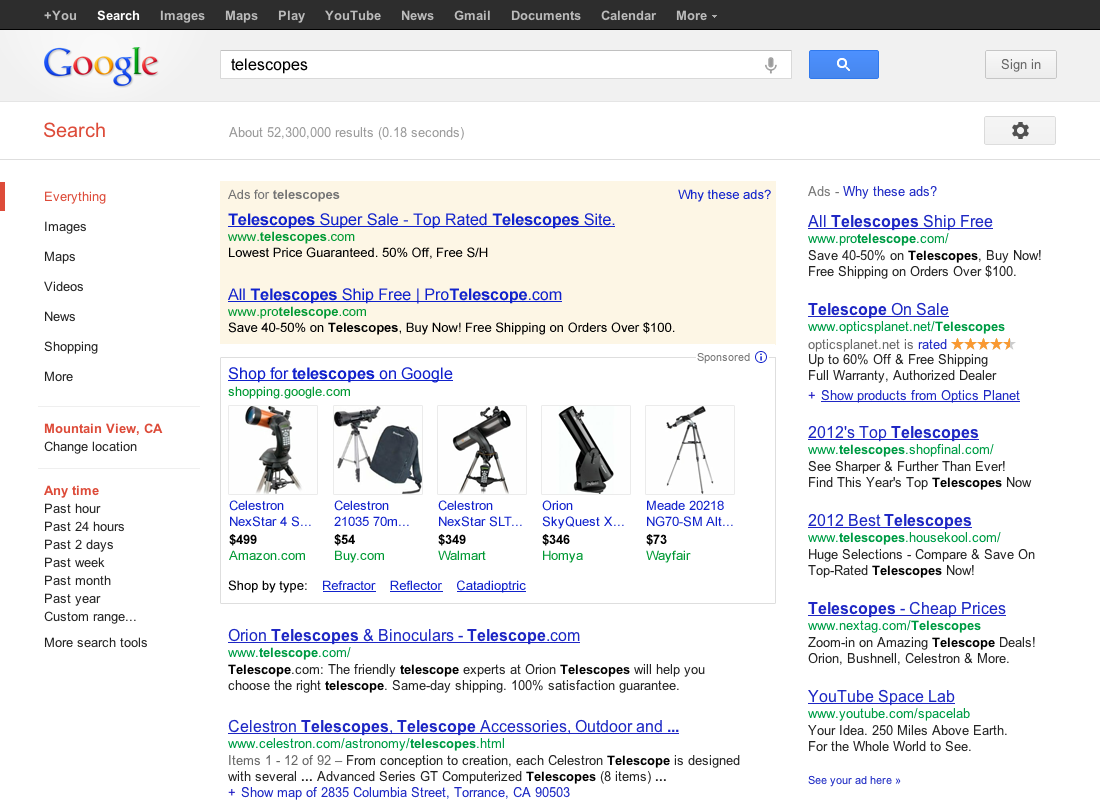
Not only that, but the specialized infoboxes at the top of Google's search results were an almost direct response to their competitor Microsoft doing exactly the same thing and promoting it at the main advantage of their search. Microsoft's comparison shopping subsidiary which they used for their search results was one of the companies complaining to the EU about this. Now that Microsoft have convinced the EU to ban Google from doing this, they can once again point to the fact that they offer this extra contextual information as a reason for using them and Google cannot compete.