It's a cool robot, but auto-dialers are a known tool in safecracking.
Additionally, the safe in question seems to be a SentrySafe SF082CS, which caries NO security rating from UL. The lowest test rating, RSC, only requires the safe survive a 5 minute attack with hand tools.
there's a little more to this than autodialing; dialing the entire keyspace would have taken several days. presenter used some manufacturing defects to narrow the keyspace into something that could be cracked in 45 minutes.
Depends on where you are. UL ratings are used in north america. There are similar EU ratings that I dont recall of hand. TL ratings are for theft/entry resistance. There are other modifiers for fire, water, chemical, etc resistance. Unrated "safes", and even some that are said to be rated, are junk. In NA you want to get in touch with a local safe dealer/specialist. Most of their business is commercial, and they are not the same as a locks ith or "security" company. Moving and installing a safe is a specialist job by itself.
As a sibling commented RSCs are the lowest level and appropriate for home use of low level valuables. Expect $500-1000 and up. TL rated products are almoat always geared towards commercial use. When I was looking a local safe company had a korean made TL-15 with 1 hr fire resistance for about $2500. This was a very bare bones commercial demo/returned unit about 2'x3'x5' interior.
All safes and RSCs must be anchored to the structure on 2 or more sides to be effective. RSCs or "gun safes" will simply be pulled/cut out of the structure if not anchored. TL safes will be knocked over and attacked at the door or floor.
That video was much dirtier and louder than I expected. Lots of brute force still involved. Not quite the domain of out of shape hackers. But I guess that's why we build robots.
A group of Italians went to Belgium's diamond district and bypassed an very expensive vault door. The best part was using an aerosol can of hair spray attached to a broom to defeat the top of the line motion sensors.
Edit: Can anyone explain why it's a 30 minute test for UL 30x6?
30x6 means 30 min on all 6 sides. Normally safes are installed bolted to concrete and sometimes positioned in a building so only the front or possibly sides are easily accessible to attack, so often the door is far more attack resistant than the rest of the safe. This saves money and mass.
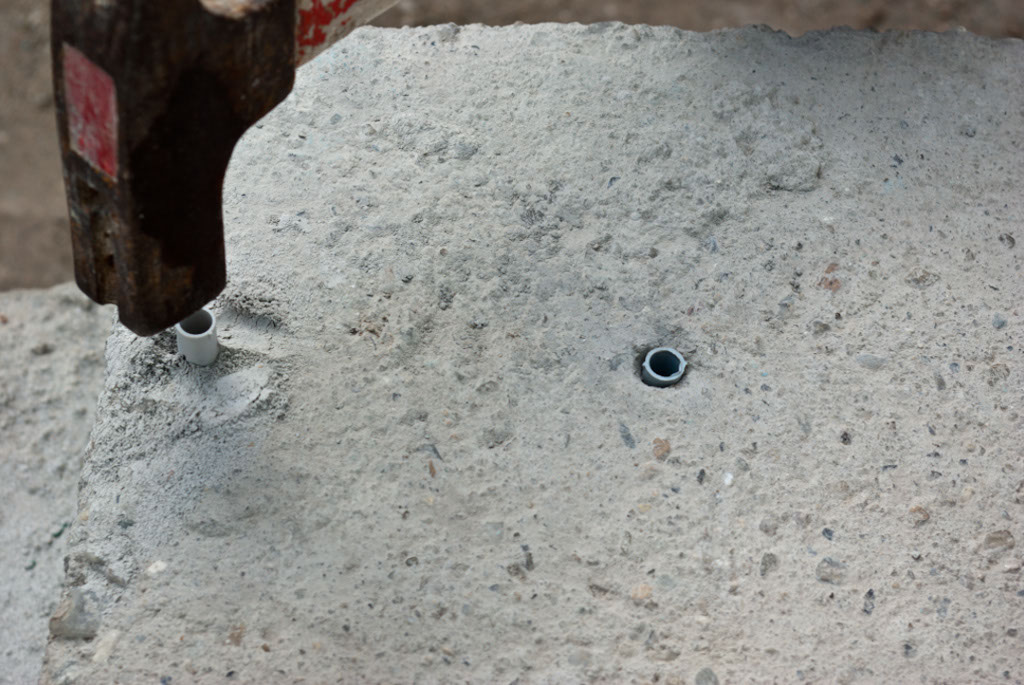
Not at all! If you're renting in a high-rise building, the floors will be concrete below the laminate or hardwood. A good safe will have either 4 holes or 1 center hole in the base to allow you to anchor it to the floor. Use a concrete drill bit to drill a hole in your apartment floor in a discreet area, like in a closet or laundry room. If you can borrow a hammer drill it'll be faster, but even an ordinary drill will work, though slower. Make sure you buy a concrete drill bit.
Then attach the safe using concrete screws and anchors. You can use either a self-tapping concrete screw or, better, put the correct size expanding sleeve into the hole first[1]. Even with a single concrete anchor/screw, the safe will be 100 times more difficult to steal. I've seen expensive TL-15 safes ($5000+) with only one center hole in the base, so I assume the manufacturer thought that was sufficient (if properly anchored).
Before you place the safe, put down a sheet of plastic or a very thin patch of carpet to protect the laminate or hardwood floor. Cut holes in the plastic sheet or carpet for the concrete screws.
When you move out of your rented apartment, fill the holes with putty matching the color of the laminate or hardwood floor. If you make a small effort at patching up, the holes will be invisible.
One more piece of advice: The drilling won't take long, but it'll be very loud. If you have a nosy landlord or superintendent, do the drilling when he's not around. A superintendent, for example, is unlikely to work on a Saturday or Sunday.
Also, cover the safe with a sheet or blanket, so if someone casually looks in your closet or laundry room, the safe won't be noticed.
As sibling point out all is not lost. In a wood framed structure put lag bolts in to studs or beams. It doesnt have to be perfect. Your primary goal is to prevent a strong man, or someone with straps/handtruck, from literally walking off with the goods. The goal of a safe is to simply delay the attacker until an active response arrives.
Edit: in an appartment building check your floor loading. A little jewelry/document safe is probably fine. Big get very heavy very quick on a relatively small surface area.
I have a friend who had a 40+ inch rear projection TV(not a modern LCD/plasma but one of those much larger ones), a couple of very large wood cabinet speakers(probably at least 3.5-4x1x1 feet) and a small mini fridge(still filled with food) all stolen, during daytime hours, from a 20-25 unit multi-story apartment.
Anecdotal I know, but I wouldn't assume most people are terribly attentive.
Funny you say that since it turned out from surveillance footage from another building that the burglars where dressed as movers and loaded all the items into a small moving van that was double parked.
Forget about stealing safes from apartments, I wouldn't be shocked if you could rob an actual bank vault by dressing as a construction crew.
University I went to had this happen in the summer. Showed up in coveralls and had a paper for the RA to sign. Cleared out all the furniture and appliances. Told the RA that the new stuff was a bit late but would be there in an hour. They were not caught but I question the target’s value.
Would fast and heavy internal gyros be a feasible alternative to bolting? I'm thinking that if the safe cannot be reoriented across all three axis, it'll be very hard to move.
Serious safes are in the neighborhood of $5-10,000 and weigh 2-4,000+ lbs. proper concrete anchors are maybe $100 and another 1-2hrs of installation time. Thats a hard roi to beat.
It depends on the type of safe. I'm not a locksmith, but I have researched this, and this is how I understand it.
There are "security" safes (aka "burglar" safes), and "fireproof" safes. A security safe should be bolted to the floor, to stop the bad guys ripping it out. It comes with pre-drilled holes for that purpose. However, a fireproof safe should not have any thru-wall holes, since a fireproof safe must protect against the deluge of water that will occur when the fire is put out. Thus, fireproof safes are often glued instead of bolted.
Some time ago, a relative showed me his new safe. It didn't have any pre-drilled holes, so he drilled some in, so he could bolt it to the floor. I chose not to tell him the following: (1) The fact that he could drill any holes in the safe, using his trusty Black & Decker drill, showed that it was a fireproof safe - not a security safe; and (2), drilling those holes destroyed its value as a fireproof safe!
In summary, you need to decide what's most important - theft protection, or fire protection. Those are different types of safes. The problem is they look identical to the untrained eye.
But for his own sake wouldn't it be better you told him so that he can either get a burglar proof safe if that's what he wants or get a new fireproof safe that he then doesn't destroy by drilling through it?
I know that a lot of people don't appreciate advice though, but still if this relative respects you they should listen.
> wouldn't it be better you told [your relative] so that he can either get a burglar proof safe if that's what he wants or get a new fireproof safe that he then doesn't destroy by drilling through it?
Fair comment. But I guessed that all he wanted was something that would stop a burglar from bashing it open in 5 minutes. It's probably fine for that purpose. But I might say something to him next time.
I'm far from an expert, but the common ratings to look for are UL RSC, TL-15, or TL-30 depending on what level of protection you want. The ratings are expensive, so generally vendors show them off prominently.
Not bolting it down does make it much easier to steal. A small safe like this can be carried off pretty easily. Even with a large safe, being able to move it can make it easier to use a pry-bar or to cut through a side-panel.
I have a friend who cleans up around the Bay. It's fairly common for him to find a safe that's been opened and then discarded as trash. (You'd be surprised at what floats).
So yeah, if your safe isn't bolted down, a burglar will probably just take it with them.
I have seen safes which you put a number of weights in the bottom, then you move the safe and door separate which both weigh a lot each. The hope is that once assembled and weighted it can't be moved easily. But...clever fools and all...so nothing is perfect and more layers of protection cost more money.
> The hope is that once assembled and weighted it can't be moved easily.
It's amazing how heavy a burglar safe is - even a small one. I have one just big enough to store some documents, spare phone, keys, and some cash. But it took two guys and a trolley to get it up the stairs to my apartment. Even if a burglar could rip it out of the floor, and push it down the stairs, I doubt that they could lift it up into their car or whatever.


Additionally, the safe in question seems to be a SentrySafe SF082CS, which caries NO security rating from UL. The lowest test rating, RSC, only requires the safe survive a 5 minute attack with hand tools.