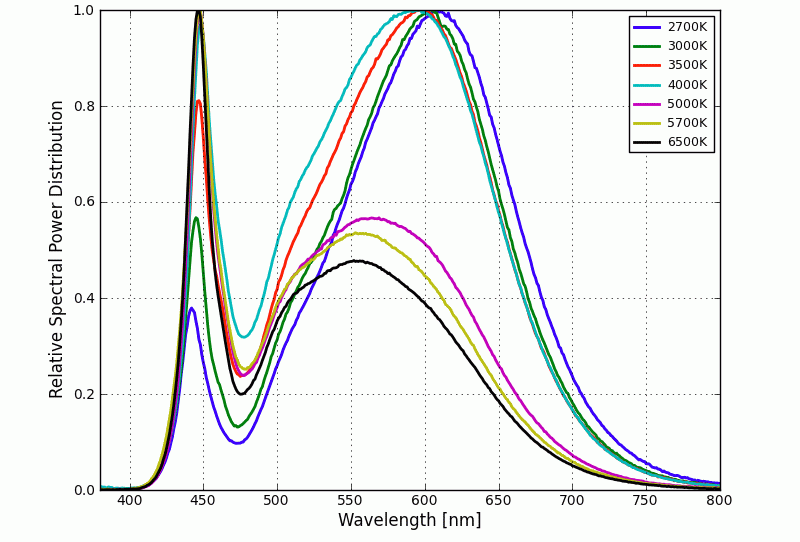
Pretty much all white LEDs are going to have high blue content. It goes back to how they work, these are actually phosphor converted blue LEDs where they pump out a ton of blue light and then use a phosphor layer to absorb and re-emit some of it at other wavelengths.
Even down at 2700K (blue line, "warm white") there's a substantial blue spike over on the left.
The LEDs being used in most streetlights are cool white, probably 4000K+, definitely a lot of blue in that.
There are high CRI LEDs available (Color Rendering Index - at warm colors it basically means "how similar do colors look under this vs under incandescent"), but they're much less efficient in terms of how much light you get per watt, and they tend to be a pretty niche product for lighting stuff where reds are important (brick walls, fruit, art, etc). Still some blue in that, but much less.
As to health effects, from what I've heard the jury is still out, but there's a definite push toward "tunable white" in the industry. Whether anyone actually wants to pay for that when it comes time to choose between that or the cheaper fixed color temperature that we've been doing forever, things are less certain...
LED's don't produce light from heat so they don't really correspond color temperature. They can fake it, but the current approach produces blue at higher efficiency than yellow. Thus upping the yellow content results in lower brightness and lower 'efficiency' for the same device or identical brightness and higher costs.
However, producing a lot of blue light is often sub optimal so you need a consumer willing to make that trade-off instead of just seeing white/cost/brightness and assuming that's the whole story. Thus, cheap really does mean more blue.
You're correct that LEDs aren't actually producing light like a hot black body radiator, but we still measure their shade of white using that scale as a reference. This is called the "correlated color temperature," which you'll almost always see abbreviated to CCT. It's not "this light was produced by a black body radiator at 5000K", it's "this light is perceived by the human eye as the same color as a 5000K black body radiator. Where does the human-perceived color fall on the Plankian locus?
As far as cheapness, yes and no. The swimming pools that I've designed tend toward the more blueish whites and low CRI because they have a light level target to hit and that's the cheapest way to do it. With the exception of some small residential pools, they aren't trying to make a warm cozy feeling, they just want it to be bright enough to meet the requirements for safety / code / IES recommendations / NCAA requirements, etc.
But a lot of lighting isn't done that way where you're determining the layout and quantity of lights to hit a target level at lowest cost. It's much more common that you pick the color temperature that you want it to look like and you buy that regardless of the exact light output.
LED bulbs at the store have a Lighting Facts label that tells you the color temperature and how bright it is, and the different CCTs of a given brand bulb will cost the same. Yes, you get more light out of the more blue one, but when you're getting bulbs for you're house you'd never say "Get the 4000K version. It's an extra 100 lumens, so we can light the house with 17 of them instead 18 and save a few bucks."
Interestingly there are cultural conventions to this too. In the US it's much more common to see the warmer color temperatures in homes and even in offices. In Asia and India you'll encounter a lot more blue.
Beyond that wall of text, a quick note on units. It's interesting (and correct!) that you put "efficiency" in quotes because (at least from an engineering perspective) efficiency is pretty strictly defined to things with equivalent units. You can divide one by the other and measure it as a percentage.
Amount of light you get per watt doesn't quite fit the bill, so we have a closely related measurement called "luminous efficacy."
Units for that are lumens per watt, where lumens are a measure of amount of light (basically watts of EM radiation weighted by the human eye's sensitivity at each wavelength), and watts are the electrical energy consumed per second.
Probably more than you wanted to know, but you never know when that piece of trivia might come in handy.