How much electricity do you use? I live in Germany and pay something like 35 Eurocents per kWh. I'm told that's a lot compared to other countries. And yet I somehow spend less than 30 Euros a month on electricity for a two person household. That's something like 5% of what I pay for rent. I really don't understand why everybody is concerned about electricity prices.
Edit: I asked around. While I pay less than my German peers, nobody I asked pays more than 30 Euro per person per month.
What do you do for heating / cool? Do you not have a fridge, or an always-on computer, or a water heater?
May last electricity bill was $750 for three months, a rate of about AU$0.26 / kWh, plus a daily supply charge of about ninety cents. The person who was responsible for a majority of that bill doesn't live here any more, but it wasn't hard to achieve.
Heating, including hot water isn't done with electricity. German climate doesn't require aircon.
I have a fridge that uses about 140kWh/year and I cook with electricity. I turn my electronics off when I'm not at home, so the fridge is the only electricity consumer when I'm at work. I use considerably less than 85kWh per day, the costs I quoted contain a rather large fixed component.
What are you doing to use this amount of energy? I DO have an always on computer, an old fridge, a laundry machine (no dish-cleaner, though, I do that by hand) and electric water heating. I use ~290kWh/month in a 2 person household. That costs me to around 80 Euros / month. Most of my consumption stems from the electrical water boiler and stove (daily cooking).
In Germany heating is most often and depending on where you live done with gas, oil or district heating plants (in cities). Electrical heating has pretty much been phased out (you'll find electrical "storage" heaters in very old apartments only).
Not the grandparent, but I used to use 1000 kWh per year, which is about the same as 85 kWh per month. (It's more since I built a desktop PC.)
> What do you do for heating / cool? [...] or a water heater?
ACs are not typical in Germany in private apartments, only in public and office buildings. My apartment is connected to district heating (which also supplies hot water), so this does not contribute to the electricity bill, either.
> Do you not have a fridge, or an always-on computer [...]?
I have a fridge (fairly energy-efficent and modestly-sized). I have an always-on homeserver, but it too is designed for small power draw.
The biggest chunk of these 1000 kWh per year (about half of it) is actually my terrarium, i.e. its heating and lighting, and the secondary fridge where the tortoises stay in the winter. I could have easily lived on 500 kWh per year if it weren't for that. (It should be noted that I don't have a large house, just a 50 sqm = 530 sqft apartment.)
During this time, my electricity bill was about 30 € per month, at 0.26 €/kWh. I currently pay 40€ per month since my desktop PC joined the consumers, at 0.27 €/kWh. I could pay slightly less (one or two cents per kWh), but I pay extra for a renewables-only power mix.
are you sure your numbers are right? I'm looking at my last electricity bill and we used 450kWh in one month. And it's not summer here so no A/C and our water is gas heated. We're a household of 2+2 young kids. We turn off lights when not in use, medium sized, reasonably new fridge, no always on computers etc.
hard for me to imagine how anyone could find a 12x reduction in usage! I need to know your secret :)
That's absolutely crazy. Do you have electric heat? If not you should probably spend twenty bucks on a kill-a-watt clone and check which of your appliances is consuming several hundred watts all day long.
according to this[1] Australian Government website about energy usage, for 3 people in my postcode (5075), no pool + mains gas, average daily consumption is 15.8 kWh, which matches almost exactly my last bill (avg was 15.3kWh).
I think some people are underestimating their usage. We're definitely not a wasteful household, we don't run the drier much, appliances are off when not in use, lights off when no one in room etc.
>If not you should probably spend twenty bucks on a kill-a-watt clone and check which of your appliances is consuming several hundred watts all day
yup already did that a couple years ago. Turns out there are no unusually bad appliances in the house.
nothing out of the ordinary I think. 2 computers on for about 8 hours/day. Dishwasher, TV on for 2 hours/day. iPad, home lighting.
I think some people in this thread are severely underestimating their energy usage. I wonder if people are just ballparking their estimates based on some rough data from years ago or if they're actually looking at last month's bill when saying they're using < 100kWh in a month.
Maybe for a single person who is never home that would be reasonable, but I can't imagine families being able to survive on so little.
edit: so this was driving me a little crazy and so I had to do some extra digging. My guess is that people not aware of their true usage. According to this [1], the average US household uses > 900kWh of energy/month. We're at half that so clearly not going overboard.
It may be crazy, but that is below average for a U.S. single-family home in many parts of the country. Old houses tend to be very inefficient, and many new houses are grotesquely large.
My family used 330kWh last month (also 2 adults+2 kids), including moderate use of AC; our energy efficiency report said we're using less than 1/2 the average of our neighbors.
Yours looks a little high, but be assured average power usage for 2+2 in Germany is 3000-4000kwh/year.
So lower than your 5400 but max 2x reduction :-)
Just to preface this: where are you getting the 12x reduction from? He spends 40 euros at 0.26, that's 150 kWh per month. That's 1/3rd of your usage, not 1/12th. And he's living alone, you with four. If anything, you're more efficient than he is per person.
Anyway if you want a reduction, just identify all the model numbers of anything plugged in and check specs and approximate usage.
It's insane how large the efficiency spectrum is, and how efficient things have become in recent years.
For example, modern 6ft fridges get so efficient they use about 8 kWh per month. Meanwhile, very old fridges can still use upwards of 40 kWh per month. We've seen a reduction of something like 75% in the past 15 years, that's pretty massive.
The most efficient washing machines now use about 10 kWh a month, while I can easily find washing machines for sale that use 25 kWh per month that were produced as recently as 2012 by LG.
And that's the difference in age. Differences in tech/model are also vast. In Europe we have a pretty decent energy labeling system for consumers for a decent approximation.
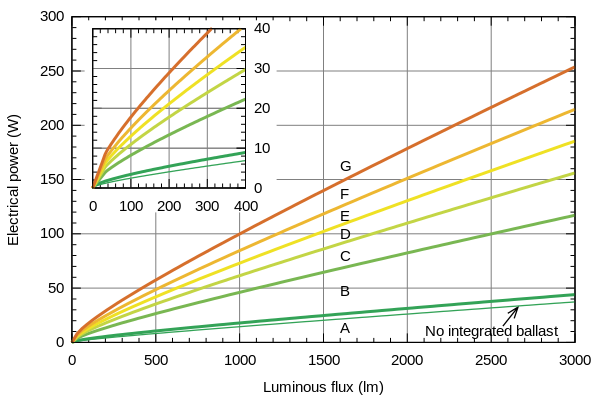
For example, here's lightbulbs [0] where you can see, for a certain amount of light (e.g. 3k lumens) the best bulbs use 50W while the worst use 250W. That's a 5x difference. You can easily drop 80% of your lighting electricity usage if you still have old bulbs.
The big items like washing machines, vacuum cleaners, microwaves, dryers, fridges, particularly old ones, all typically draw 2 kW or more at various times, so that's probably low-hanging fruit, assuming you have changed your bulbs.
A big TV is another one, not as high-powered but a lot of people keep em on for very long times, sometimes just as music players or on the background, and some TVs are really inefficient. Mine is alright but still draws 220 W. Contrast that with say the 2017 Macbook, which has a 42 Wh battery and lasts 10h. i.e. it draws about 4W. If you use your Macbook for 5h each day before/after work, you'd use about 0.6 kW per month, or about $1.5 typically. But if I have my TV on for 5 hours (I've used it as a music player like this but stopped due to electricity) it'd draw 33 kWh a month for about $80 a year.
If I compare the utility between these devices, it's crazy I spend 55x as much energy on my TV per hour of usage than a modern laptop. It's just that electricity is so damn cheap. The comparison to a phone is even crazier.
Also from central Europe (same climate zone as Germany) so I can answer.
Central heating in Europe usually works this way. You have a boiler in the ground/underground level of the building which turns water into steam which is pumped to radiators in the building through vertical pipes.
Most of boilers I have seen in central Europe use gas so it wouldn't be included in electricity bill. There are electric boilers as well but I haven't seen a lot of them out there, it seems like a rarity to me.
We have abundance of cheap gas so it makes sense most people would use gas boilers as you'll save money.
Another big factor is in central Europe doesn't need AC which is a massive electricity hog in places with warmer climate.
I think most of your crazy electricity bill in Australia is because of AC no? Do you have electric or gas boiler?
My wife and I had an average draw of about 100 Watts in the winter when we lived in San Diego. Made for electric bills around $12 a month. However, we had gas water heating. The gas bill was always for 0-1 therm per month.
The only always-on computer was an Odroid, and our bulbs were LED. The fridge was pretty efficient.
Just as a reference point, I use a LOT of electricity compared to my peers.
650kwH/month at the moment (and that is before I turn the heaters to max for winter..)
wow, makes me realise how crazy expensive Australian prices are. Your price is .11 Euro/kWh (.16AUD). I'm paying .38AUD/kWh, almost 2.5 times more than you! Don't event get me started on gas prices. Last month my Gas+Electricity bill was $541.44. Insane.
That's insanely high! Here in Europe I'd say 1/3 of what you pay for energy would be considered within reason. Why is energy so damn expensive in Australia? Not just electricity but also gas. Gas is super cheap here.
I live in Aus, and i think I am pay 28c per kilowatt/hr. It wasn't long ago that we were paying 22c.
Power prices in Australia is becoming one of the bigger political talking points at the moment. There is a lot of finger pointing going on. The main culprits appear to be:
1. a poorly designed energy market where electricity suppliers can get paid more by turning down their capacity, increasing scarcity to lead to price spikes, at which they can sell their electricity for inflated prices
2. governments allowing exporting of too much of the countries natural gas supplies - the spike in natural gas prices has caused increased costs for natural gas power stations
3. the market not accommodating the intermittent nature of solar / wind properly
4. the desire to decommission coal stations (probably because coal is on the nose, but more likely that gas stations can fire up/down quicker in response to renewable volatility, and coal is too slow in this respect)
24 million people spread across a really big continent[1] might play a role.
My state, South Australia, recently received the dubious honour of having the world's highest energy prices. Here's an article which has a go at explaining some reasons [2], apparently delivery infrastructure (poles + wires) is a major part of the cost.
That and there seems to be a lot of price gouging going on, not sure of the reasons for this. Maybe not enough competition?
A modern efficient European fridge typically costs about $3 a month where I live.
I'd rather ask you, where you spend 900 kWh per month on :p
I suspect airconditioning is a big factor though, I've never had a fan in my home in my life and heating and warm water is done by gas. (although the country is shifting away from gas right now).
I live in Bulgaria in a place completely filled with electronics and gadgets and other stuff. My wife has a gourmet restaurant kitchen and we have heated flooring (electrical) for the winters and air conditioning (that's on 24/7 on max) for 5 months out of the year (it's going to be almost 40 here today) and we pay about $75CAD/month max.
Ohh and BG is expensive for electricity. At least %30 more than Canada.
It's not only what you pay directly, it affects virtually all prices. Let's take a bread for example: most modern bakeries use electric ovens, and as far as I know, it's one of the biggest part of total running cost. Moving that bread to the malls using electric trucks? Add % to that too. Mall also uses electricity to power HVAC, lighting, refrigerators etc. See how that % increase of electricity prices adds up in every step and might lead to much higher increase in a final price?
That's a good argument. But how come that bread is not much more expensive in Germany compared to, say France, where electricity is much cheaper? I used to live very close to the French border and occasionally got my baguettes from there.
"But how come that bread is not much more expensive in Germany compared to, say France, where electricity is much cheaper?"
Because it's not the only factor. Many other factors might balance the price: labor cost, taxes, logistics etc. If electricity prices are as in France, maybe you would get even cheaper bread locally? I'm not trying to say that increase of prices would be dramatic, just wanted to point out that what you pay directly is not the end of it.
Wind turbines, solar panels, dams don't come for free and their capital cost ends up in consumers' bills anyway. Sure, on the long run we might achieve cheap or even free energy, but current tendency is rising of electricity prices in many regions, despite wider use of renewables, due to demand increasing even faster.
Google says the average rate is ~0.15 $/kWh, less than half of what I pay. The most expensive state seems to be Hawaii at 0.26 $/kWh, which is still a lot cheaper than what I pay.


Edit: I asked around. While I pay less than my German peers, nobody I asked pays more than 30 Euro per person per month.