> Even if they had to put slicks on the car to reach that time, that still puts it on par with 1000 HP dedicated drag cars.
Horsepower is a misleading figure, because 1000 HP means a maximum of 1000 HP at some engine RPM. So, in other words, if a gasoline car delivers 100 HP @ 0-2000 RPM, and only delivers 1000 HP between 5500-6000 RPM, we call it 1000 HP.
The Tesla delivers its power constantly, from 0 RPM and — more importantly — its torque is also constant and available from 0 RPM. Add to this the fact that an electronic drive train can adjust the power independently for each wheel 100 times per second, which is simply impossible for a combustion engine (mechanical parts transferring that much power can’t switch that fast).
> — its torque is also constant and available from 0 RPM
I don't think torque is constant. The power is constant, and torque gradually decays as RPM increases as per the following equation:
HP = Torque x RPM ÷ 5252
Most 1000 HP drag cars are in their power band from the time the driver lets go of the trans brake until the race is over (unless it's a stick shift, but most drag cars are automatic).
Like any other conventional automatic, there is a torque converter between the engine and the transmission which allows the engine to spin faster than the transmission input shaft.
At the starting line, the driver engages the transmission brake, which locks the transmission and allows him to floor the engine, which brings it up to the optimal RPM (and spools the turbos if so equipped). It's almost the same as if you were to hold the brake and floor the accelerator at a red light. The only difference is that the brakes on a drag car wouldn't be able to hold it back, so they use the transmission instead.
Then, when it's time to start, he lets go of the trans brake and the power is instantly delivered to the wheels.
There usually isn't an issue with not having enough power at the starting line. It's actually the opposite. High power cars usually have to limit their starting RPM to avoid doing a wheelie or losing traction.
Interesting. Do they do that on purpose or is it due to how the motor works? It's so flat that It seems like they limit the torque on purpose, perhaps to prevent breaking things.
The almost perfect linear decline after the constant part is what I would have expected for an electric motor running with a constant power.
They almost certainly are limiting the torque. Zero rpm torque on these electric motors goes asymptotic since torque is power per change of angle and the angle isn't changing.
Also he specified max torque was 10k newton meters which is absolutely enough to pull a steel driveshaft like taffy. That's triple the torque a semi produces.


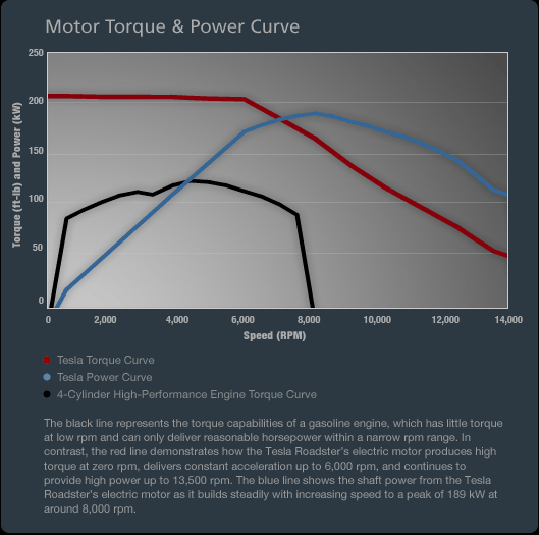
Horsepower is a misleading figure, because 1000 HP means a maximum of 1000 HP at some engine RPM. So, in other words, if a gasoline car delivers 100 HP @ 0-2000 RPM, and only delivers 1000 HP between 5500-6000 RPM, we call it 1000 HP.
The Tesla delivers its power constantly, from 0 RPM and — more importantly — its torque is also constant and available from 0 RPM. Add to this the fact that an electronic drive train can adjust the power independently for each wheel 100 times per second, which is simply impossible for a combustion engine (mechanical parts transferring that much power can’t switch that fast).