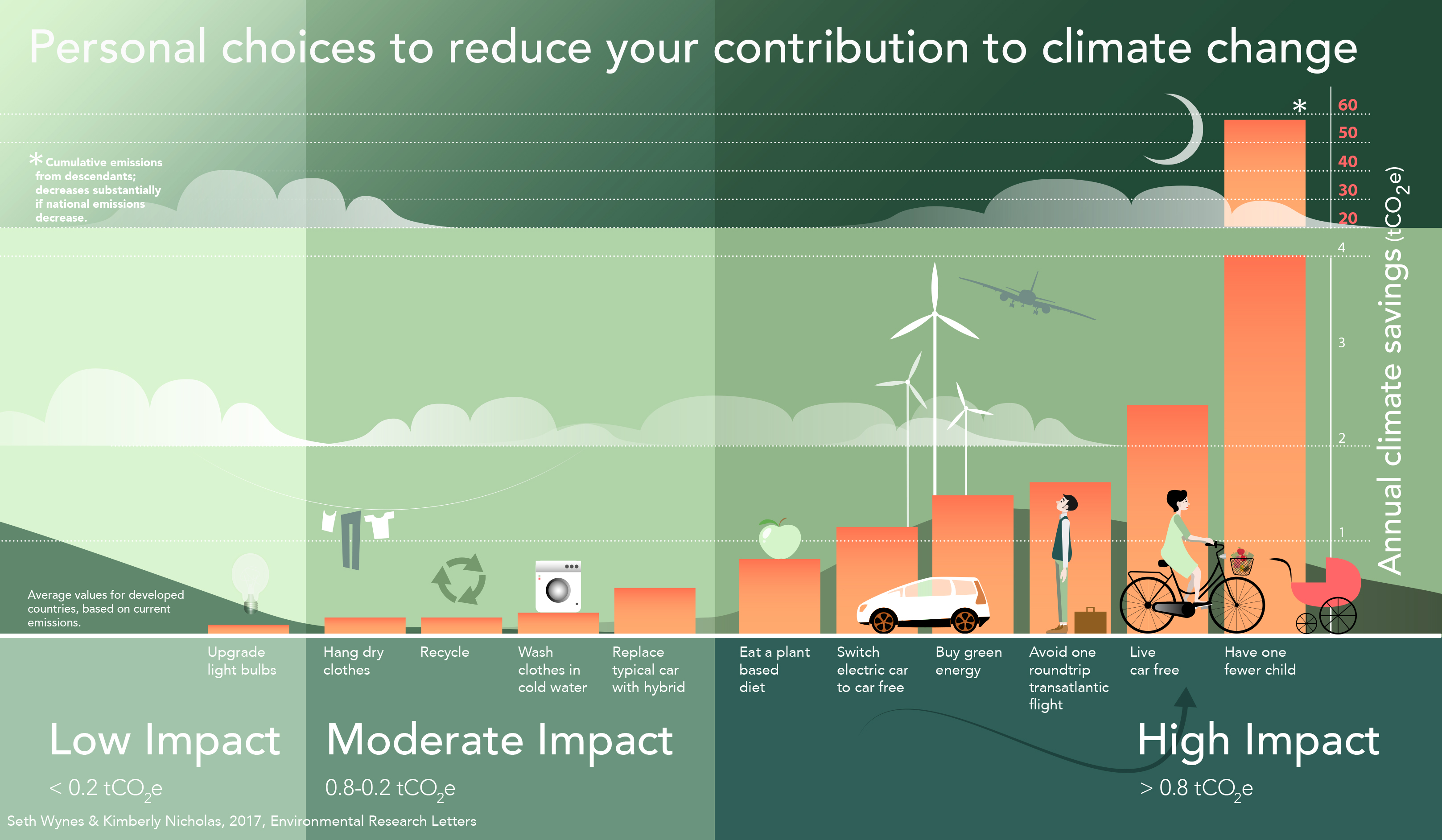
Is there an ordered list of what produces most pollution? What's at the top? Is there an easy way to answer the question "I just did environmentally bad thing X, now what can I do to offset that?"
Yes. Fossil fuels for power generation, followed by transportation and industry [1]
> Is there an easy way to answer the question "I just did environmentally bad thing X, now what can I do to offset that?"
Little bit but to seriously make an impact you might have to look for alternative sources of powering your life. But nevertheless every single bit helps. This climate change conundrum cannot be fixed without the entire planet committing to it.
Though all meat production is not made equal; beef production is overwhelmingly more emissive per serving (6.61 lbs of CO2 per 4 oz) than pork (1.72 lbs) or poultry (1.26). Even without giving up eating meat, substituting most of your beef meals for chicken would still be a step in the right direction (and is essentially zero-cost, considering that this requires no significant lifestyle changes and anywhere that sells beef is almost certainly also going to sell chicken).
This might have ethical implications considering how much worse chicken lives are than cows lives and how many more chickens you need to kill per calorie.
Inaction will lead to climate change killing millions of humans. If someone won't consider eating vegetarian more often, switching to chicken is far better from an ethical standpoint than doing nothing.
Assuming switching to chicken reduces carbon by 12%, assuming carbon responsible for 250,000 death then meat consumption is responsible 30,000 ppl/year
Number of cows in u.s. 30,000,000 for 3% of global market
US market responsible for 900 deaths / year
140 chickens / cow(calorie wise)
estimated 20 years of life lost per death
18,000 QALY for 4.1 billion more chickens
Rough estimate of 2.3 minutes of human life gained per chicken raised
> Meat production is almost as much as transportation, roughly 17%.
That 17% includes all transportation related to meat production. If meat was replaced by plant-based foods, not all of that transportation could be eliminated.
Livestock consume far more feed grains (mostly corn) than they produce food on their own [1]. The transportation costs to feed them are greater than the transportation costs would be if we were to feed humans on plant based foods, so transportation would actually be reduced if we lowered the amount of animal products we consume.
That is a US-specific article. In the US, animal agriculture contributes about 2.8% of US total CO2eq emissions, whereas US transportation sector contributes 26%.
Not sure what your point is. I never said emissions related to animal agriculture outweigh total transportation emissions. What I said was reducing meat consumption would lower transportation emissions associated with food.
The overlap is less than 2% of the total man made CO2 emissions.
Processing and transportation of animal products is 6% of the meat production emissions. Feed production also involves transportation, that would add maybe half of that (3%).
> cannot be fixed without the entire planet committing to it.
And if the entire planet will not commit as you desire? Then what will you do? War is the ultimate extension of any policy; will you personally go kill other people because they burn oil?
I've got nothing against renewables, but don't like this kind of absolutist rhetoric.
Fundamentally, there is very little you can change on an individual basis that will make a real difference. By all means, lead by example, but we have to support systemic changes at all levels of government to actually make any head way here.
You can do both. Campaign for political change and change your personal behaviour. I've done radical changes to my life at least last few years to reduce my pollution/co2 footprint and if more people think like this it _will_ help.
So saying that there is nothing that can be done on the individual level is quite dangerous as I personally think over time this will have the biggest effect as more and more people realise that is what has to be done.
Then you need the politicians to kick remaining ignorant part of the population into action.
On the other hand, if a small percentage of concerned citizens do everything they personally can without changing the political climate, nothing will change.
In Ontario (Canada) we elected a conservative government who is running advertisements against the Federal Carbon Tax saying:
> “Ontario has a better way: holding the biggest polluters accountable; reducing trash; and keeping our lakes clean. A carbon tax isn’t the only way to fight climate change.”
My government thinks reducing trash and lake runoff is fighting climate change. Everything I've personally done; switching to public transit, flying less and buying my electricity from a green supplier has been swamped by this huge step backward at the political level.
The politicians definitely have to be on board in the end but when you say your efforts are swamped, remember that it is not just you, there are millions of us changing our behaviour and trying to reduce the carbon footprint.
Together we actually make a difference. Personally I also try to encourage friends and family in a non pushy way to attempt some of the things I do. Many respond positively, especially considering other benefits like eating more healthy and walking more.
Dunno - if you look at the ozone hole business it was fixed by a global action to ban CFCs and the like. An individual stopping using aerosols or what have you wouldn't really have fixed things.
With CO2 emissions we have a lot of individuals trying to make changes and again it's not really fixing things - CO2 levels keep going up. It's a bit trickier than the ozone thing though.
Banning CFCs etc did not require people to fundamentally change their lifestyles.
Reducing carbon emissions does so and due to that it requires knowledge and action from the individual I think as a politician trying to change people who do not want to change is doomed.
It is a lot trickier than the ozone issue and I think it requires action on all levels from the individual to the UN.
I agree the CO2 tax is a big part of the solution. The real cost of externalities has to be priced into consumer goods. One just has to hope everyone is on board and nobody becomes the Cayman Islands of CO2. Hopefully such a system will eventually be extended to other forms of externalities.
The price change will hopefully also accelerate R&D into alternatives which will also be a big part.
Boycotts have never toppled an industry as far as I'm aware. In this case the beef or aviation industries could be targeted. They have only succeeded in small changes and when customers have very similar alternatives they can use.
You don't have to aim to topple the industry, just pressure them to make changes, with the implied threat of a boycott.
I'll admit that approach works better with a simpler less wide ranging issue. Examples off the top of my head, in the UK I don't believe you can buy non fair trade bananas from any of the major supermarkets, and most eggs now seem to be free range.
Yes, most eggs. I just checked and 44% are intensively farmed(not free range). Generally most use in processed food and catering will be of a lesser quality standard. Funnily enough the environmental impact is usually less for intensively farmed food.
"Funnily enough the environmental impact is usually less for intensively farmed food"
What are you comparing here? Could a mega farm invest in slightly more efficient processes than a mere 'very large farm'? Possibly. But by that time you've already got all the issues of grubbing up hedgerows, mono cropping, reliance on artificial fertilizers, soil erosion, etc.
A small organic subsistence farmer isn't going to have anywhere near the same impact. Now you may not be able to feed the world using that model, but I don't think its fair to say that the environmental impact is worse compared to intensive agriculture.
It would be good to have a system in place to reward measurable action on the individual level.
One example might be to institute a "carbon savings account" which individuals add to when they add solar panels, buy more efficient vehicles and appliances, reduce their heating bills... whatever's measureable. Mandatory restrictions on carbon-intensive activity (there's no way around that anyway) would enable spending these rewards.
> It would be good to have a system in place to reward measurable action on the individual level.
Wouldn't a Carbon Tax do exactly that? At least it would bring your individual financial interests in line with with society's climate interests. It would mean that doing whatever costs you the least money is likewise best for your carbon footprint (which you would no longer have to think about in order to optimize).
>I've done radical changes to my life at least last few years to reduce my pollution/co2 footprint and if more people think like this it _will_ help.
Ah yes, the 1%, living in their mansions and driving Teslas to their summer homes, telling the rest of the world that they need to "make radical changes". Good luck with that.
I'm far from being in the 1%, however the things I've done personally so far is
* Use public transportation to work (bus/train)
* Drastically reduced meat consumption from every day to
once a week. I still eat fish about twice a week.
* Converted part of my garden (my house is 150 square meters so I wouldn't exactly call it a mansion) to a vegetable garden.
* Make sure the food I do buy is produced locally, it is clearly marked in the stores. I buy honey and eggs from the farm right next door.
* When I do go to the store I walk instead of driving.
* I bought but have not yet received an electric car. Yes it's a tesla but I have a normal job and with the way taxes are structured here it's a very common car on the road along with other electrics like leafs, e-trons, kias, e golfs etc.
* Not travelling too far for vacations, avoiding air travel as much as possible. Recently I've mostly use air due to work, but there too I often drive/take the train 8-10 hours instead of taking the plane.
There is plenty more to do, but for me personally I can't just sit idle and you have to start somewhere.
And last I did not tell anyone to radically change their lives, I said I did so myself. But the more people that do it the better.
Again, most people on the planet are just scraping by.
They don't have time to garden.
They can't afford to shop at farmer's markets.
They can't afford most cars, let alone electric vehicles.
I assume your intentions are good, but climate change won't be remotely close to solved by such measures, and when people say, "I bought a Tesla so I could drive it to my summer home and do my part for the planet!" it probably causes more resentment from the 99% than anything else.
I am wondering if you see any possibility to avoid work related air travel as well? I understand that certain jobs require flying but I also see, at least at my own company, that a lot of those flights are not really necessary and could easily be avoided. Would you mind to elaborate?
There are some ways to reduce air travel imho (and probably other ways to do so).
* Video conferencing
* Car/train/bus transportation if the hours used is acceptable. A good way to do this is a "night train" with a sleeping compartment.
* The big one: electric planes.
However it is a though one. Sometimes you just have to travel far to meet someone face to face and unfortunately the only way to achieve this in a reasonable way today is by hydrocarbon burning air travel.
It's ranked in terms of low-hanging fruit ('these are the highest-impact changes we could make') rather than absolute harm, but the spirit is the same as the question you're asking.
Realistically, the only thing you can do as an individual is campaign for political change:
This is really neat. In this space, is the normal metric 'atmospheric CO2 equivalent'? Is this just so they can normalize the affects of all the different things that cause warming into one unit for discussion purposes?
realistically there is no way to "offset" carbon emissions today. there are plenty of people that will take your money, but to date they can be considered at best beta tests, not functioning solutions.
your choice is to vote hard environmentalist, agitate hard for immediate change, stop flying and stop driving and stop eating red meat.
or don't. but don't delude yourself. a lot of people wish so hard there were easier options that they will endlessly talk about made up ones. but those are the only real ones today.
Also, don't have children and pursuade those around you to not have children. It's about 60 times more impactful than going vegetarian.
https://images.app.goo.gl/WzvXhy9brdTih8PWA
I have 3 kids, so I'm basically forced on one side of the climate debate. I worry will soon have to wear a scarlet letter for my shame.
Instead, I intensely advocate for technology-based approaches to climate stabilization, such as marine cloud brightening.