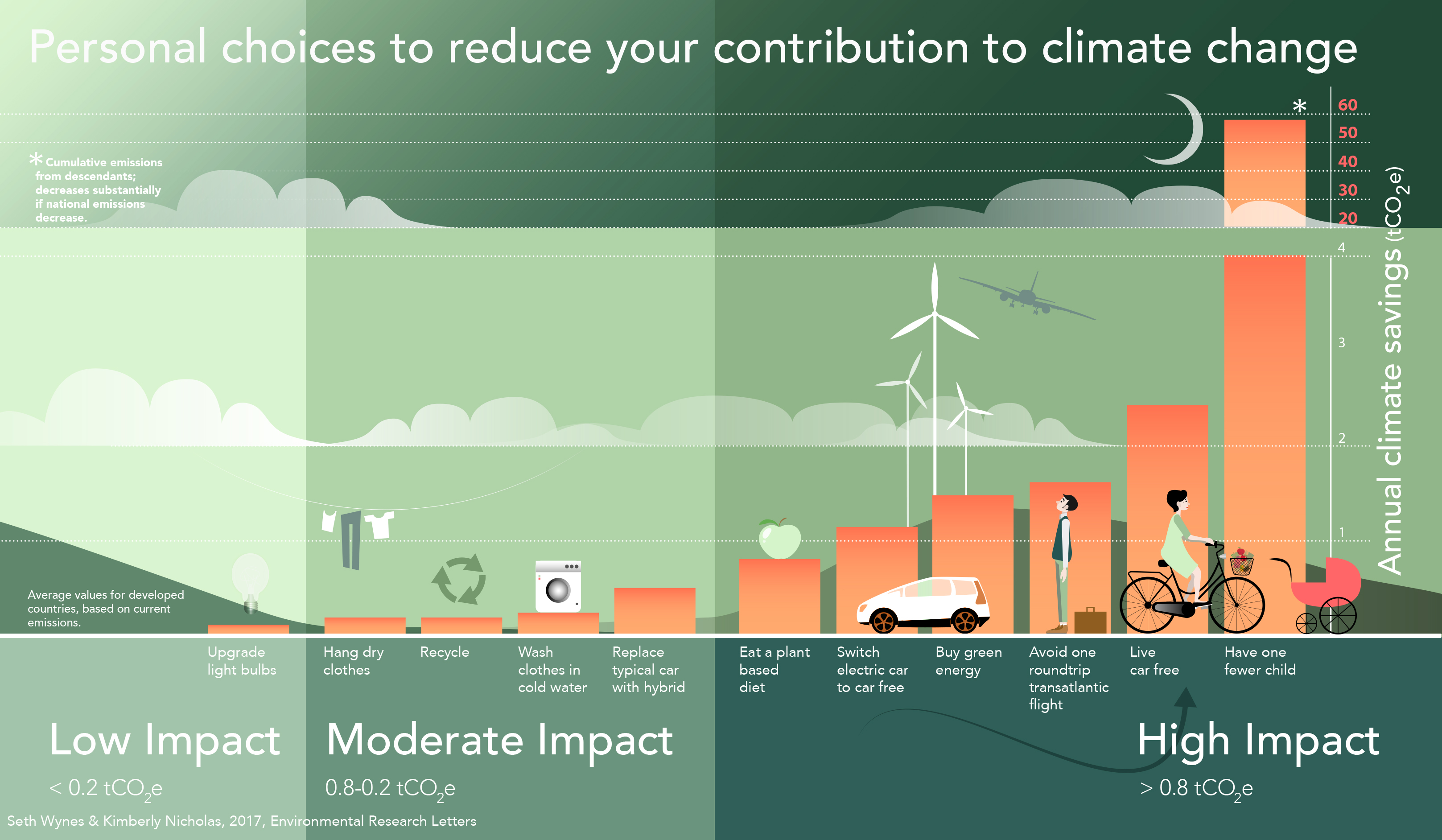
> but I think less air travel would in many ways be a good thing for the world.
This seems overly myopic to me. Aviation accounts for at most 2% of global juman CO2 emissions during normal years. I think you could come up with dozens of arguments for why it’s a net good. For example, tourism has income allows small island nations to better financially prepare for rising sea levels far in excess of aviations contribution to sea level rise. Not only that, but travel exposes citizens of wealthy nations to the real living conditions of people in developing nations, which can have a number of positive political effects.
Aviation has a relatively low percentage of total emissions only because globally almost nobody can afford to fly. For a rich person like you and me, a transatlantic trip is a good way of doubling your emissions for the year.
A transatlantic flight of 6 hours on a Boeing 737 would emit about 540 kilograms for a single passenger. In the US per capita C02 emissions were 15.8 metric tons in 2017. So the round trip would account for ~1/15th of a person's yearly total.
You could probably make that up by driving less, since a typical passenger vehicle emits about 4.6 metric tons of carbon dioxide per year. If you look at the UK, it's estimated that 20% of the nation's emissions are directly from heating and hot water, which is analogous to many areas of the US. This is largely due to old and poorly insulated housing stock.
This isn't meant to be CO2 whataboutism, but rather to compare meaningful individual contributions to emissions. IMO aviation for most international travelers may be a large single contribution, but they do it infrequently and other activities could be moderated of modified to make up ground. I mention this to support my parent claim that aviation has numerous benefits, and they may likely outweigh their costs accounting for externalities. That said, I would advocate a carbon tax that prices emissions into things like gas, heating, flying, etc.
1/15th of a yearly total that is far, far too large. A sustainable value is 3 tons of CO2 per year (https://www.ecocivilization.info/three-tons-carbon-dioxide-p...). Now that transatlantic flight is 1/5 a person's yearly total which also has to include the emissions for their heating, water, food, and transport which is just not feasible in western countries today.
To reply to makersofspoons the blog post cited sources the 3 ton figure from a 2011 UN report. The report only mentions the figure in the summary and states "3 tons of carbon dioxide (CO2) emissions per capita by 2050 MAY
need to be considered". This seems a little thin for advocating the eradication of aviation in 2020.
There's really no budget for burning kerosene if we are serious about the 1.5 degree target. The only way I see aviation being compatible is if there is a massive breakthrough in biofuels or battery technology.
That article doesn't directly cite any IPCC report. This actual IPCC policy maker summary report[1] makes exactly 1 mention of air travel and it is to suggest structurally shifting some air travel to rail as a minor component of improving total transit emissions.
You're right, I cited the wrong article. The summary does mention air travel only once, but it does mention the 80% reduction figure, which seems nearly incompatible with air travel if everyone is expected to live with yearly emissions of ~3-4 tons of CO2.
CO2 emitted high in the atmosphere has a stronger warming effect. I've seen factors of 2x-3x for airplane emissions[eg 1]. I underestimated per capita emissions for US people. A German only emits 9t, a French person only 5t.
Nice infographic. I'm sad to say I moved in the wrong direction on a few of these: I used to be car-free and vegetarian. Now that I have a family, I'm neither. Then again, I did get two fewer children than I actually wanted.
> In the US per capita C02 emissions were 15.8 metric tons in 2017.
What about taking a normal person and not an American? Even compared to other developed, Western-type nations, the US emissions are terribly high (only matched by the other 2 large Anglo-Saxon colonies); but triple of UK and France per capita emissions. And those 2 are already over the emission budget.
2% of CO2 emissions is a lot when you consider the number of people who produce it. For anyone who flies regularly it will typically make up the lion's share of their carbon footprint.
If you see my other comment, for most travelers in the US at least who make a single large trip every year or so the single trip makes up less than 10% of their emissions for that year.
2% is not negligible. that's about a fourth the emissions share of cars, which are much more essential to daily life where they are used. we don't have the emissions budget for any sacred cows; we need to see a big cut from every source of CO2.
the arguments you gave are not that compelling. air travel doesn't need to disappear entirely, but the environment would benefit from having it be a good bit more expensive. part of this could be increased airport fees to help the island nations recoup some of the revenue.
> Not only that, but travel exposes citizens of wealthy nations to the real living conditions of people in developing nations, which can have a number of positive political effects.
maybe so, but I doubt you could measure this with enough confidence to use as a basis for policy.
I'm arguing against the idea that a decrease in aviation is on balance good, and I was trying to avoid just making the economic argument.
However, there are tons of economies that rely on tourism to function. There is no clear way to make up for that in the short to medium term. It's generally agreed that economies need to decarbonize energy production ASAP, and that takes money which has to come from somewhere. For many economies less air travel directly means a diminished ability to decarbonize energy.
Now let's turn our focus to the nations that originate the travel in question. These places generate a lot of economic activity from travel as well. Now laid off employees of Boeing do not pay income taxes, and use public money in the from of unemployment services. If they were still employed their taxes could go to any number fo climate initiatives, their pay checks could purchase more efficient vehicles, and they could retrofit their homes.
Diminished economic activity doesn't position any nation to take active measures towards climate change mitigation.
Yeah that's not how it works, people losing their jobs and others being unable/unwilling to experience the world and travel is a very bad thing for the world.
There are other jobs, and I would like to see objective evidence that those wealthy enough to fly international derive more value from "cultural experiences" than not putting those metric tons of CO2 into the atmosphere.
Yeah that's very "woke" of you for saying that but there's really no positive way to spin this. When a pilot, or flight attendant, or engineer has to retrain and possibly leave an industry they've worked in potentially their entire life that causes pain and suffering.
It doesn't surprise me that the HN crowd lacks the empathy to see the damage being done here, but say for instance someone told you couldn't code anymore, you lose your job, and you might have to pivot into another industry at a time when nobody's hiring and you don't even have the skills or training to get in the door. Then some pompous asshole online says "well ackchually this is good for the environment because computers consume energy and don't run off of the hot air I blow everytime I open my mouth"
Please don't conflate being realistic with being "woke". It sucks you've lost your job. Retrain or retire. I'm not without empathy, but America has chosen the lack of safety nets it exhibits. And I can appreciate the environmental benefits from the pandemic that we couldn't do ourselves as a species.
I would be a huge fan of Medicare for All and more robust safety nets resulting from this carnage, but I don't expect it. People are irrational and selfish in aggregate, and when times are good they are entirely apathetic to the political process. Only under duress do they scream "do something" to the people they've elected who actively do harm to their constituents' interests.
Propose an alternative solution to a sudden destruction in demand for these roles. This is why your job is not who you are, but merely a means by which you support yourself. I apologize if your life path has lead you to where your identity is your work. I never said we shouldn't take care of these people. They deserve a similar quality of life, even if their role no longer exists, and I apologize if that wasn't made clear by my comments. To be clear: We absolutely should take care of people collectively whose roles have evaporated.
I am not willing to have communal tax dollars to pay pilots, aircraft lease payments, and fuel for unneeded air travel capacity, or workers to build planes that'll never fly, and I don't think that's unreasonable. I would be totally fine taking those tax dollars and putting those folks on Social Security early (or whatever safety net is going to keep them comfortable). Take that safety to go find new work you enjoy. Or go fish. Or woodwork. Or spend time with loved ones.
I think many here do have empathy with the people involved. I certainly do. But we also see the bigger picture.
Every industry that dies or suffers a setback is a tragedy, but it's also the unavoidable result of progress, of capitalism, and of any sort of active economic activity.
And the people involved can be taken care of. There doesn't need to be pain an suffering unless society decides that people who lose their jobs because of something like this need to suffer.
And for the record, a close friend of mine did indeed lose the ability to code. He dropped out of his PhD and become a shop security guard for 7 years. Not exactly his dream job, but he accepted it and it worked out. There are millions, probably billions, of people in the world who don't get to work their dream job. Pilots and flight attendants aren't the only ones. I'm all for helping them.
None of that changes the fact that excessive air travel does a lot of damage.
Agreed. Furthermore, traveling is overrated - yes I said that. Traveling to other places IMP is not as fun as going to national parks and exploring nature right here at home. Just my personal take on it - I’ve travelled extensively and I don’t enjoy it anymore.
You were agreeing with the statement "I feel sorry for the people who lose their jobs because of this, but I think less air travel would in many ways be a good thing for the world.
".
That necessarily implies that fewer people should be able to travel.
Yeah not all of us travel to compare national parks and nature. Bird watching in the Aleutian Islands would be a drag for most of us.
On the other hand, events with friends, lovers, annual festivals (yacht weeks, film festivals, music festivals), getting immersed somewhere else so long that you take classes and go about the day to day with others in the class, actually enjoying taking cross country trains because they are a fast and viable form of transportation. Can't wait till that is viable again! Many of those things are possible in the US, many of the events are just not in the US and their original locations are better for it, there are also lots of people not interested or capable of coming here, who I like to be around.
Even if I agree with your argument, not everyone lives near nature and national parks. Many people live in cities without sea, mountains, canyons, forests etc.