To be recorded the VAS had to be made directly through the merchant, which is not always the case since it is possible to return directly from the manufacturer: however, this represents a minority in the first year.
Hitachi is plummeting, which was first in the previous ranking! Western Digital retained its second place despite a failure rate increasing, while Maxtor is occupying the first place.
More specifically the failure rate for 1TB drives:
Overall, failure rates recorded are bad. That does not really want to entrust to 2TB of data to these discs alone: a mirroring will not be too much for securing data. Logically 7200 rpm disks are less reliable than the 5400/5900 rpm, with almost 10% for the Western model!
For the first time, we also integrate SSDs in this article type. The rates of failure recorded by manufacturer:
Edit: and on last page of the previous link there is a list of the current models sold between 10/01/2010 and 04/01/2011 with the worst fiability track record:
Simplistically assuming a very high failure rate of 7%, Jeff's friend anecdote of 8 out of 8 failures has a probability of about 0.07^8 or about 1 in 2 billion. That's quite a lottery to win.
What this tells me is that there are probably some differences in the environment that you use your SSD in that can have disproportionate effects on its lifetime.
Did you read the article? I'm referring to this: "Portman Wills, [...] he went all in. He purchased eight SSDs over the last two years ... and all of them failed".
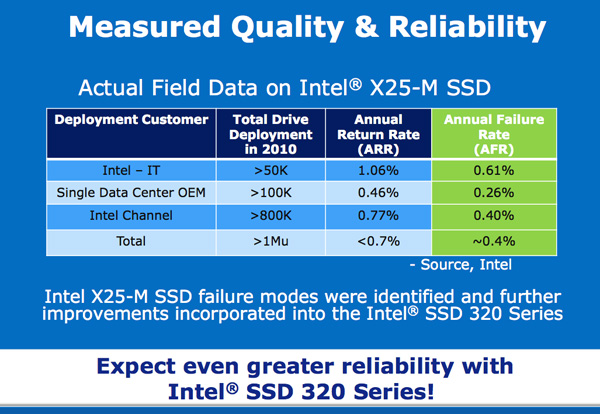
Jeff's anecdotal failure rates are scary, but don't line up with expectations - e.g. my Intel SSD has a 3yr manufacturer's warranty which would suggest failure rates more in line with these numbers.


http://forums.storagereview.com/index.php/topic/29329-ssd-fa...
To be recorded the VAS had to be made directly through the merchant, which is not always the case since it is possible to return directly from the manufacturer: however, this represents a minority in the first year.
- Maxtor 1.04% (against 1.73%) - Western Digital 1.45% (against 0.99%) - Seagate 2.13% (against 2.58%) - Samsung 2.47% (against 1.93%) - Hitachi 3.39% (against 0.92%)
Hitachi is plummeting, which was first in the previous ranking! Western Digital retained its second place despite a failure rate increasing, while Maxtor is occupying the first place.
More specifically the failure rate for 1TB drives:
- 5.76% Hitachi Deskstar 7K1000.B - 5.20% Hitachi Deskstar 7K1000.C - 3.68% Seagate Barracuda 7200.11 - 3.37%: Samsung SpinPoint F1 - 2.51% Seagate Barracuda 7200.12 - 2.37%: WD Caviar Green WD10EARS - 2.10% Seagate Barracuda LP - 1.57%: Samsung SpinPoint F3 - 1.55%: WD Caviar Green WD10EADS - 1.35%: WD Caviar Black WD1001FALS - 1.24%: Maxtor DiamondMax 23
Hitachi is logically the less well placed, what with two separate lines! What about the 2 TB version?
- 9.71%: WD Caviar Black WD2001FASS - 6.87% Hitachi Deskstar 7K2000 - 4.83%: WD Caviar Green WD20EARS - 4.35% Seagate Barracuda LP - 4.17%: Samsung EcoGreen F3 - 2.90%: WD Caviar Green WD20EADS
Overall, failure rates recorded are bad. That does not really want to entrust to 2TB of data to these discs alone: a mirroring will not be too much for securing data. Logically 7200 rpm disks are less reliable than the 5400/5900 rpm, with almost 10% for the Western model!
For the first time, we also integrate SSDs in this article type. The rates of failure recorded by manufacturer:
- Intel 0.59% - Corsair 2.17% - Crucial 2.25% - Kingston 2.39% - OCZ 2.93%
Intel stands here with a failure rate of the most flattering. Among the few models sold over 100 copies, displays a rate of no more than 5% VAS.