Here's a fun one to debate with your skate friends, nollie and fakie tricks are "swapped".
For example:
- nollie fs 180 and fakie fs 180 (fs half cab) are two different directions: nollie fs 180 is in front of you and fakie fs 180 is behind you going blind
- nollie 5-0 and fakie 5-0 (fakie switch nosegrind) lean differently on the grind: nollie 5-0 you pop off your nose and land on your back truck, fakie 5-0 you pop off your tail and land on your front truck
- nollie noseslide and fakie noseslide are different motions to get into the slide: nollie nose you pop off nose and land on the nose in the ledge, fakie nose you pop off tail and land on the nose but you do a sort of half cab
The key distinction in the argument is that in fakie, your tail is always considered your "tail". Therefore you treat any derived tricks as being "backwards". In the 5-0 and noseslide examples, you're still popping off the front of your board, but you classify it as nose or tail based on if it's nollie or fakie.
There are caveats though such as "fakie crook" where if you kept the rule it should be "fakie suski", which no one says.
There's a million arbitrary and nonsensical rules in skateboarding which is part of the reason to love it, especially for something that "has no rules".
And remember, never carry your board by your truck :)
I always thought names like "180 nosegrind" made no sense. Why not "180 switch 5-0"? That seems so much more intuitive.
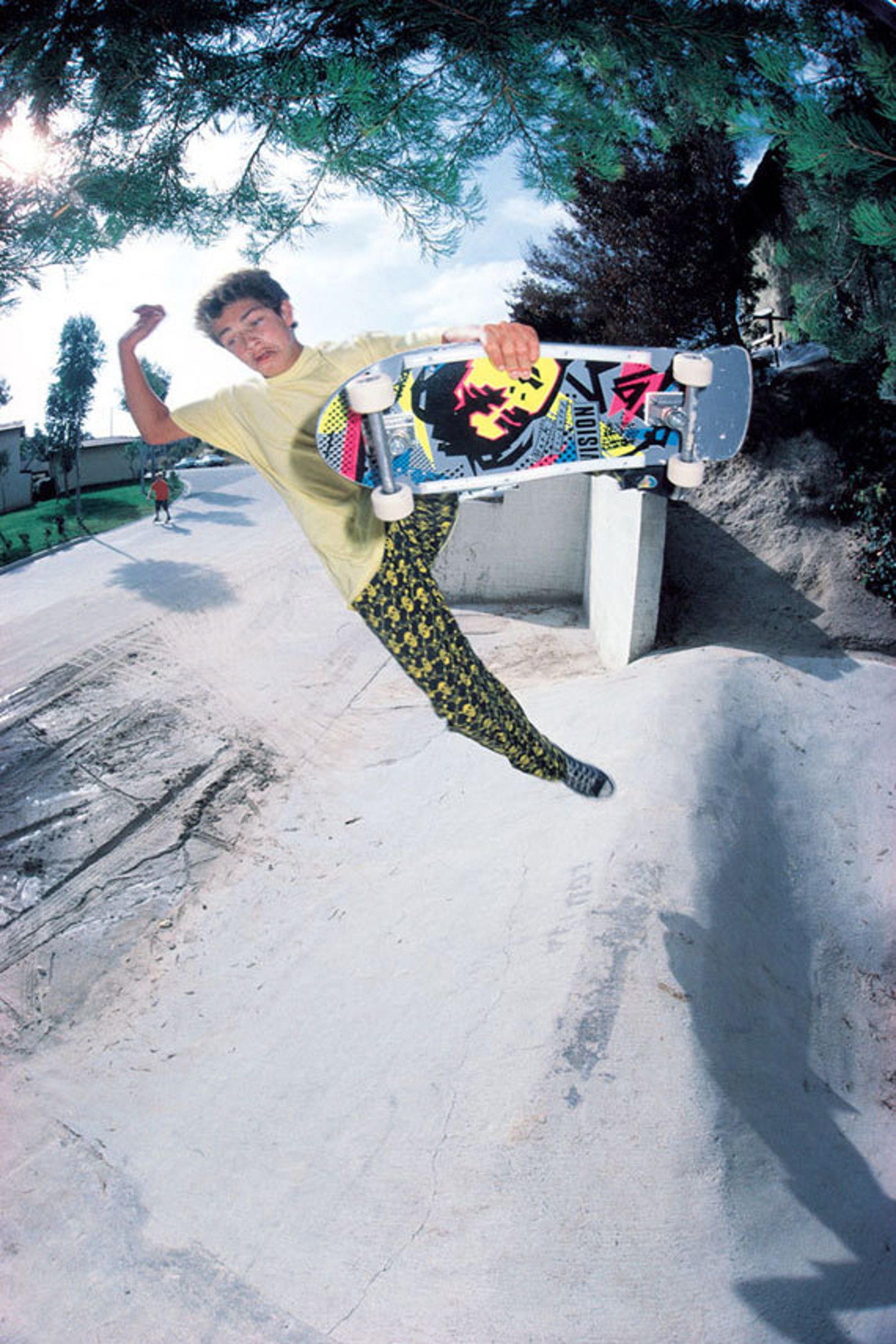
It made so much more sense when I learned a lot of these tricks were first invented in the 1980's, when most boards had an obvious nose versus tail difference. Like this one:
And these are just for street! Transition has its own set of weird names (losi, andrecht, g-pivot, etc.), including some slight street overlaps (varial, pivot, etc.).
I have a little passion project where we log pro’s tricks and interview them called 4ply[0]. The naming convention is something we always have to get right to make the logged data at all useable. I actually grew up skating with Erick Winkowski but can’t do an article on him because he does so esoteric transition tricks and we can’t name them all (or find someone who can).
Yo! That’s awesome you’re working o skatevideosite! O just read your guys interview on Jenkem [0]. I used your old data years back for an article for The Pudding
[1] years ago - invaluable resource. Growing up I would spend so much time on the site just finding music and skaters. If there’s an issue board or something please plug it, would love to contribute!
Woah! That's so random, I recently came across your article a few months ago. Great work and small world :)
I have a private discord and github for the project I can add you too. I eventually plan to open up the discord for anyone once we get a little further in the rebuild.
Wish there was a good way to DM on HN, I can send you a discord invite. Or if you happen to be on slap let me know.
Holy!!! That site still exists??!?!?!?!?!! I remember when this was filled with videos which were mostly hosted on what were google videos back in the day(and a small number on vimeo). Must have been 2006-7-8-ish...
> - nollie fs 180 and fakie fs 180 (fs half cab) are two different directions: nollie fs 180 is in front of you and fakie fs 180 is behind you going blind
That is till this day(12 years since I last set foot on a skateboard) the most illogical thing. Especially when combined with board slides which were also not apparent from the start(for years on I called front side board slide back side) and from a logical perspective the lip slide names made a lot more sense. That said, I never figured out how to classify nollie/fakie board and lip slides front or back. As far as experience I also never understood why were hard flips called hard(I learned how to do them in less than 15 minutes after I first decided to give them a go).
Well, the "logic" for fakie is that your tail remains the reference even though you are popping backwards. Therefore you would spin the same direction for fakie fs 180 as you would for regular fs 180.
> I never figured out how to classify nollie/fakie board and lip slides front or back
Yep this one still trips me up to and is great argument over some beers. Especially when you introduce flip tricks into them as well :p
all these terms originated from skating pools so you have to visualize them relative to your position on a transition as opposed to flat. fs/bs is quite literally how you are facing the the wall while fakie is simply treated as the inverse of your natural position.
I always thought the difference is with a normal shove-it the board pivots on the back trucks, whereas with a pop shove-it all wheels are off the ground for the rotation. They seem to be depicting only the latter in the animations.
Popping, i.e. hitting end of the board on the ground, to get height is the difference.
A pop shuvit will be higher while a non-popped shuvit may barely leave the ground. Popping can actually make it easier to keep the axis of rotation closer to the center of the board.
I don’t know about mathematical, but I’ve always thought of it as a vertical vs horizontal motion with the front foot used as as kind of rotation axis for an impossible…
Yeah for sure, the way the foot wraps with the board is the visual cue. It has led me and friends to some fun debates in a game of skate i.e. "that wasn't an impossible", so I was hoping to be able to point to some ridiculous mathematical definition the next time it comes up.
I was curious about this as well and gave modeling the Impossible a try... the foot drag seemed to be best mimicked by a half-kickflip, followed by a 360 shuvit, then a half-heelflip.
> As a last example we will describe the hardflip. This is a simultaneous half kickflip
(a 180 degree rotation about the axis joining the tail to the nose of the skateboard)
and a 180 degree rotation about the x-axis in the right-hand orientation.
Is it? Isn't a hardflip just a mirror of the varial kickflip they describe, and rotation around their x-axis something else entirely?
It both is and isn't. Technically the rotation is just the inverse of the varial kickflip (a frontside varial kickflip as opposed to the "normal" backside varial kickflip").
The problem comes around that your front foot is very much in the way of the board if it is only doing an "inverse varial". The vertical (end over end) rotation comes out of necessity to get the front foot out of the way.
The hardflip is unique in that it has two main variations. One is the end-over-end style that I think they're describing, where the board only does half a kickflip. The other is "flatter," and explicitly a 180 shuvit with a complete kickflip. In practice the end-over-end style is much more common, easier to perform, and nicer looking.
Correct me if I'm wrong, but the whole beginning of the article implies that the skateboarder is "regular" in terms of foot placement, meaning the right foot is on the tail and the left foot is at the front.
The fact that each skater can reverse their stance (aka switchstance), doesn't that double the possible number of flip tricks?
I suppose. Maybe I missed a part where they say they're using a regular stance skater for the sake of simplicity.
Note that a goofy skater could also do the moves described in the paper, but it would be a different trick because he's doing it switchstance.
(Source: the rules of SKATE per Battle of the Berrics, the skater has to declare his stance ahead of time for the purposes of normal vs switch tricks, aka the "Skategoat" (Leandre Sanders) rule)
Essentially the same trick. Best metaphor for “switch” tricks is basically doing something left handed (assuming you’re right handed and have always done the “thing” with your right).
It’s the same trick but you essentially have to relearn it with your other “hand”. Tricks are then flagged with the “switch” qualifier to indicate the rider wasn’t in their normal stance. Example: a regular (footed) skater skating right foot forward (switch) doing a kickflip is simply doing a switch kickflip (switch flip).
Not really, the flipping maneuver remains the same, the stance is more of a modifier. A 360 flip and a switch 360 flip are both still just 36 flips, you’re just facing a different way in each.
The mechanism for a kick flip and a heel flip are different, it’s not about the spin of the board in relation to the earth, it’s the spin of the board in relation to the skater.
A kick flip uses the front toe to rotate the board towards the skater. A heel flip uses the front heel to rotate the board away from the skater (you’re basically pushing it away from you by sliding your heel up and out off the edge of the board).
So if I understand correctly, letting “~” denote homotopy equivalence,
  Kickflip ~ 360 shove it

  Ollie ~ 720 shove it ~ double kickflip
I may have missed it in the paper, but does anyone have intuition about how to visualize these homotopies? I don’t get how to continuously deform a 720 shove it into an Ollie.
Kickflip, heelflip, flip + shove it in the "natural direction" (e.g. varial kickflip, 360 kickflip), and flip + shove it in the unnatural direction (e.g. hard flip)?
I'm guessing it's kickflip, heelflip, bs shuv, and fs shuv.
Your definition leaves out varial heels and inward heels.
Edit: On second thought I'm still not sure, I saw this in the paper, and I'm guessing they're classifying both direction shuvs as the same, and kick/heelflip as the same
Below we list these four tricks with their corresponding residue class in Z/4Z.
0 ↔ Ollie
1 ↔ 180 Shove-it
2 ↔ 360 Shove-it
3 ↔ 540 Shove-it
Another interesting choice of representatives is given by a combination of the shove-it
and the kickflip.
The main result of the paper seems to be saying that kickflips and heelflips are homotopic, and therefore equivalent. Fs shove it is just the inverse of a pop shove it.



For example:
- nollie fs 180 and fakie fs 180 (fs half cab) are two different directions: nollie fs 180 is in front of you and fakie fs 180 is behind you going blind
- nollie 5-0 and fakie 5-0 (fakie switch nosegrind) lean differently on the grind: nollie 5-0 you pop off your nose and land on your back truck, fakie 5-0 you pop off your tail and land on your front truck
- nollie noseslide and fakie noseslide are different motions to get into the slide: nollie nose you pop off nose and land on the nose in the ledge, fakie nose you pop off tail and land on the nose but you do a sort of half cab
The key distinction in the argument is that in fakie, your tail is always considered your "tail". Therefore you treat any derived tricks as being "backwards". In the 5-0 and noseslide examples, you're still popping off the front of your board, but you classify it as nose or tail based on if it's nollie or fakie.
There are caveats though such as "fakie crook" where if you kept the rule it should be "fakie suski", which no one says.
There's a million arbitrary and nonsensical rules in skateboarding which is part of the reason to love it, especially for something that "has no rules".
And remember, never carry your board by your truck :)