I don't understand why people continue to do IAT tests. One of the core authors of the original IAT paper released a paper last year showing how the test doesn't actually measure bias, and how it is not clear what this kind of test actually measures.
Brian Nosek who is one of the co-authors of the IAT test just released a paper [1] that show that changes in implicit bias don’t lead to changes in behaviour. You can find a summary of the article and its findings here [2].
The paper examining 499 studies over 20 years involving 80,859 participants that used the IAT and other, similar measures. They discovered two things:
* One is that the correlation between implicit bias and discriminatory behavior appears weaker than previously thought.
* They also conclude that there is very little evidence that changes in implicit bias have anything to do with changes in a person’s behavior.
These findings, they write, "produce a challenge for this area of research." The finding that changes in implicit bias don’t lead to changes in behavior, Forscher says, "should be stunning."
"I see implicit bias as a potential means to an end, something that tells us what to do and some possible remedies for what we see in the world," Forscher says. "So if there’s little evidence to show that changing implicit bias is a useful way of changing those behaviors, my next question is ‘What should we do?’"
Is it like dark matter in cosmology? Except that here, "scientists" observe a social galaxy and note that it's round. According to their beliefs, the galaxy must be rectangular, so they had to postulate an invisible ubiquitous force that makes the galaxy round. They called this dark force many names: inequity, implicit bias, structural racism.
I understand the analogy you're trying to make, but that particular one doesn't track. Dark matter is required by quantum mechanics. Sean Carroll had a great explanation of this in his Biggest Ideas in the Universe video series. The models of particle creation in the early universe require there to be something with the characteristics of a class of particles holding the label "dark matter."
"Structural racism," "inequity," and "implicit bias" all mean very different things.
Structural racism is where a society is deliberately constructed to be racist, as under Apartheid in South Africa. (It is otherwise nonsensically applied to current Western governments that employ capitalism as an economic system.)
Inequity is the state of receiving disparate treatment. It can be caused by structural racism, by personal racism, or by empirical discrimination (person A is denied a mortgage because their income indicates they likely cannot afford to pay the loan back, whereas person B is granted the mortgage because their income indicates they likely can).
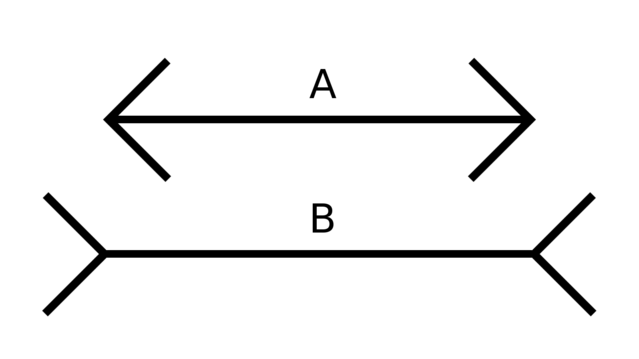
Implicit bias is an actual psychological phenomenon where quirks in the way humans think affect their judgement. The classical example is to take two parallel line segments of equal length where the ends are lined up. On one segment draw arrowheads pointing outward, on the other, arrowheads pointing inward. When asked, humans will visually judge the line segment with arrowheads pointing inward as being longer than the one with arrowheads pointing outward [1]. Convincing yourself the line segments are of equal length requires measurement. That this occurs is true. That it is the great bugaboo of our times and the cause of inequity has a far more tenuous connection to reality.
That these phrases are used as proxies for "bad" is the real problem. We can agree that structural racism is evil. Inequity occurs for the full spectrum of reasons, some immoral, some moral, some merely neutral and reasonable. Implicit bias simply is. The hard part is separating out acculturated bias (like racism) from implicit bias. One evaporates in the face differing environments. For example, children that grow up in integrated schools and integrated neighborhoods are far less likely to suffer from racist attitudes. The other is a cognitive feature that must be countered with measurement (empiricism) or rules (equally applied).
Those attempting to use the terms as umbrella labels diminish our ability to talk about and address issues arising from them. It isn't a single dark force, and there isn't a giant conspiracy out to perpetuate all perceived societal ills.
1. Inequity = the uneven distribution of matter along the radial axis of the galaxy. The scientists believe that density should be isotropic.
2. Implicit bias = the apparent tendency of stars to gravitate towards the galaxy core. The scientists believe that stars should be free to roam the galaxy space.
3. Structural racism = the spiral structure of the galaxy. The scientists believe that stars shouln't form any clumps like that.
The obvious conclusion: since the reality disagrees with the model, something is deeply wrong with the reality. There is faction among these scientists that suggest to fix telescopes to fix the observed reality.
As laid out in the original post, there is currently no commonly agreed on definition of implicit bias, or if it even exists at all. As such, we can't reliably extrapolate the properties and effects of it, much less how it interacts with other aspects of reality.
Modern day Lysenkoism. Compromising science for ideology, any ideology, is one of the more destructive things a society can do to itself. Not only does it halt progress, it destroys the credibility of the scientific community.
Unfortunately we are now in a situation where there will a trailing legacy for the next 30 years of people who went through the university system and have been indoctrinated to believe there is only the one correct opinion on any given topic.
Yes, the whole field has pretty much fallen to the replication crisis. The thing this article is complaining about is that "Science" magazine apparently has a section in which it uncritically repeats politically-fashionable junk science.
I’m really not impressed by hacker new’s scholarship on this. Here’s a paragraph from one of the papers cited here. Basically one of the key arguments in this paper is that basis might be justified. Ignoring for a second that biase in real humans is much strong than differences between races, it also is beside the point. Race isn’t something people can control. If people at large are classifying people based on it that will legitimately act to keep the situation locked in place. If I think everyone with red hair is a criminal and act like it people with red hair will have pretty bad lives and a lot more of them will end up turning to crime
> Cultural knowledge and accuracy as sources of implicit associations.This analysis has akinship to that of one of the earliest critiques of the IAT (Arkes & Tetlock, 2004). They argued that,rather than reflecting prejudice, the race IAT might reflect knowledge of cultural stereotypes. Our argument, however, goes further. The associations tapped by the IAT may reflect not just cultural stereotypes, but implicit cognitive registration of regularities and realities of the social environment.Consistent with this analysis, IAT response times were faster when stimuli corresponded to ecologically valid base rates (Bluemke & Fiedler, 2009). Even evaluations of groups may come from knowledge of those groups’ social conditions (Payne et al., 2017). For example, groups disproportionately living in unpleasant conditions (such as poverty, crime, rundown housing) may be associated with “unpleasant” more than other groups
This article also says something about IAT test being strongly correlated with other things, so their individual contribution to racist outcomes is small as evidence against IAT tests which the original article turned around and tried to say means implicit basis isn’t real or that IAT tests are bad, but it literally doesn’t, just that you could measure implicit bias in other ways
The mentioned article appeared in the "News" section of Science, not the "Research" section. There are very different standards for those, this is not a peer-reviewed paper. The snarky remark in the first sentence is a bit misplaced here as this is actually the section of Science that is more like a magazine than a scientific journal.
A few questions that are never really addressed in these discussions about "bias", "discrimination", "race", etc.:
What is discrimination at a fundamental level? The term originally means to perceive something as validly distinct - e.g. to discriminate between truthhood and falsity, between up and down, between black and white. The term is most often now used with the implicit qualification of "unjust", "unwarranted", "unreal" or "quasi". So-called "racial discrimination" is a charge made when there appears to be some kind of injustice in the evaluation. So does this mean the mark of racial/ethnic/(even religious)/whatever stock is to be totally unrecognized as a heuristic in all judgments? Or just some? If just some, which ones? Why? Where is the line drawn? How many cycles of flawed attempts at psychological programming (the unintended consequences of which are perhaps not even entirely observed or taken into consideration) do we need to go through before ditching this endeavour? As it pertains to law enforcement, is it easier to simply admit that our current system can't be reformed through psy-ops, and that maybe we need to revert to a more subsidiarian/local principle of security in general?
Thomas Sowell breaks down discrimination into far more useful categories.
> At a minimum, we need to know what we ourselves mean when we use a word like "discrimination," especially since it has conflicting meanings. The broader meaning--an ability to discern differences in the qualities of people and things, and choosing accordingly--can be called Discrimination I. The narrower, but more commonly used, meaning--treating people negatively, based on arbitrary aversions or animosities to individuals of a particular race or sex, for example--can be called Discrimination II, the kind of discrimination that has led to anti-discrimination laws and policies.
He goes on to break Discrimination I down into two subcategories, A and B.
Type Ia: "The ideal, and more costly, variation is seeking and paying the cost for information that would permit judging each individual as an individual, regardless of the group from which that individual comes."
Type Ib: "In other cases, where such information is too costly to be worth it, individuals may be judged by empirical evidence on the group they are part of."
An example of type Ib is judging a person's ability to pay back a mortgage loan based on their income.
These are good distinctions. But I think maybe the central question or line of questioning I was driving at was this: what is it that makes some given discriminatory judgment borne of animosity or pure arbitration without reason? How could we even consistently determine something like that? Even about ourselves? If it must be borne of explicable reasons, to whom must we justify ourselves with these reasons?
Personally, instead of dealing with this litany of issues I'd rather do what I normally do and just lol at people who charge me with waaaacism for whatever bizarre reason they happen to concoct today.
> I'd rather do what I normally do and just lol at people who charge me with waaaacism for whatever bizarre reason they happen to concoct today.
So apathy? Perhaps a reasonable strategy if others are objectively being irrational. Being a part of the majority demographic, especially one with outsized wealth and opportunity, though could make apathy more dangerous if the cost is systematically harming all the others.
You're talking about the "majority demographic" like they're some kind of parental figure. Like they have some kind of, uh, burden or something. No matter. By refusing to engage people who wouldn't even dream of extending their scrutiny of my theorized unconscious "biases" to themselves, I am doing more to advance the cause of muhnorities than ten Martin Luther Kings combined. I am ousting myself - a racist - from their community! What could be better than that?
Are these slurred spellings supposed to communicate something constructive about the most vocal of the disgruntled, out groups?
MLK Jr advocated desegregation at a critical moment in the civil rights era. How is your personal segregation (and praise thereof) benefitting those neighbors who are unlike you?
Because if my instincts cannot be altered to the point of having "neutral" heuristic judgment (again, whatever the heck that is even supposed to entail and even supposing that that is an ideal) then it is literally a benefit to their community if I am not regularly among them. My presence among them would necessarily be parasitic (regardless of my intentions, because we are talking about inflicting harm unconsciously). That is, so long as I am otherwise giving to their community as much as anyone else in that community.
Even though I don't think it is necessary to make an appeal to the destiny of an ethnic minority, I would nevertheless maintain that Martin Luther King Jr.'s vision and really the whole paradigm of "civil rights" beginning with the Fourteenth Amendment was and has been objectively bad for blacks in America considered collectively. We romanticize decisions like Brown vs. Board and the forced integration that came thereafter because of cherry-picked pictures of well-to-do white ladies screaming at a little black girl in Little Rock, but the fact of the matter was that most black parents wanted their children to attend all-black schools, and these schools basically went out of existence and many black teachers were left without jobs because they couldn't get hired at the integrated schools that stayed open that were by-and-large white-administrated. Of course, the civil rights apologist would say that this was because federal government had not yet gone far enough, but the federal government is necessarily slow and there is little incentive for a holistic program of forced integration on behalf of the executive branch. But there is just enough incentive to dish out these measures when it appeases some short term interest a particular critical mass, and this kind of high(center)-low(periphery) cooperation against the middle(subsidiary) is quite commonplace throughout Western history. The fact of the matter is that the history of civil rights in America is a sequence of not-having-gone-far-enough-yet that stretches to nowhere. This is why I prefer the Malcolm X approach, despite some of his own flaws. Blacks do not have a position of national sovereignty. They have a position of being dispersed into the urban areas of major cities and integrated (often initially by force of higher power) into what were originally WASP institutions. Their dependencies on white institutions is what has utterly screwed them for decades now.
You know I've been wondering this an awful lot myself and have thought about discrimination WITHOUT the qualifier and I find it enlightening because if you use the qualifier you just answer a question with a question - what is "unjust" or "unwarranted"
People look at me funny when I use the term broadly and society is unapologetically extremely discriminatory against people who are "stupid" to the point that people will get outraged if a smart person doesn't get what they DESERVE, say admission into an elite university, when they are so far above the unwashed masses. Take the Asian student taking his case about discrimination to the Supreme Court about not getting into school with a GPA over 5, is that his school SHOULD have essentially discriminated in his favour due to his grades, and SHOULDN'T have discriminated against him due to his race. Grade based discrimination is legitimate, race based discrimination is not.
"Anti-discrimination" is more like "Anti-unwarranted-discrimination" or "anti-unjust-discrimination", people are generally supportive of discrimination, just so long as it isn't unjustified. Racial discrimination is terrible for race relations, gender discrimination is bad for gender equality, discrimination against different nationalities causes wars, discrimination against transgender people reduces mental health, so this is BAD discrimination. Discrimination by grades means more people end up productive members of society so this is GOOD discrimination. Also discriminating against those who discriminate inappropriately is very important, so as to ensure everybody is discriminating in the correct manner.


Brian Nosek who is one of the co-authors of the IAT test just released a paper [1] that show that changes in implicit bias don’t lead to changes in behaviour. You can find a summary of the article and its findings here [2].
The paper examining 499 studies over 20 years involving 80,859 participants that used the IAT and other, similar measures. They discovered two things:
* One is that the correlation between implicit bias and discriminatory behavior appears weaker than previously thought. * They also conclude that there is very little evidence that changes in implicit bias have anything to do with changes in a person’s behavior.
These findings, they write, "produce a challenge for this area of research." The finding that changes in implicit bias don’t lead to changes in behavior, Forscher says, "should be stunning."
"I see implicit bias as a potential means to an end, something that tells us what to do and some possible remedies for what we see in the world," Forscher says. "So if there’s little evidence to show that changing implicit bias is a useful way of changing those behaviors, my next question is ‘What should we do?’"
[1] https://www.researchgate.net/publication/308926636_A_Meta-An...
[2] https://www.chronicle.com/article/Can-We-Really-Measure-Impl...