This whole article seems light on nuance. The plant in question is a peaker plant. The entire point is to run it as little as practical. It's not being built to satisfy base load or to produce enormous amounts of total energy -- it's being build to supply capacity to the grid. Unlike solar or wind or even a battery system of any reasonable size, it can be run when needed and turned off when needed. It's entirely reasonable to build a sustainable grid based on lots of renewables and gas-fired peaker plants to keep everything working reliably under adverse conditions.
So surely the article should talk about the economics (to the grid operator and to the rate-payers) and how it, or a plant like it, affects the average emissions per unit energy supplied by the grid.
The next someone gets excited about installing a shiny new heat pump in a place that can get very cold (which includes parts of Arizona!), remember that its coefficient of performance can get quite low on a cold winter night, that it's really nice to keep one's house warm, that the sun won't be shining when this happens, and that the worst-case grid capacity has to come from somewhere. And, as some Texans can remind you, it really sucks when that energy fails to show up when needed. (Not to mention that parts of Arizona get very very hot and surprisingly humid, too, and the capaity needed for cooling and dehumidification on the worst days also has to come from somewhere.)
To be clear, I'm entirely in favor of calmly and carefully phasing out residential natural gas, but doing so is not at all a free lunch. In places where gas infrastructure already exists, and to the extent that leaks can be controlled adequately, an efficient, low-emission natural gas boiler/furnace is a very nice way to produce efficient heat in very cold weather, and it is just as efficient in very cold weather as it is in more mild weather. Unlike, say, a heat pump. Far too many people who want to phase natural gas out quickly don't consider the tradeoffs.
> The next someone gets excited about installing a shiny new heat pump in a place that can get very cold (which includes parts of Arizona!), remember that its coefficient of performance can get quite low on a cold winter night,
Ground loop heat pumps are efficient in nearly any climate short of perma-frost. They do cost a lot and I imagine they aren't exactly cost efficient in Arizona, but the technology means heat pumps are viable even in places where the temperature drops below 0 degrees fahrenheit.
The other solution is good insulation so the house doesn't need a ton of heating at night.
I work in this industry, and you have it right. Peaker plants are still valuable and serve a different need than solar. We might one day get to a point where batteries are the better option, but for now it's still just not economically sound.
This about it ruining their view and lowering market value of what should be the last house they live in.
On a side note - I am very excited about the cost lowering for whole house battery systems. In places like Arizona, and California where I live, we get enough sun that 2 of those can almost ensure the ability to not even need the grid for most people that have space to install the panels.
Which doesn't invalidate the point. If the desired indoor-outdoor temperature difference doubles (say 68F indoors, 30F outdoors changes to 68F indoors, -8F outdoors), then a gas furnace uses gas at about twice the rate (as the heat loss in a house is roughly proportional to temperature difference). And natural gas is easy to store. But a heat pump needs twice the output and its COP drops, so maybe you need 3-4x as much electric power, and electric power is not easy to store. But you can still store gas, and you can connect a peaker plant to the grid, and it all works out, and you might not even need to run that peaker plant very much.
The grid needs several nines of reliability even on that cold night, and more nines are needed in places where extreme cold weather happens and people use electric heat. To achieve any reliability at all, there needs to be enough capacity for these extreme temperature events.
With heat pumps, on a cold night, 3-4x normal usage from all the heat pumps is possible, even likely. Maybe worse in places that get really cold and push the limits of the heat pumps (where COP can get quite close to 1).
So the grid needs overprovisioned capacity. One could hook up a lot of renewables, a lot of storage and a lot of inverter capacity to that storage, which is expensive. But this is expensive: batteries are approaching reasonable prices if the get used heavily, but there aren’t extra-cheap batteries for systems that only get used on rare occasions. But there are extra cheap power plants that make economic sense even if rarely used: these are peaker plants.
Yes, it would be nice to have a non-emitting peaker plant, and someone will surely figure this out eventually. But it wouldn’t be shocking if the eventual solution is an ordinary methane-fired plant (or maybe methanol?) where the fuel is synthetic. After all, even with renewable sources, if you actually want to store a whole lot of energy, chemical storage is pretty effective.
it does take some special point of view to assert that!
> lacks nuance
yes true, but the topic is valid and widely applicable. The journalist did a bad job of an engineering problem, but maybe an OK job of casting light on this subject.
> as some Texans can remind you, it really sucks when that energy fails to show up when needed.
it is hard to express the irony of the free state of Texas, their impact on economy and their impact on global climate catastrophe, in a few short words. Way to go to paint it in the most myopic terms. Of course you are also right because every life is a personal life, too.
> Far too many people who want to phase natural gas out quickly don't consider the tradeoffs
this is a political situation and a political moment. All things considered, globally, yes it is time for a political change.
Edit: I got load following and peaker plants mixed up. Nuclear Powered Load Following Plants[0] are a thing, but strictly speaking, peaker plants are not. This is my error.
Edit 2: There are some interesting developments with Gen 4 reactors[1] and hydrogen production, which could theoretically mean during non peak load you could store energy in the form of hydrogen to be burned later, which may make gas fired peaker plants green, but its entirely theoretical right now
Nuclear is really terrible at peak loads; it's a very reliable base load. It's basically impossible to quickly increase or decrease the output of a nuclear plant.
I have family who lived in Arizona for awhile, and I visited them. I was always confused why everything in Arizona wasn't covered in solar panels, because it seemed like ideal solar energy scenario. Of course, with these kinds of things there's often some thing you don't think of at first but it just seemed like every single parking shade and roof could be covered in solar and it would work very very well. Not only is solar radiation intense there, but it's a daily expectation, and the trees to the extent they exist (mostly mesquite) generally don't grow higher than the surrounding buildings.
A big factor is that battery storage wasn't there technologically until recently. You could cover Arizona in solar, but that just pushes the price of power down during daytime hours to $0. It doesn't help during the pinch times of late afternoon through sundown, when everything is still really hot, but solar produces significantly less. We need tons of batteries to store the excess solar from mid-day until the evening. Those batteries are being built very fast, but at the scale we need them, it will still take years.
This story is also a good illustration of why local government matters. National races get most of the media attention, but your personal day-to-day is more affected by your local government.
> Republicans expanded their majority on the utility commission to 4-1 in 2022 and have taken steps since then to reverse clean energy mandates. Most recently, the panel voted 4-1 to sunset rules that required regulated utilities to set energy efficiency requirements and get 15 percent of their energy from renewable resources by 2025.
> This story is also a good illustration of why local government matters. National races get most of the media attention, but your personal day-to-day is more affected by your local government.
Arizona is getting what it voted for. At the generation capacity amounts needed to replace fossil generation (a handful of GWs, 15k-20k acres of leased land assuming ~4.5k-5k acres per GW of solar capacity) [3], this is simply a lack of desire and will. Someone else in the thread mentioned peaker plants; utility scale batteries are cheaper than peakers in most (but not all) cases [4] [5].
Feelings on this topic are warranted, climate change and all that jazz (parts of India are hitting 52C/126F today). With that said, success is inevitable based on current trajectories, but very unpleasant there will be substantial unnecessary effort to get there. Humans gonna human, keep on grinding.
Exactly. It's one thing to have objections to some climate policy, it's another to explicitly try to block future projects. God forbid we actually learn something and change our behavior in the future.
If the majority of electricity use is air conditioning systems (at 6pm on a hot day, it is), then you're better off to have some chunk of users with thermal storage instead.
Thermal storage systems have a big chunk of concrete or tank of water under the house which can be cooled or heated by the air conditioning system. Then, at peak power demand times, that hot or cold is transferred to the living space of the house.
It effectively allows time-shifting of power use. It also lets you buy a smaller AC unit, since the AC unit can be operating 20+ hours a day, yet providing more cooling in the daytime and less at night when the need is lower.
Currently such systems cost more due to their novelty, but I am reasonably confident that if hour by hour electricity pricing becomes common, they will soon be widespread (in new builds at least, probably not worth retrofitting).
More complex versions of the same system allow many sources and sinks of heat - eg. they can heat/cool waste water, heat/cool the roof, heat/cool the ground under the house, heat/cool the outsides of the walls or the air outside the house. That means clever software can maximize efficiency - for example by radiating heat to the sky at night, dumping heat into north-facing walls in the daytime. Then, in the winter when it's cold it can scavenge heat from south facing walls.
If power prices were negative at 5pm, I’d be pre-cooling my house like mad before the sun went down… in other words, demand can shift and houses can act as energy storage.
Pushing the cost of power to $0 during the day seems worthwhile still. And panels keep making power until the sun is very low. LFP batteries have been around for morr than a decade. We just foolishly haven't pursued it in the US due to the fossil fuel industry's grip on our government and much of this country's misinformed populace.
They are part of the nationwide grid right? They don't really need to store it, just put solar everywhere, dump the excess into the grid and purchase from the grid when solar isn't available.
They're part of the western grid, which helps some, but the sun is up broadly, so if Arizona has excess power, so do California, Nevada, and other Western states. Likewise, if they need power in the evenings, so do those other states as well so then additional generation is needed, or batteries that can be depleted in lieu of more expensive non-Solar generation.
Just having rooftop solar panels on a building actually passively cools the roof underneath since you're basically building a shade structure for the building. The initial install is certainly more work than putting the panels in a field but the bonus cooling from the free shade may offset or negate the additional expense.
Could be less environmental impact to install on land that is already used. The desert is habitat for all sorts of species of various level of endangerment.
And then cleaning them every once in a while. That’s why I don’t have any - cleaning the gutters on my house is $400 nowadays ($300 before Biden). Cleaning solar is probably twice that, and it’d need to be done every year - there’s a lot of vegetation around and everything is covered with pollen every spring and with leaves every fall. Even once-a-year cleaning would be like half of my yearly electricity bill.
The GP was commenting about the lack of widespread solar in AZ, which is quite different from large scale solar in AZ.
The reasons why you don't see as much small scale (residential/commercial property) solar PV in AZ (or NM, where I live) are different from the reasons why solar is being built quite quickly these days.
You're talking about a part of the country with chronic job shortages. Concretely, they have a low employment rate and a high number of unemployed people.
The unemployment rate in AZ is 3.6%. There are roughly 133k unemployed people there. Many of them likely lack the skills and/or physical ability to do solar PV installs.
The latter is even more capital intensive, but you probably wouldn't look to hire from within AZ for that project, and so the labor pool gets bigger. You're going to be hire a substantial contractor for a project like that.
The labor for residential/commercial solar PV comes mostly from the local population, and each project is doable with small crews.
So I don't know for sure which one is more challenging. Very different challenges, certainly.
This seems more reasonable than I expected from the headline. They already have a solar farm, they're looking to add a gas-fired peaker plant right next to it to handle spikes in demand. It won't run 24/7.
It's not great, but it's probably less bad than a coal-fired plant which is what they imply is used to meet the demand currently. And it's probably significantly cheaper than deploying enough battery storage to meet the demand.
There's also complaints about the location and about the plant being just under the size that would require an environmental review. Those are fair, but the utility is working withing the rules, so folks should really be taking those complaints to their legislature if they want the rules changed.
When you drive through California, Arizona, Utah and New Mexico it's surprising that not every house has solar plants and the deserts isn't full of large solar plants. If there ever has been an area that's perfect for solar, it's the southwest of the US.
Seattle has a program to reimburse landlords for installing EV chargers. Used EVs are affordable now so I asked my landlord to take advantage of the program; it sounds like a win for everyone.
The issue is that solar is produced when energy is cheapest during the day, and during the night when everyone returns home energy surges.[1] This means that the grid has to include non-solar backup generation that can exceed the peak generation of all the solar on the grid.
The real breakthrough for solar will have to come from energy storage advancements, such as cheap neighborhood-scale batteries. This will allow the energy created during the day by solar to be used at night when demand peaks.
Transmission in space is important too. It is a long haul to the demand center of Southern California and it may make sense to build closer and not have to build new power lines which take about as long as a nuclear power plant.
Energy is cheapest during the day because solar is producing. In my country what happened is that hidro now works as a "battery": it's not used while the sun shines compared to what happened ten years ago, and it enters the grid inbthe afternoon. Despite not being connected like reversible dams, it allows the regular dams to save water and work paired.
Putting on the side the shady tactics that the energy company used to get a gas peaker close to houses...
For context:
"Arizona households use 66 million Btu of energy per home, 26% less than the U.S. average.
The combination of lower than average site consumption of all energy, but above average electricity which is relatively expensive, results in Arizona households spending 3% less for energy than the U.S. average."
So people in Arizona are using a lot less energy than the rest of the country, and only pay marginally less. Someone is making even more money on the energy bill.
And yes, solar is not perfect, and sometimes one needs some extra electricity on the grid (peakers). For a 16,000 household community, maybe batteries should be considered ? It is not like they have an heavy industry requiring high energy consumption 24/7. It is a small community (houses, and RV parks).
For instance, a Tesla Megapack 2 costs $1.5M and delivers 3.854 MWh so to replace the 98MWh gas peaker, we would need 25 x Megabuck 2, for a cost of $37.5M. How much the gas peaker is going to cost ? We can run the cost on maintenance too, which I suspect would also favor the battery solution.
A Tesla Megapack 2 can provide about 2MW of power, so you need 50 of them to replace the gas peaker. And since they have a 3.8MWh capacity, they only go for about two hours before being depleted, so if you want to cover the whole night when solar is not producing, you need 6x more, or 300 in total.
We are talking about 16,000 residential town in Arizona, with no heavy industry, I doubt they would need full capacity for 12hrs straight at night. But in any case, it seems appropriate to compare to the cost and maintenance of 98MWh gas peaker.
This part of Arizona is just north of Lake Havasu (a reservoir on the Colorado River). Summer highs average 109 degrees (hottest days are 120+), nighttime lows average 85 degrees - so people need to run their air conditioning units after the sun goes down. Adding to the duck curve with more solar panels won't provide power for overnight use of AC systems.
The proposed gas plant is a 98MW gas peaker turbine. The alternative to gas peaker plants for this part of Arizona are pumped hydro and 'cold storage', where AC systems are run during off-peak hours to build up a reservoir of cold.
Surely there's an opportunity for pumped storage somewhere on the Central Arizona Project, which starts at Lake Havasu (738' elevation) and deposits its water at Lake Pleasant (1700' elevation): https://www.cap-az.com/
> lawmakers and commissioners who are ideologically anti-clean energy
I don't believe anyone is actually pro pollution. More likely they stand to benefit financially from prolonged use of fossil fuels before it inevitably gets phased out.
I have a feeling that someday people are going to realize that the 1 or 2 EVs (with bidirectional power) in their home garage can handle most of the rooftop power storage needs. This would greatly remove the utilities out of the picture.
We still do need base & peak load and batteries are not sufficient currently.
These plants currently do have to be in someone’s backyard.
If we really care about transitioning as fast as possible, we should probably end our trade war with China over solar panels and EVs. “Buy America” requirements for green products will hamstring us.
The US comparative advantage is in agriculture, an insanely protected industry, computer software, which is the most mobile industry on the planet, and financial services, which produces nothing. If we want to be good at anything, we need to have the first, worse attempts be worth it.
we are extremely good at services, invention, and economic planning. your claim about financial services producing/doing nothing seems more virtue signal than based on reality.
our economy is extremely productive, your narrative of 'good at almost nothing' is ridiculous, we're just not a manufacturing economy.
Mobile services, like software, are mobile. Nothing ties them to their consumers.
Non-mobile services, like healthcare and hairdressers, aren’t exportable. (And calculations are entirely COL-based; 20% inflation causes a 20% rise in cost of haircuts which causes a 20% rise in their contribution to GDP).
Counting non-tangible, immobile, non-exportable goods is not useful as a measure of productivity.
As for financial services: what do they make. It’s a lot of “value” entirely generated by accounting. There’s nothing tangible backing it; KPMG’s accounts might as well be in cryptocurrency for all that they can be used to materially improve lives. You can’t eat a futures contract and you can’t make anything with a credit default swap. The financial system is all musical chairs.
I would have thought the pandemic would have woken people up a little bit.
No you can’t just consider “owning stuff” and “moving assets around on spreadsheets” to be the same thing as international power.
China isn’t confused about this at all and they don’t make idiot mistakes like letting hostile foreign powers own or control the core means of production needed for their population to prosper.
Good luck with your fucking economic planning business when Taipei is being shelled from three directions.
You have a degree in economics and think we should be manufacturing EVs & solar panels domestically? It seems like you've internalized the things you've learned in your degree as "stories" and the way-the-wind-blows media coverage of our 'adversaries' as real.
Abso-fucking-lutely we should be producing those things domestically.
Being able to produce the core technology we need for the future is the only way to have a future.
The power and stability of the country is fundamentally based on its productive capacity. Do you think it's based on green pieces of paper or something?
The idea that this is not true is the greatest collective mass delusion of our lifetimes. Or just a good story told by those who benefit from the financialization of everything.
we dont have these tariffs in europe, and still the sunnyest place in europe, the Canary Islands, make 85% of their electricity with oil. Always wonder why they dont have more solar panels.
The explanation for this is simple and has been true for decades: the major investors in utility corporations have huge holdings in fossil fuels. So if you own the electric utility and are trading gas futures and hold many shares in gas producers, then a transition to solar - while good for the customers and for the utility's balance sheets - hurts the investor's other larger interests.
It's comparable to kerosene lamp manufacturers and kerosene producers trying to block rural electrification because people would use electric lights if they only could get access to them.
Of course, this is why the US government - whose politicians are little more than middle managers for the investment capitalism system - implemented huge tariffs on Chinese monocrystalline silicon PV panels.
What an odd, off-topic comment. The utility companies in this article, Mohave Electric Cooperative (MEC) and Arizona Electric Power Cooperative (Aepco), aren't investor owned. Have you considered looking into what's actually happening instead of inventing imaginary conspiracies?
Well as they say "You get what you vote for". I am sure these people will continue to vote against their own and the world's long term interests even after the plant is build :(


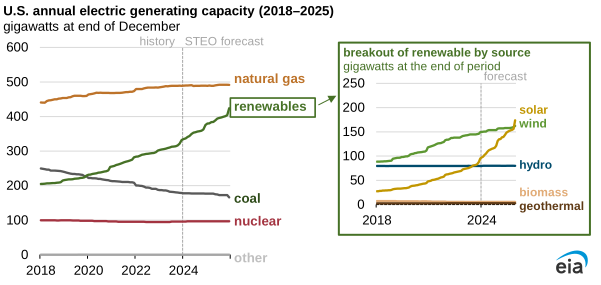
So surely the article should talk about the economics (to the grid operator and to the rate-payers) and how it, or a plant like it, affects the average emissions per unit energy supplied by the grid.
The next someone gets excited about installing a shiny new heat pump in a place that can get very cold (which includes parts of Arizona!), remember that its coefficient of performance can get quite low on a cold winter night, that it's really nice to keep one's house warm, that the sun won't be shining when this happens, and that the worst-case grid capacity has to come from somewhere. And, as some Texans can remind you, it really sucks when that energy fails to show up when needed. (Not to mention that parts of Arizona get very very hot and surprisingly humid, too, and the capaity needed for cooling and dehumidification on the worst days also has to come from somewhere.)
To be clear, I'm entirely in favor of calmly and carefully phasing out residential natural gas, but doing so is not at all a free lunch. In places where gas infrastructure already exists, and to the extent that leaks can be controlled adequately, an efficient, low-emission natural gas boiler/furnace is a very nice way to produce efficient heat in very cold weather, and it is just as efficient in very cold weather as it is in more mild weather. Unlike, say, a heat pump. Far too many people who want to phase natural gas out quickly don't consider the tradeoffs.