Changing the temperature of a fridge based on electricity rates just feels like a bad idea. A lot of food can have its texture ruined by slow freezing (a common occurrence at the back of many fridges already) and waiting to get food down to the target temperature will just lead to bacterial growth.
Seems like having an ultra-chill button for that function would help with that.
Might want some phase-change materials to optimize the thermal banking.
That’s easier for a freezer (very salty water bottles) than a fridge (need some carefully produced waxes), but fridge contents should be more tolerant of temperature variability.
Would add that refrigeration is more efficient at night when ambient temperatures are generally cooler and/or heating needs are greater, so the “ultra-chill overnight and daytime backoff” might not increase consumption.
the fast chill button is a thing. it's in both my 8yr old GE and my newer samsung..I never use it though but it's made for putting still warm leftovers in and getting them cold fast
These functions do not change fridge temperature, choose when to run the defrost functions for no-frost units (a quick wall heating to melt the ice and quickly came back to normal), choose to run or not some ancillary functions (like making ice cubes) etc. They are VERY chatty https://news.ycombinator.com/item?id=38984609 but not much useful.
Shifting loads for hot water, if you have big enough reservoirs on contrary change MUCH the game, being able to shift some loads automatically, like leaving a dishwasher or a washing machines, a pumped irrigation systems and so on might significantly change the overall bill to makes investments in that sense meaningful.
A recent podcast turned me onto them. The idea is to heat water to higher temps than normal and use that extra heat as an energy store for use during peak times.
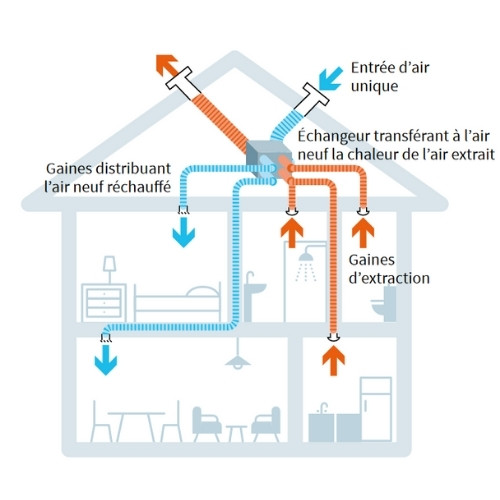
I think is not a novel idea: there are various vendors here in EU that offer "thermodynamic VMCs", meaning dual-flux ventilation system [1] with a small heat-pump between the to air flows, sucking heat from the outgoing air, heating the incoming flow in winter, in summer to avoid injecting too humid water they passively exchange outgoing fresh air with the incoming and the heat a water tank for sanitary water, cooling as needed the incoming air after the passive exchange, for instance https://www.broferpura.it/en/products/Domestic/compact06.htm... this reduce the number of compressors a home need in mild climate and new homes.
For me I simply run the main heat pump at full power during the day on p.v. reducing the grid absorption for some hours in winter and for sanitary water almost zeroing it since 300l @60-65℃ (140-149℉) suffice for a whole day, at least when I have enough p.v. a day after another.
Honestly I doubt it's possible to store enough heat with current tech to compensate the home heating needs, it's possible for sanitary hot water (except for a swimming pool) but no more. However for mild climate for some months might be enough to significantly reduce the grid absorption. The sole issue here is that heat pumps now, without any specific reasons, have skyrocketed in retail price enough to make them far less convenient than just few years ago... So the economy is still not much.
This is very standard stuff in Finland for decades. And before heat pumps became popular large tanks were common and those were heated during the night.
Most freezers already do a defrost cycle so could probably play with that. It’s only a few degrees oscillation so idk how much savings you could get there.
A modern fridge only consumes around 350kW a year or so, so any savings are going to be modest. It would not be the first target if I wanted to cut my power usage, especially if the consequence was going to be more freezer burn.