The spec fafs around a bit talking about how the px is a "visual angle unit" But I am unable to form an interpretation where the "reference pixel" is anything other than 1/96 inch.
I guess theoretically a tv could say "this tv will be viewed at 12 feet away so our reference pixel is 1/16 inch" and still be in spec. Which sounds like it has messy implications, Does anyone do this?
Anyway the point being a pixel should fundamentally be a hardware measurement, and if they wanted a "visual angle unit" they should have introduced one.(the moa?) But the last thing we need is a pixel being defined as a hard 1/96 of a inch. which is what we got.
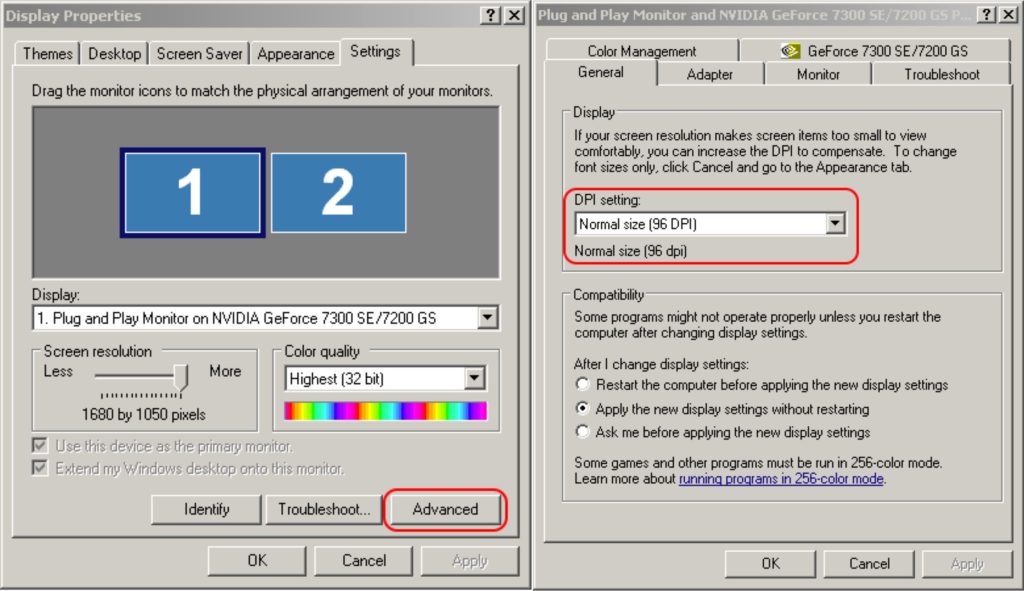
Windows used to let you set the DPI setting of the monitor, circa Win95-WinXP. Software tended to only expect a value of 96dpi, so it wasn't a very practical setting to change, and eventually windows introduced display scaling (which leaves old software in the belief that you are on a 96dpi screen, while allowing software to opt in to knowing about the real device pixels)
I guess you could use that setting on an old version of windows to set a screen to 16dpi, and now a CSS reference pixel is 1/3rd of a real pixel? But more realistically, what the spec is getting at is that a mobile device should set its dpi setting close to the real device setting, and a reference pixel is now something that looks about as big as a pixel on a 96dpi screen. That nobody actually sets their screen dpi on desktops is probably of secondary importance to them
what the spec says doesn't really matter though, the spec is just nonsense people wrote down to try to back-explain decisions that the browsers had already made.
pixels are pixels, and no browser implements them as a fractional-inch measurement. in every actual implementation i'm aware of, they're a hardware based unit.
> Samsung Display succeeded in designing the most optimal spatial frequency design with a 45 degree diagonal symmetry across the entire display layout.
All of the components are in that diamond pattern. When you try to draw to a specific pixel width, the display chooses which sub-pixels make up a logical pixel. There is no specific square for you to target.
Pixels very much exist in hardware outside mobile. Microsoft’s clear type even exploited the specific layout of color channels in discrete hardware pixels. Mobile displays are all over the place, but most other displays use standard RGB layouts.
Right, but there's still an addressable set of display units that convert an RGB signal to actual glowing lights, right?
It seems like defining px to be perceptual is one of those compatibility hacks that probably helped a ton back in the day, but we have perceptual units and now we're stuck with that baggage.
I don't have much of an opinion on this (I use em) but it has taken me by surprise a few times.
> Right, but there's still an addressable set of display units that convert an RGB signal to actual glowing lights, right?
Yes. But those glowing lights aren't little squares in a neat horizontal and vertical rows.
The square pixel is useful in logical contexts - like an SVG or bitmap graphic. But when it is turned into a physical display, those pixels aren't displayed as little squares. The RGB elements are arranged in dozens of different formations depending on the display technology.
Yes, except 80% of those displays align them as neat little rows and columns. Mobile is really the outlier with odd formations. Nearly everything else is physically identical to the grid conceptual model.




https://drafts.csswg.org/css-values/#absolute-lengths
I guess theoretically a tv could say "this tv will be viewed at 12 feet away so our reference pixel is 1/16 inch" and still be in spec. Which sounds like it has messy implications, Does anyone do this?
Anyway the point being a pixel should fundamentally be a hardware measurement, and if they wanted a "visual angle unit" they should have introduced one.(the moa?) But the last thing we need is a pixel being defined as a hard 1/96 of a inch. which is what we got.