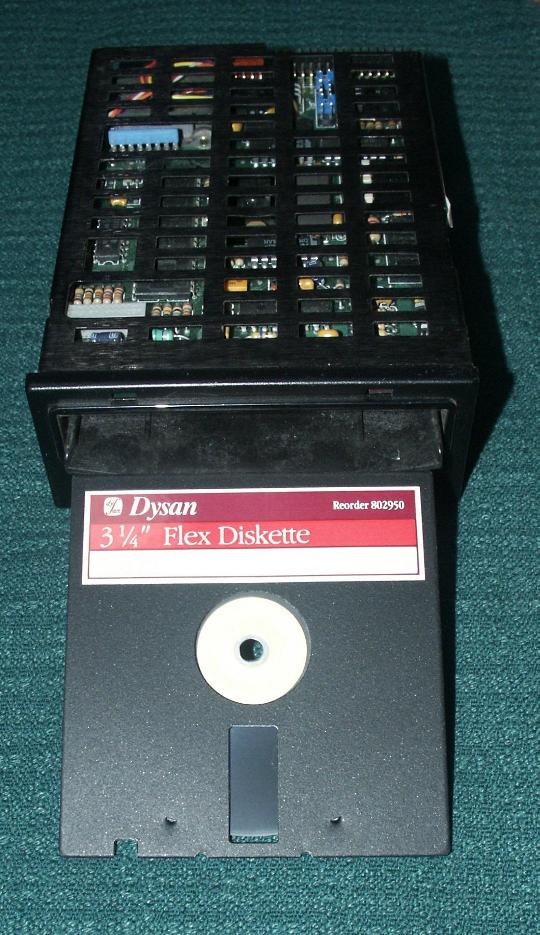
What must really drive you nuts about your 3.5" floppies are the fact that they are not 1.44 MB, or 1.44 MiB, or anything else that resembles 1.44 x some factor. They are actualy 1000 x 1024 x 1440 bytes (so 1440 KiB). The 1.44 on them is derived from a mixture of SI and Binary units.
Yep, looks like I did. I'm having a hard time remembering memory and disk sizes so small. Actually, I think I meant for the 1440 to 1.44, so it is 1.44 x 1000 x 1024 (showing mixing the base-10 and base-2 units). So a MB in the 1.44 MB floppy is 1024 x 1000. Or, to put it another way, to get the number 1.44 out of 1474560 bytes, you first divide 1474560 by 1024, then by 1000. Weird.
Typical usage was to pack 3 6-bit characters into a word on these machines if you weren't simply using it as integer data. So it's "really" something closer to 12k of text or (assuming all the computations fit in the different word sizes) 16k of integer/pointer data.
Oh sure, "real" English text processing only ever worked with EBCDIC and ASCII (and obviously everyone else in the world had to wait for yet another bit to be added). But an awful lot of work was done with all the caps-only sixbit encodings (like BCDIC -- without the E), including source code and documentation that we all would view as classic "text" tasks these days.
The only real point was that early computers were packing an awful lot of useful information into some really tiny quarters. Just four of these cores would have provided an environment very similar in space to a C64.