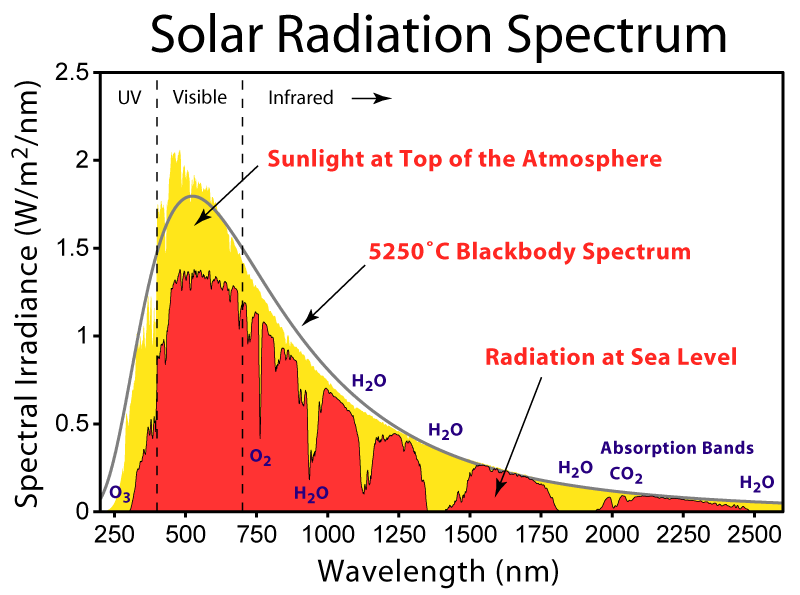
> we can assume our eyes evolved to the spectrum best suited for our environment and survival
Sadly, no.
Fish, reptiles, dinosaurs and birds have four colour receptors, so they would need four primary colours in their monitors (and would consider us colour-blind). Back when they competed with dinosaurs, mammals were nocturnal, so colour-vision de-evolved and most mammals today only have two receptors (so humans would would consider them colour-blind).
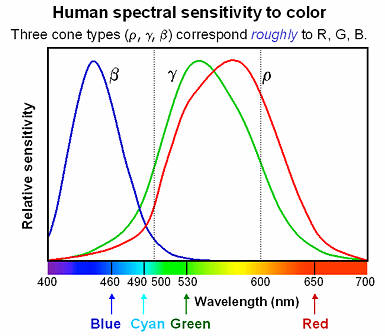
The fact that humans have three receptors is a recent development, it is only present in primates. It comes from a mutation which split a single receptor type into red and green ones. They are still not optimal---because they diverged recently, the sensitivity curves overlap more than would be ideal.
RGB isn't white, it just looks that way to us. True white has every frequency in it.
Color is an infinite-dimensional space since you can have any amount of any frequency EM waves. Humans eyes reduce that infinite dimensional space to 3 dimensions, centered on RGB.
To add to that, to an animal with only two colour receptors (there are a lot of them), just RG might look white.
Or to be more precise, for them instead of equal proportions of 560 nm/530 nm/420 nm light being white, their own white might be something completely different like 550 nm/460 nm depending on their photoreceptors. Which would absolutely not look white to us. And mantis schrimps would need equal proportions of 16 different wavelenghts to see what they could call white.
This is inaccurate. When you combine those three wavelengths, you get light with those three wavelengths in it. To get truly white light, you need to have a continuous spectrum of different wavelengths, such as one might obtain from a radiating blackbody at a sufficiently high temperature.
RGB was chosen exactly because of trichromatic vision. It simulates white light because it produces biological activation in the eye indistinguishable from truly white light. A tetrachromat pigeon could look at one of our screens and complain that what we see as white was actually lacking in ultraviolet light. But our eyes are not receptive to UV, so we just leave it out.
Choosing other colors for display would simply be a waste of power, as those colors would be both less efficient and less selective when activating cone cells on human retinas.
Print pigments are cyan, magenta, and yellow because those are most efficient at creating colors in ink or paint that humans cannot discern from the color of a natural object. The whole game is about ensuring that the light levels in the three color channels that most humans can use are identical.
True color reproduction, that matches absorption and reflection spectra across light frequencies from ultraviolet down to infrared, would require instrumentation more sensitive than the human eye. Paints have more than just CMYK in them, because cost-effective, stable, and non-toxic pigments don't necessarily match what is convenient for the human eye. So paints may have varying quantities of red ochre, titanium white, carbon black, ultramarine, cochineal, etc. And this is why you have to go to the hardware store to look at the paint chips under different lighting conditions. The color gamut of paint pigments simply cannot be accurately reproduced by most computer monitors, because there is some overlap in the frequencies that activate our three color channels.
The blue light from your monitor also activates some green in your eye. The green also activates some red and some blue. The red also stimulates green. So there are some colors you cannot see on your monitor, simply because the light used is not specific enough to your color channels. That is the basis for the "eclipse of Mars" illusion. That overstimulates the red channel until your brain starts to ignore it, allowing a blue-green background to appear as a true cyan instead of cyan with a little bit of red in it.
> That overstimulates the red channel until your brain starts to ignore it, allowing a blue-green background to appear as a true cyan instead of cyan with a little bit of red in it.
I think this is less due to the brain and more due to the chemical regeneration of rhodopsin, which takes time (minutes, even).
>I'm fairly certain the colors of light were there a bit before our eyes evolved.
Light existed before humans. Colors, as seen by humans can only exist when humans do. In my worldview, colors are signals in our brain, corresponding to light of particular wavelength entering our eyes.
>I'm not certain, however, that RGB was chosen because of the trichromatic nature of our biology.
I'm pretty sure that you need at least three base colors to represent all of the colorspace (most) humans can see. If we used less base colors, we simply would not be able show some colors on the monitor. It happens so that we have receptors for red, green and blue light [0]. IMO, choosing these as base colors would be a good idea.
>when you combine those three wavelengths, you get white
You get "white" as perceived by humans, but Mantis shrimp [1] would see that it is different from sunlight.
>Choosing others would result in, well, not white.
You can get "white" from any pair of complementary colors. But combining these would not cover all of visible colorspace.
You can get "white" from any three linearly independent colors (if you allow subtracting).
You can choose any basis for colorspace as long as three colors are linearly independent. You can write a transform matrix from one basis to another. In some cases, these transformation matrices are simple (cmyk -> rgb), in some cases (rbg -> YCbCr), they are not.
>I would attribute this more towards the fact that our sun happens to consist of particular elements
No, it has to do with the fact that light emitted by Sun is very close to black-body radiation [2], and it only depends on temperature of the Sun's surface. There are absorption lines [3] corresponding to some elements in Sun's atmosphere, but you don't see them with a naked eye.