I don't think it's complete nonsense - buying something useless and expensive is a very strong signal (like the peacocks tail). Buying something useful for the money instead is not the same thing at all.
So while the diamond thing was created through advertising, it persists because it has a real function. Maybe it could be replaced by something else, but that would probably be something just as useless to demonstrate commitment.
Still, if you can get by without the investment, good for you.
> ...buying something useless and expensive is a very strong signal...
I see this comment every time engagement rings come up on Hacker News. Yes, it's a strong signal. But we're a bit smarter than that, and we can select mates who are smarter than that too. Perhaps this kind of peacocking will die out. Perhaps nature will select for mates who are level-headed enough to look at salary figures rather than shiny rocks. There are going to be a lot of people who realize that a down payment on a house or money in the bank will make their relationship more successful than a shiny rock will. I'm willing to bet on those people living and reproducing.
Right... but humans have a much richer way of signaling than most animals. My point is that some humans will find ways to signal commitment without sinking three months of their salary into a worthless rock. Signalling theory is an explanation for observed behavior, not a guarantee that such behavior will persist if the organisms in question develop alternative strategies.
I like to think humans are pretty good at developing alternative strategies.
Besides, if you get divorced, you don't get your down payment back anyway.
Sure, as I said in another comment, diamonds could probably be replaced. But it would probably be by something just as useless.
Or maybe if you can find a way to mimic the effect, but make it useful, you have your hands on a very valuable startup idea.
I guess it would be something like helping friends move, which is considered a good signal for true friendship. I don't know (not an expert on this), maybe if you find a way to "help your spouse move" for the equivalent worth of 3 months of your salary, you are good.
Why don't you get your down payment back if you get divorced?
The point is, changing spouses is expensive if they all want a diamond ring. So that custom is a shield against heavy spouse changing.
The whole marriage thing is also extremely expensive. I suspect for similar reasons - so that people think twice before throwing it away. In that case they also have angry friends and relatives who invested into expensive travel and presents and probably wouldn't be too happy if it was all for nothing.
There are only a few outliers, by definition. So most people have to make the compromise. Coordination games work by punishing you when you don't follow the crowd.
I would rather take out a few thousand dollars in cash and burn it in front of her than spend them on a diamond. That also has the added benefit of reducing inflation.
So how about donating to some charity? The wives can then talk about that... "My husband donated thirty thousand to a school in africa". Or is it harder to show than a diamond?
The problem is that the husband in your example might have liked to donate to charity anyway. It would have to be something the husband doesn't give a shit about or even actively dislikes spending money on.
Also it's harder to show off reliably.
The ring is in many ways pretty good: It's always on your body, in direct view of your peers and it had absolutely no utility to the buyer except as a gift for the receiver.
Maybe there's a market for "ethical rings" that work as a token / certificate of a donation. For example restaurants like to show all kinds of diplomas on the wall at least around here.
So she should pick the charity. I'm sure it's easy to find ones which the husband would not have donated to on their own.
Classification societies already by the way have established ways to do development aid verification.
On the other hand, just withdrawing the amount in cash and setting it on fire might cause less harm to the world than a blood diamond. What a bachelorette party... :)
I thought expensive jewellery was meant as a sort of life insurance policy. ie the widow could sell it in the event of the husband's death and have enough to support her for a period of mourning. Or something like that.
Historically it replaced suing the other party in a failed engagement for "breach of contract". The idea being that a woman who had a failed engagement was less able to find a good match. The engagement ring essentially acted as a good behaviour bond that the marriage would go ahead and especially to stop the "I promise I'll marry you, now let's have sex" cad.
>buying something useless and expensive is a very strong signal (like the peacocks tail)
And how did it help the peacocks to feed itself or outrun a panther? You will say "but the ultimate goal was to transfer his genes and he did". Yeah OK, so the ring is a lie and probably first bad financial decision in a future long strike of bad ones that help dudes to get laid and then get trapped in the rat race pay check to pay check.
The point of signalling is to prove fitness - the peacock can afford to carry around a huge tail because he is fit enough. Women walking on high heels PROVE physical fitness. The point is to create a signal that is hard to fake.
Putting money into a down payment for a house doesn't signal commitment or financial strength. You would have had to pay for housing anyway. Throwing away x times your monthly salary shows commitment and financial strength.
Financial security is obviously important, and I might be in a minority here, but I'd like to think that financial strength isn't a good basis for choosing a partner. Depends what you want out of a relationship I guess.
Financial issues ruin marriages, moreso even than infidelity. "Richer or poorer" is the bit of the vow that might seem easy when you're young, in love and likely to get richer, but if a financial crisis destroys your social circle, uproots your children and severly challenges your lifestyle then it becomes very hard to overlook.
I'd also observe that "ability to live within ones means" is not necessarily a "richer or poorer" thing. There are those who will always live within, say, 80% of their free income until you literally hit the bottom where you can no longer survive, and there are those who will always live within 125% of their income, even if you give them a 25% raise every single year of their life. The first of these is marriable, the second effectively isn't.
(Note my complete lack mention of any gender whatsoever, or any other characteristics. Regardless of what the population statistics may be based on any traits a person may have, what matters is whether this person standing in front of you can live within their means, and anyone has the capacity to pass or fail this test.)
I agree that this is what can be observed, although it's probably a lot more complex than "being rich = beautiful partner". Either way that's why I said I'm probably in a minority in considering it less important than other traits (such as honesty and kindness).
That you think most women need some sort of extravagant and useless signal of a man's commitment to them, and that this is in your mind a uni-directional thing.
But why not signal with something that has "real" value, e.g. a golden/platinum ring (that you can actually resell for it's weight in gold)? Same signalling, same expense, but better investment.
"Most of us are way above the peacocks, intellectually."
Lol - not really. Lots of signalling going on among humans. I mentioned the high heels, but I think most womanly things are like that: long hair and long fingernails show not having to work (manually), so high status.
Even drinking and smoking could be part of the game (showing off that you are healthy enough to cope with a little poison). Many, many things - signalling theory is essential to understanding our society.
What is useless about something that is beautiful? Many people purchase objects of beauty (just look at the art world!) which cost much more than a diamond!
The fact that you're paying radically more than any actual open market price that you could possibly access.
If you paid $10,000 for something but could generally resell it for something like that value it wouldn't be a scam. But if you buy a $10,000 ring from a vendor and try to find a way to sell it for anything like that much, you will find you can not, and not only the usual "I can't recover the vendor guarantee and reputation premium" that you'll find if you try to sell things on Craigslist or something, but you'll find that you can't even come close.
It might be tempting to get into philosophical discussions about "what is value, really?", but that would be the wrong direction to go here. I'm happy to take value as a highly subjective judgment, because that is indeed what it is. My point here is brutally practical, and, well, exactly what I said, and no more... the problem here is literally that you will find that what you've bought can't be resold for anything like what you bought it for, and where that truth comes from doesn't much matter when you're trying to resell.
The art world is radically different. It is assumed that you are a smart consumer who is expected to defend themselves. And I'd also point out that if you spend a million dollars on something that turns out to be a really high quality forgery worth about $5K on the open market, we still call that a scam.
> the problem here is literally that you will find that what you've bought can't be resold for anything like what you bought it for,
What does this have to do with an "open market price"? Most anything bought at retail price will not have the same resale value, that's just how resale markets work. They buy at wholesale and sell at retail. Pieces of jewelry and whatnot are not commodity bundles you can trade on a liquid market.
Retail art pieces aren't any different.. High dollar art trades at auctions (again, lots of liquidity), that's why they're easier to resell. But if you sink five grand into a piece from some gallery, good luck reselling it.
As I said in my message, I covered that with the "retailer premium", which I understand exists for a reason, which I describe. That reason does not cover the degree to which you can not resell the ring, which is absurdly large. Also observe that despite technology recently being able to make "forgeries" ever better, this inability to resell at anything like what you paid for it has been true for decades.
Maybe because the demand for rings is not for their commodity value, but for their signaling value? So buying a ring from Tiffany's is worth a lot more than buying one off craiglist? And they aren't scarce so jewelers don't need to snatch them up off the "open market", but they need to make high margins to cover the overhead of their fancy stores.
Are you looking for a cause to the "absurdly large" degree? Or just pointing it out as some mysterious conspiracy?
Of course you can't get full retail value when reselling a luxury good. That's as true of Tiffany rings as it is of Macbooks.
But there is a conspiracy to exploit people desperate enough to have to liquidate their jewelry. It's detailed in the article linked to by the OP. That conspiracy is what causes jewelry to have a resale value of maybe 20%. Compare this to 6-month old MacBooks Air (worth ~80% of their retail price) or a car you drive off the dealer's lot (worth ~80% of what you paid).
Gold, silver, and diamonds are quite literally valued by an open market. You can call a broker and buy them for what the whole world has agreed is a fair price.
A piece of jewelry's wholesale value is determined by adding up the market value of its constituent components and then adding a workmanship premium. In an ideal world, consumers could buy and sell jewelry in the same way.
This is interesting, but I guess I'm wondering how it really differs to buying a brand new car. The moment you drive it outside the car dealer you've lost money. It would be interesting to compare the lost value of jewelry as a percentage to other items purchased brand new.
The diamond I have was purchased at wholesale price and custom made into a setting - it wasn't some off the shelf piece from Tiffany's. I think that where you purchase the jewelery from can also make a significant difference to its resale value.
"This is interesting, but I guess I'm wondering how it really differs to buying a brand new car. The moment you drive it outside the car dealer you've lost money."
A: Nowhere near as much, and B: That's what I was referring to with the "vendor guarantee"... the reason why your car loses its value when you drive it off the lot is obviously not that the car changes meaningfully, but that in the somewhat scammy world of used cars you will not be able to establish to anyone that your car really is brand new anymore, so you take a hit based on the fact that you do not have a reputation that says "I am $CAR Dealership XYZ and I stake my name on the fact this really is a brand new $CAR straight from the factory".
(Incidentally, to some extent, note that when people suggest that the solution is to always buy used, they often aren't taking that into account properly in their zeal to make their point. You're paying less precisely because the odds of you being scammed just went up. If you are, for instance, someone very likely to be able to detect scams, by all means, go collect your "knowledge premium" from the market and buy used. But if you are not such a person, think twice. I don't mean "never do it"... I just mean, think twice. I have family that was taken for a ride by buying used when they "couldn't afford" new... well, it turns out they couldn't afford "scammy used" either....)
Yes, that is one solution to the conundrum, buy at actual market value. In the longterm that's an unstable solution... if rings lose their signaling value entirely (see other comments), then the eventual stable solution is not to buy them at all. However, in the meantime, what the eventual stable solution 50 years from now will be isn't actionable today, so by all means buy something that impresses your friends and pocket the difference. My wife and I went a different route and bought a nice ring with two Tanzenite stones in it for, IIRC, on the order of $250 1999-dollars, and I still think it looks pretty nice. Tanzenite is a bit soft but we've had no problems, and I think it's beautiful but the jewelry community seems to think it isn't worth much. We were happy to come to arrangements with them on that matter. This is another way to hack the process, since people aren't consciously thinking all the way through this it can suffice to present a token similar to a "diamond ring" but that did not require the useless investment.
But the jewelry doesn't even have to be used. It loses value /when you buy it/, wherein lies the scam. If you buy a car and don't start up the engine and try to sell it a week after you bought it it will be worth approximately the same as when you bought it.
Good luck if you're not a car salesman. It's a reputation issue, why should I trust you that there isn't a problem with the car, why are you selling it? That "risk of it being a lemon" factor is what causes a new car to massively depreciate.
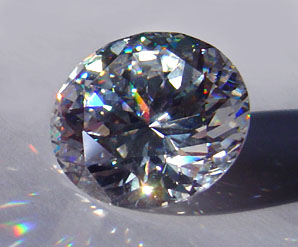
But why is it beautiful? A CZ is indistinguishable from a diamond until you look at it with a microscope, yet maligned as an inferior piece of jewellery.
High quality diamonds look grayer/silvery under bright light, whereas CZ produces rainbows. I own both, and it's easy to tell the difference if you're, say, outdoors in the summer, or under full-spectrum lighting. Moissanite is closer, but moissanite still has more of a "rainbow" look, and is often yellowish.
If a friend of mine was showing off her engagement ring and it was refracting a little rainbow on her finger in the sun (like this http://upload.wikimedia.org/wikipedia/commons/b/bd/CZ_brilli...) I obviously wouldn't say anything, but come on. Getting a CZ engagement ring is going to lead to an awkward situation at some point.
There are a few quick tests that can quickly separate a CZ from a diamond. Exhale on a similar diamond and it clears up much faster because of diamonds high thermal conductivity.
More importantly, CZ is far less though than diamonds so they don't keep their shape under abuse nearly as well. There cheap enough you could swap out the stone every year, but just keeping the same CZ in a ring does not work over a lifetime.


So while the diamond thing was created through advertising, it persists because it has a real function. Maybe it could be replaced by something else, but that would probably be something just as useless to demonstrate commitment.
Still, if you can get by without the investment, good for you.