Not a great example of a wrong prediction, IMHO. People did never end up taking laptops fishing. Tablets, ebooks, and cell phones are fundamentally different things that address the key problems noted in the article (screens and keyboards).
The thing about predictions that gets ignored in retrospect is that there are always implicit qualifiers, because it's not very interesting to hypothesize about the totally unconstrained future.
"Whatever happened to the the laptop computer?" may be the HN headline here, and the 1st sentence of the article, but if you read to the end you'll see the following:
"Sales representatives, service managers, field auditors of all varieties have not been adequately served by the computer industry in pushing laptop computers. As the technology of these machines, particularly of their displays, improves, and as their price declines, a lot of briefcase computers will probably be sold. And as the software that is capable of turning them into true satellite offices becomes refined, they will probably even be used - in fact, profitably so."
I'm hearing another prediction, that "a lot of briefcase computers will probably be sold." if things like displays and software improve.
Not sure who is calling this a wrong prediction, but the article leaves us with more than a gist of laptops weren't working out for the common business in 1985, but they did not explicitly state that they were never going to work out.
Not really. The author's main idea was that even people who were already using word processors and spreadsheets would by and large not be interested in using them anywhere but at their office and at home, and that technical or price improvements to laptops would not change this. He returns to that thesis immediately after the excerpt you quoted. He really was just far wrong in this.
I suspect he would have been far less wrong were it not for the rise (much later than the article) of near-ubiquitous (in terms of places one might want to work) high-speed wireless networking. Not having to either to lug your data from desktop to laptop on physical media or to find a phone line to dial in to where the data lives via modem makes laptop use a _lot_ nicer than it would have been otherwise.
No doubt Wi-Fi helped to push laptops to a new level of popularity. But the laptop became a big mainstream success—as a fraction of the total size of the business PC market, which is roughly the yardstick the author held up—even before dial-up Internet and the WWW became popular. The Compaq LTE https://en.wikipedia.org/wiki/Compaq_LTE came out in 1989, and by the end of 1992 the ThinkPad and PowerBook were both with us.
You're right. For me, it does point to the fact that most predictions are wrong at some point, right at some point, and irrelevant before and after. The things that was a laptop then (5kg beasts like this http://en.m.wikipedia.org/wiki/Sharp_PC-5000) were nothing like today's machines. The T1100 seems to have been the first close thing.
It's impressive to think that it took 20 years from that article for notebooks to outsell pc. http://www.theguardian.com/technology/2009/oct/28/laptops-sa... also fun to see how net books are a focus of attention for that article.
I wonder what level of accordance will be needed for a wearable to seriously compete with the current mode of computing.
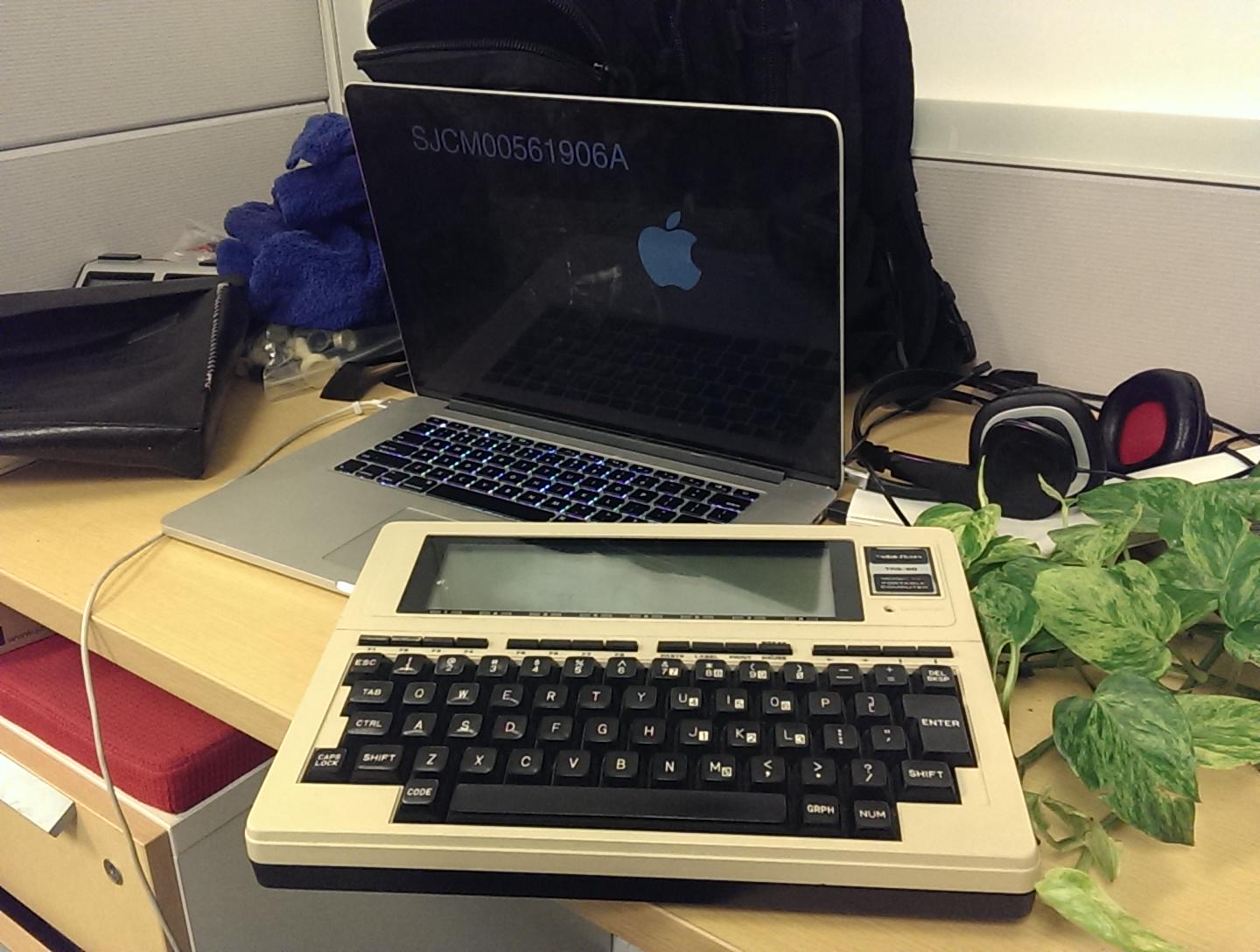
The TRS-80 model 100 had a bit of a following of the 1983 crop as I recall. Journalists could write a story and file it by modem. The luggable Compaq had some use cases but I think was sort of a novelty. The others of that generation didn't really take off. The Toshiba T1100, might have been announced in 1985 but I think came out later. I remember them as a new thing after I started my first job in late '86. So I could see laptops as something that had been hyped in '83 and by '85 still not ready for mainstream adoption. Those later Toshibas were usable for Lotus 1-2-3 and text-mode MS-Word. First Mac portable around '90 was still not ready for prime time.
Yes, I used that TRS-80 model while haunting the stacks at the Library of Congress in the 80s. A lot of people would ask me about it. It was great for basic text entry, and made life so much easier. It was a fantastic tool for the time.
I always wondered how useful things like the Poqet PC and HP 95LX actually were. I remember seeing them in electronics stores and trade magazines, but they were really compromised in terms of resolution and memory.
I had an HP200LX (still have actually) and it was fabulously useful - a full CGA DOS computer that ran on 2 AA batteries for 40 hours and fitted in your pocket.
It had XIP (Execute-in-Place) applications built into the ROM which ran instantly, including Lotus 1-2-3.
I kept all my finances on the (built-in) Pocket Quicken and organised my Calendar, Address Books, Writing, you name it. Even printing was a doddle - I just pointed its Infra-Red port at the Office Laser Printer and it printed quite happily.
I used it as an e-reader, turning it on its side like a book, before e-readers even existed.
It was so fabulously useful I find it hard to believe that they weren't more widely used!
I don't think it's accurate to say that those early laptops were nothing like today's machines. For starters, we've still got laptops that are every bit as heavy as that PC-5000. I think it's just been a clear gradual trend of reallocating the bulk and weight from the under-the-hood electronics to the display, and the minimum size necessary for a functional machine has been steadily dropping.
The article starts off describing laptops on airplanes, the tag about fishing just seems like an exaggeration by the author. I would say that the author was wrong and this is a good example of a bad prediction. I mean, did you read the line about floppy disks? The authors points were that laptops are #1 to heavy #2 their software doesn't stack up and #3 their price is far to high.
All of the predictions are wrong, so I see this author as betting on the wrong horse.
All of those points were true, though. (Also #4, the displays suck.) The author correctly called out all the reasons that laptops weren't popular at the time. Maybe he didn't explicitly say "and once these problems are fixed, laptop sales will rise," but you can read between the lines.
If you read the last paragraph the author doesn't believe in the idea of the laptop and says they will remain a niche market. I honestly believe he couldn't imagine a light, affordable laptop with features being desired other than in niche settings like the military.
The prediction is in the title, and it's that laptops are a drying (or dead) trend because they are #1 too heavy, #2 do not have good software, #3 are too expensive.
I feel like we read vastly different articles. I read an article where the author discussed the limitations of laptops as they existed thirty years ago (when, I'll remind you, this[0] 12-pound beast was state-of-the-art), discussed some advancements that would need to be made for them to have more widespread appeal, and discussed some realities of how, when, and where people use computers that remain essentially accurate today.
If that was the case, I wouldn't have had a problem with the authors viewpoint but it statements like,
For the most part, the portable computer is a dream machine for the few.
that really miss.
And then their is the conclusion, which comes after the author acknowledges the possibility of improvements in laptops.
But the real future of the laptop computer will remain in the specialized niche markets. Because no matter how inexpensive the machines become, and no matter how sophisticated their software, I still can't imagine the average user taking one along when going fishing.
What?! To me that just shows the author downplaying the idea of the technology. He just couldn't imagine any laptop ever being more than a "niche".
> "For the most part, the portable computer is a dream machine for the few."
I would say that 30 years ago, this was an objective statement of fact.
> He just couldn't imagine any laptop ever being more than a "niche".
And you'll see he was and is correct if you consider, as the author was, the usage model. People largely use modern laptops the same way they use desktop PCs. They simply transport them between their regular workspaces. Multiple devices have been collapsed to one, but the way people use them remains the same.
You are focusing very narrowly on the physical devices that the (then and now) inaccurate label "laptop" has been applied to. The article makes much more sense if you abstract to the concept of a laptop, particularly as pushed by marketers 30 years ago.
You are ignoring the line "But the real future of the laptop computer will remain in the specialized niche markets..." That's the part that's a prediction, which informs the tone of the whole article, which turned out false.
The false prediction indeed comes largely from the author's inability to believe that such technological advances could come, within only about 10-15 years, that would completely erase all the downsides he correctly identified (size, cost, etc).
I think we're less likely to make such false predictions today, because we've seen such rapid technological advances. This sunk in for me about 10 years ago, before the iphone, talking about digital book readers with a professor, who said to many students who didn't believe digital book readers were in our future: Imagine what you _would_ need in a digital book reader. Smaller and lighter than a paperback? Cheap? Can be read in sunlight? Because all of those things are coming, only in the next few years. Then do you think digital book readers will take off? Lightbulb moment.
Even though the author of this OP continues with "Because no matter how inexpensive the machines become, and no matter how sophisticated their software...", I think if he really believed inexpensive, cheap, small, light, sophisticated computers were coming, and soon, he would have had a different prediction.
> You are ignoring the line "But the real future of the laptop computer will remain in the specialized niche markets..." That's the part that's a prediction, which informs the tone of the whole article, which turned out false.
I'm not ignoring it, see my other comment[0]. Consider lessening your adherence to excessive literalism, and then reviewing the author's points free of the bias instilled by the unfortunate label of "laptop" that has been slapped on devices that are rarely used on people's laps.
See if you can't bring yourself to understand that the author was right a lot more than he was "wrong".
Even false prediction have truth behind them. Just because the author mentions some truths doesn't mean that his conclusion is right. This is his case, and though he mentions some truths, his conclusion is "laptops will remain in niche markets".
I think the article is interesting irrespective of the "wrong prediction" aspect. I think it was asking a legitimate question at the time. I was only a kid, but my dad had a computer company and I remember those early laptops he sold. They were interesting, but they were limited in a number of ways.
Also, they took some weird turns. Manufacturers didn't want to try to cram standard 5.25" floppy drives (3.5" were not yet standard at that time) into laptops, so they came out with all kinds of weird proprietary drives. And then you had to shell out tons of money for those proprietary disks.


The thing about predictions that gets ignored in retrospect is that there are always implicit qualifiers, because it's not very interesting to hypothesize about the totally unconstrained future.