The real problem with shifts like this is the transition period.
I agree that that, considering every luddite separately, that each did have valid concerns. Every person cares forst on foremost about themselves and/or their immediate family.
And when new things make old things redundant, of course it negatively affects the person whose job revolved around the old thing. And this in turn negatively affects their families.
So, they are srewed. But the new thing is staying and from that point on, every "new" adult that looks for a job in that area will know nothing but the new thing. Will operate this new thing and will make a nice life for himself.
In the end it will be viewed that the new thing is so much better and maybe society is actually better of having the new thing instead of how things would be if the old thing was still used, but the persons who were the last to rely on the old thing of jobs and thus prosperity will always be the ones who were screwd by this new technological advancement.
The people didn't get screwed by the technological advancement. They were forsaken by society. The technological advancement will happen either way. The problem that can be avoided is letting people starve on the streets but as history has shown we prefer to silence them with bullets rather than help them.
The "Luddite" argument is about what happens to the "useless" people. So far everyone just says "It's gonna be fine. Everyone else will be better off." which is equivalent to "fuck you I've got mine".
the persons who were the last to rely on the old thing of jobs and thus prosperity will always be the ones who were screwd by this new technological advancement.
That's not a law of nature; society could bail them out, much like we've done for arguably much less deserving classes.
Same here. Although it's been a very long time since I bought on eBay as well.
Now that I make some serious money, I'd rather buy from Amazon. Not the marketplace either. Just plain old Amazon. Where I know I am dealing with a company should problems come up and not some kid in their parents basement.
As far as selling goes, I come to know that all the buyer has to do is complain to eBay they never got the goods. How do they proof that? As far as I know they don't. They just write a colorful mail to eBay claiming nothing arrived and they sent the money via paypal and just as easy, the payment gets reversed.
I use gmail and search for stuff. That is about it. And because of that, I only log in like once a day into gmail, check mails and log out. Why would I want to stay logged in after that?
This site only showed me that it knows nothing about me which is intended.
That's too bad. The light bleeding makes playing games like Elite Dangerous really cumbersome. You can even dial down the cockpit LED brightness but that doesn't help with the bleeding. Because then the LEDs are too dull to read everything allright. Since the game plays mostly in space and the only light sources are the cockpit LEDs makes this problem really stand out.
Also, the general blurryness of everything outside of the center of the lenses make racing games way less fun than they are supposed to be. Everyone who drives in teh real world knows you keep your head mostly in one position and then peek down by moving your pupils to take a short glance at your instruments or the mirrors. All you see with the Vive is a blurry mess unless you move your entire head down until the intruments are dead center of your field of view. Not really the realism one would expect from a VR racing game, imho.
All this is just too bad. Because I think while roomscale is pretty neat it is still very much work to set up. I mean by clearing your room, moving furiture etc. And then you still don't get to act freely because you will always know that you can't go very far because you would run into something. Kinda immersion breaking if you ask me.
But where VR could really shine is with cockpit simulation games. No furniture moving needed. Just sit down, put the VR goggles on and of you go. Too bad that the light bleeding and the off center blurryness hinders this at the moment. Heres hoping this will be changed in the future.
It's not just too much work to set up. It's too much work to play. Standing up and moving around is never going to be as comfortable as lounging on the couch moving only your thumbs.
I think roomscale VR has a real problem as an entertainment medium. People expect it to slot into the same place in their lives as TV and video games, but it doesn't work like that. It's better to think of it as an indoor sport like table tennis (of course, it can literally be table tennis). It can actually work really well as a form of lightweight exercise. But roomscale VR is not what you want for vegging out at the end of the day like TV, and better hardware won't change that.
What really convinced me of this was playing puzzle games in VR. I wanted VR Myst to be awesome, but it's unfortunately quite uncomfortable to stand in place for ten minutes at a time while you ponder some contraption. Wearing a pound on your head doesn't help, but even if the headset weighed nothing it still wouldn't be comfortable just because of the standing. You can't rest, except by sitting on the floor. You can't lean on anything. You can't even put a hand out to steady yourself. It's exhausting.
I feel you on the boring parts of F1.
This, coupled with the idiotic halo they just have to put on the cars next year will mean that I spend my weekends a bit differently.
But, to the matter at hand, the vid only seems to be blocked when it is embedded on websites.
I had a "watch this on youtube" link in the message and when I clicked there it took me to youtube.com and the vid started playing. Whatever the reasoning is to block embedded vids but not the vid altogether is beyond me. But then again, so is uglyfying the car with apendages that make it look like a flipflop...
I get nightmares thinking what that will do to electricitry prices. The graph of how they rose is already awful.
And now imagine if the tax collected on mineral oil for gas falls away cause everyone drives electric. And know that there isn't a specific car electricity to tax.
Thinking the government would just eat this loss without thinking of ways to make the people pay would just be naive.
How much electricity do you use? I live in Germany and pay something like 35 Eurocents per kWh. I'm told that's a lot compared to other countries. And yet I somehow spend less than 30 Euros a month on electricity for a two person household. That's something like 5% of what I pay for rent. I really don't understand why everybody is concerned about electricity prices.
Edit: I asked around. While I pay less than my German peers, nobody I asked pays more than 30 Euro per person per month.
What do you do for heating / cool? Do you not have a fridge, or an always-on computer, or a water heater?
May last electricity bill was $750 for three months, a rate of about AU$0.26 / kWh, plus a daily supply charge of about ninety cents. The person who was responsible for a majority of that bill doesn't live here any more, but it wasn't hard to achieve.
Heating, including hot water isn't done with electricity. German climate doesn't require aircon.
I have a fridge that uses about 140kWh/year and I cook with electricity. I turn my electronics off when I'm not at home, so the fridge is the only electricity consumer when I'm at work. I use considerably less than 85kWh per day, the costs I quoted contain a rather large fixed component.
What are you doing to use this amount of energy? I DO have an always on computer, an old fridge, a laundry machine (no dish-cleaner, though, I do that by hand) and electric water heating. I use ~290kWh/month in a 2 person household. That costs me to around 80 Euros / month. Most of my consumption stems from the electrical water boiler and stove (daily cooking).
In Germany heating is most often and depending on where you live done with gas, oil or district heating plants (in cities). Electrical heating has pretty much been phased out (you'll find electrical "storage" heaters in very old apartments only).
Not the grandparent, but I used to use 1000 kWh per year, which is about the same as 85 kWh per month. (It's more since I built a desktop PC.)
> What do you do for heating / cool? [...] or a water heater?
ACs are not typical in Germany in private apartments, only in public and office buildings. My apartment is connected to district heating (which also supplies hot water), so this does not contribute to the electricity bill, either.
> Do you not have a fridge, or an always-on computer [...]?
I have a fridge (fairly energy-efficent and modestly-sized). I have an always-on homeserver, but it too is designed for small power draw.
The biggest chunk of these 1000 kWh per year (about half of it) is actually my terrarium, i.e. its heating and lighting, and the secondary fridge where the tortoises stay in the winter. I could have easily lived on 500 kWh per year if it weren't for that. (It should be noted that I don't have a large house, just a 50 sqm = 530 sqft apartment.)
During this time, my electricity bill was about 30 € per month, at 0.26 €/kWh. I currently pay 40€ per month since my desktop PC joined the consumers, at 0.27 €/kWh. I could pay slightly less (one or two cents per kWh), but I pay extra for a renewables-only power mix.
are you sure your numbers are right? I'm looking at my last electricity bill and we used 450kWh in one month. And it's not summer here so no A/C and our water is gas heated. We're a household of 2+2 young kids. We turn off lights when not in use, medium sized, reasonably new fridge, no always on computers etc.
hard for me to imagine how anyone could find a 12x reduction in usage! I need to know your secret :)
That's absolutely crazy. Do you have electric heat? If not you should probably spend twenty bucks on a kill-a-watt clone and check which of your appliances is consuming several hundred watts all day long.
according to this[1] Australian Government website about energy usage, for 3 people in my postcode (5075), no pool + mains gas, average daily consumption is 15.8 kWh, which matches almost exactly my last bill (avg was 15.3kWh).
I think some people are underestimating their usage. We're definitely not a wasteful household, we don't run the drier much, appliances are off when not in use, lights off when no one in room etc.
>If not you should probably spend twenty bucks on a kill-a-watt clone and check which of your appliances is consuming several hundred watts all day
yup already did that a couple years ago. Turns out there are no unusually bad appliances in the house.
nothing out of the ordinary I think. 2 computers on for about 8 hours/day. Dishwasher, TV on for 2 hours/day. iPad, home lighting.
I think some people in this thread are severely underestimating their energy usage. I wonder if people are just ballparking their estimates based on some rough data from years ago or if they're actually looking at last month's bill when saying they're using < 100kWh in a month.
Maybe for a single person who is never home that would be reasonable, but I can't imagine families being able to survive on so little.
edit: so this was driving me a little crazy and so I had to do some extra digging. My guess is that people not aware of their true usage. According to this [1], the average US household uses > 900kWh of energy/month. We're at half that so clearly not going overboard.
It may be crazy, but that is below average for a U.S. single-family home in many parts of the country. Old houses tend to be very inefficient, and many new houses are grotesquely large.
My family used 330kWh last month (also 2 adults+2 kids), including moderate use of AC; our energy efficiency report said we're using less than 1/2 the average of our neighbors.
Yours looks a little high, but be assured average power usage for 2+2 in Germany is 3000-4000kwh/year.
So lower than your 5400 but max 2x reduction :-)
Just to preface this: where are you getting the 12x reduction from? He spends 40 euros at 0.26, that's 150 kWh per month. That's 1/3rd of your usage, not 1/12th. And he's living alone, you with four. If anything, you're more efficient than he is per person.
Anyway if you want a reduction, just identify all the model numbers of anything plugged in and check specs and approximate usage.
It's insane how large the efficiency spectrum is, and how efficient things have become in recent years.
For example, modern 6ft fridges get so efficient they use about 8 kWh per month. Meanwhile, very old fridges can still use upwards of 40 kWh per month. We've seen a reduction of something like 75% in the past 15 years, that's pretty massive.
The most efficient washing machines now use about 10 kWh a month, while I can easily find washing machines for sale that use 25 kWh per month that were produced as recently as 2012 by LG.
And that's the difference in age. Differences in tech/model are also vast. In Europe we have a pretty decent energy labeling system for consumers for a decent approximation.
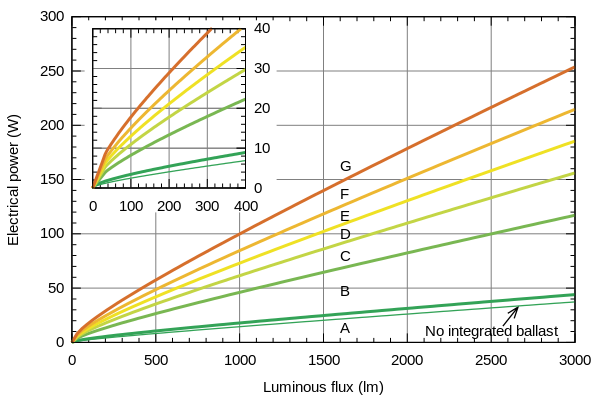
For example, here's lightbulbs [0] where you can see, for a certain amount of light (e.g. 3k lumens) the best bulbs use 50W while the worst use 250W. That's a 5x difference. You can easily drop 80% of your lighting electricity usage if you still have old bulbs.
The big items like washing machines, vacuum cleaners, microwaves, dryers, fridges, particularly old ones, all typically draw 2 kW or more at various times, so that's probably low-hanging fruit, assuming you have changed your bulbs.
A big TV is another one, not as high-powered but a lot of people keep em on for very long times, sometimes just as music players or on the background, and some TVs are really inefficient. Mine is alright but still draws 220 W. Contrast that with say the 2017 Macbook, which has a 42 Wh battery and lasts 10h. i.e. it draws about 4W. If you use your Macbook for 5h each day before/after work, you'd use about 0.6 kW per month, or about $1.5 typically. But if I have my TV on for 5 hours (I've used it as a music player like this but stopped due to electricity) it'd draw 33 kWh a month for about $80 a year.
If I compare the utility between these devices, it's crazy I spend 55x as much energy on my TV per hour of usage than a modern laptop. It's just that electricity is so damn cheap. The comparison to a phone is even crazier.
Also from central Europe (same climate zone as Germany) so I can answer.
Central heating in Europe usually works this way. You have a boiler in the ground/underground level of the building which turns water into steam which is pumped to radiators in the building through vertical pipes.
Most of boilers I have seen in central Europe use gas so it wouldn't be included in electricity bill. There are electric boilers as well but I haven't seen a lot of them out there, it seems like a rarity to me.
We have abundance of cheap gas so it makes sense most people would use gas boilers as you'll save money.
Another big factor is in central Europe doesn't need AC which is a massive electricity hog in places with warmer climate.
I think most of your crazy electricity bill in Australia is because of AC no? Do you have electric or gas boiler?
My wife and I had an average draw of about 100 Watts in the winter when we lived in San Diego. Made for electric bills around $12 a month. However, we had gas water heating. The gas bill was always for 0-1 therm per month.
The only always-on computer was an Odroid, and our bulbs were LED. The fridge was pretty efficient.
Just as a reference point, I use a LOT of electricity compared to my peers.
650kwH/month at the moment (and that is before I turn the heaters to max for winter..)
wow, makes me realise how crazy expensive Australian prices are. Your price is .11 Euro/kWh (.16AUD). I'm paying .38AUD/kWh, almost 2.5 times more than you! Don't event get me started on gas prices. Last month my Gas+Electricity bill was $541.44. Insane.
That's insanely high! Here in Europe I'd say 1/3 of what you pay for energy would be considered within reason. Why is energy so damn expensive in Australia? Not just electricity but also gas. Gas is super cheap here.
I live in Aus, and i think I am pay 28c per kilowatt/hr. It wasn't long ago that we were paying 22c.
Power prices in Australia is becoming one of the bigger political talking points at the moment. There is a lot of finger pointing going on. The main culprits appear to be:
1. a poorly designed energy market where electricity suppliers can get paid more by turning down their capacity, increasing scarcity to lead to price spikes, at which they can sell their electricity for inflated prices
2. governments allowing exporting of too much of the countries natural gas supplies - the spike in natural gas prices has caused increased costs for natural gas power stations
3. the market not accommodating the intermittent nature of solar / wind properly
4. the desire to decommission coal stations (probably because coal is on the nose, but more likely that gas stations can fire up/down quicker in response to renewable volatility, and coal is too slow in this respect)
24 million people spread across a really big continent[1] might play a role.
My state, South Australia, recently received the dubious honour of having the world's highest energy prices. Here's an article which has a go at explaining some reasons [2], apparently delivery infrastructure (poles + wires) is a major part of the cost.
That and there seems to be a lot of price gouging going on, not sure of the reasons for this. Maybe not enough competition?
A modern efficient European fridge typically costs about $3 a month where I live.
I'd rather ask you, where you spend 900 kWh per month on :p
I suspect airconditioning is a big factor though, I've never had a fan in my home in my life and heating and warm water is done by gas. (although the country is shifting away from gas right now).
I live in Bulgaria in a place completely filled with electronics and gadgets and other stuff. My wife has a gourmet restaurant kitchen and we have heated flooring (electrical) for the winters and air conditioning (that's on 24/7 on max) for 5 months out of the year (it's going to be almost 40 here today) and we pay about $75CAD/month max.
Ohh and BG is expensive for electricity. At least %30 more than Canada.
It's not only what you pay directly, it affects virtually all prices. Let's take a bread for example: most modern bakeries use electric ovens, and as far as I know, it's one of the biggest part of total running cost. Moving that bread to the malls using electric trucks? Add % to that too. Mall also uses electricity to power HVAC, lighting, refrigerators etc. See how that % increase of electricity prices adds up in every step and might lead to much higher increase in a final price?
That's a good argument. But how come that bread is not much more expensive in Germany compared to, say France, where electricity is much cheaper? I used to live very close to the French border and occasionally got my baguettes from there.
"But how come that bread is not much more expensive in Germany compared to, say France, where electricity is much cheaper?"
Because it's not the only factor. Many other factors might balance the price: labor cost, taxes, logistics etc. If electricity prices are as in France, maybe you would get even cheaper bread locally? I'm not trying to say that increase of prices would be dramatic, just wanted to point out that what you pay directly is not the end of it.
Wind turbines, solar panels, dams don't come for free and their capital cost ends up in consumers' bills anyway. Sure, on the long run we might achieve cheap or even free energy, but current tendency is rising of electricity prices in many regions, despite wider use of renewables, due to demand increasing even faster.
Google says the average rate is ~0.15 $/kWh, less than half of what I pay. The most expensive state seems to be Hawaii at 0.26 $/kWh, which is still a lot cheaper than what I pay.
There was a burst of news stories in the UK about how EVs would melt the grid, you wouldn't even be able to boil your kettle and change your EV at the same time.
The company running the grid had to put out a "myth-buster" PDF to clean up after the misinformation:
I get nightmares thinking what that will do to electricitry prices.
What about supply? Where does all the electricity to charge the cars come from? Is there enough surplus generating capacity in the system to support millions of EVs?
Yup, that's the other thing. Obviously, the greens don't want nuclear power but so far, the renewable energy can't satisfy the current demand. Let alone an incresed one because of EV's.
>go to whole foods and use their monster-fast chargers. You can do a whole car in just a few hours
I'm sorry but things like this always come up and I can't keep my head from shaking at these types of comments.
So, you don't have other options to charge and simply go somewhere else where there is a charger that can do a car in "a few hours"?!
So, I guess you say if you can do it, everybody else in that situation can, too? A short thought experiment, if everybody else did exactly that, how often would you say you will find your charger occupied? And since it is "a few hours" per car, you are in for a nice long shopping spree in whole foods while you wait for the guy in front of you to finally drive off. IF you are already next in line, that is. "Hi Honey, sorry, it'll be a couple of hours till I'm home. What? No, I'm not working late, I just want to gas up the EV and there is one person in front of me."
And before you say "But there are two or three chargers there" I say: And all would be constantly occupied if EV adoption would take of as many here wanted it to. The only way this could technically happen would if if at a snap of a finger suddenly every parking space had a charger available. Then the EV industry could go "Buy an EV today, no matter where you park, you can always charge it" Before something like that is in place, the odd charger at whole foods ONLY works as a solution as long as only a tiny subset of driver choose an EV. If not, you will find yourself cursing all the other EV drivers that constantly block your charging spot and you curse at anyone who still tries to drum up support for EV adoption. Cause that just means an even longer queue to get to your charger.
> I'm sorry but things like this always come up and I can't keep my head from shaking at these types of comments. So, you don't have other options to charge and simply go somewhere else where there is a charger that can do a car in "a few hours"?!
You can fill a car from a dead charge in a few hours with these type 3 DC chargers. If your car's battery is NOT empty, it'll go significantly faster. Or if your car has a smaller battery.
> So, I guess you say if you can do it, everybody else in that situation can, too? A short thought experiment, if everybody else did exactly that, how often would you say you will find your charger occupied? And since it is "a few hours" per car, you are in for a nice long shopping spree in whole foods while you wait for the guy in front of you to finally drive off. IF you are already next in line, that is. "Hi Honey, sorry, it'll be a couple of hours till I'm home. What? No, I'm not working late, I just want to gas up the EV and there is one person in front of me."
Yours is a great example of a terrible comment. The kind of comment where you showed up wanted to yell at people about something, not talk about something. This discussion is about short term solutions for people in an early electric car market, specifically because the infrastructure isn't there for everyone yet.
That's okay, most people in this discussion do not have the option to purchase a pure electric car, yet.
> And before you say "But there are two or three chargers there" I say:
See what I'm saying about "yelling at" rather than "talking to"?
> If not, you will find yourself cursing all the other EV drivers that constantly block your charging spot and you curse at anyone who still tries to drum up support for EV adoption.
Quite the contrary. EV drivers are pretty good about this and we share where we can. Driving an EV is a interesting experience, because other EV drivers on the road will interact with you.
My Win7 Ultimate installation is looking better and better.
At least three more years of peace of mind while being entertained by stories like this.
One can only imagine the state of this mess in three years. Let's not forget that win10 is basically just one year old. And they already have it in such a ridiculous state.
Battery life seems not like a surprise. Isn't Apple only selling 2015 MacBooks without a discrete GPU? So you basically only have Intel Graphics in there which would mean a charge lasts much longer if it doesn't need to drive an NVidia or AMD card as well.
I'm inclined not to believe the 15 hour claim. I've had the 2015 MBP since it came out and get maybe 4-5 hours of battery life doing non-heavy web development nowadays. After I newly bought it I got maybe around 7 hours at most. With integrated graphics only of course - with the dedicated GPU active I get around 3 hours or so only.
Same here. I didn't believe my friend when he told me it was Chrome and, for some reason, I didn't believe the battery meter that kept telling me that Chrome was using significant power. Switched to Safari and now my battery lasts all day. If I could get Slack to play nice I think I'd have over a day of charge (1 day meaning a 12-16 hour working day, not 24 hours).
I'm not inflating my claim, but it's possible that I use really efficient apps most of the time compared to the average user. I am also not watching movies or YouTube or listening to music. Just writing code in a very efficient editor (emacs), and doing very little web browsing.
Also perhaps they improved their batteries in the most recent iteration? Just guessing because your experience is definitely different than mine.
Sounds fine for people who are resistent to motion sickness.
But, especially in a medical setting, what would they do if the patient became nauseated during surgery? Surely that can't be beneficial.
And lying in bed while all senses tell your body you are stationary and only your eyes say "no, we are actually standing and the world is moving around us" will cause motion sickness. It is a normal response from the body.
So you would be basically switching the sedatives with drugs to combat motion sickness when you want to use VR.
I don't know much about what causes motion sickness - My only experience was when I was developing a game for the Vive and I manually moved the CameraRig. How hard do you have to try to trick the body? Would sitting so your back and head are upright (and legs bent at ~90 degree angle) be enough? What if you were laying down but sitting up?



I agree that that, considering every luddite separately, that each did have valid concerns. Every person cares forst on foremost about themselves and/or their immediate family.
And when new things make old things redundant, of course it negatively affects the person whose job revolved around the old thing. And this in turn negatively affects their families.
So, they are srewed. But the new thing is staying and from that point on, every "new" adult that looks for a job in that area will know nothing but the new thing. Will operate this new thing and will make a nice life for himself.
In the end it will be viewed that the new thing is so much better and maybe society is actually better of having the new thing instead of how things would be if the old thing was still used, but the persons who were the last to rely on the old thing of jobs and thus prosperity will always be the ones who were screwd by this new technological advancement.