The submitted article doesn't mention it but my guess at connecting the dots is that it's related to EU Article 13's stringent requirement of "upload filters"[0].
Yes, Spotify's direct uploading "gave opportunity for small artists to share their talent" -- but that same mechanism also made it too easy to upload copyright infringing content.
Since Spotify does not have a machine learning AI copyright filter like Youtube's ContentID[1], shutting down the direct upload was their best course of action. Restricting uploads to their distribution partners (record labels) is the human version of the "contentid" algorithm.
Spotify has internal fingerprinting stuff that can handle this easily enough. The shutdown is entirely due to pressure from the record labels. It's a shame; this was a surprisingly difficult product to get off the ground, and a lot of folks put in heroic efforts to make it work.
Think about it from the artist's point of view. What financial incentive does an unknown artist have to clear samples?
On one end of the spectrum, you create a song using an uncleared sample and it goes nowhere. Nine Inch Nails never hears about your song, and neither does the public.
On the other end of the spectrum, your song goes viral and makes you one of the most popular artists in the country.
Even if Nine Inch Nails claims every cent you make from the song, you have already accomplished your goal. You're a popular artist and now have a platform.You can sell merch, sign sponsorship deals, and get paid to advertise for brands on social media. You can put out new music with all your ducks in a row and go on to have a very successful career.
Why go through the trouble of clearing your sample when the chances of your song becoming popular are very slim, and even if it does become a hit, the reward far outweighs the risk?
Outside of ethics, there is no reason for an unknown artist to clear samples when they are trying to make it in the music industry.
It should also be noted that both the creator of Old Town Road(Lil Nas X) and Nine Inch Nails are currently under Columbia records.
You make an excellent point, and even if the song goes viral they are still unlikely to make any money from the song itself, regardless of whether they cleared samples. Presumably any physical merchandise they sell is clear of anyone else's copyright.
I donate lots of money monthly to my private music trackers because it's such a superior experience for music lovers, far better than Spotify and the like. I wish the labels would let these ecosystems emerge into the light, because I'd pay $100 a month for a legitimate version of Redacted...
Pedantic nitpick: it's not just music labels, but copyright trolls/racketeers in general; music is just the industry where it's most obvious/egregious.
Maybe labels are bad, but piracy is far worse for artists -- it reduces their incentive to produce. That's why, for instance, big bands have become such an endangered species. Almost nobody can afford to hire, say, a horn section today.
Big bands were essentially killed [0] by cheaper multitrack recording, synthesizers and samplers in the 80s, when there were no such things as torrent trackers. Even the wonderful although hugely inefficient Napster was more than a decade away.
Today artists get most money from gigs, while record labels profit the most from printed music sales and royalties.
[0] The correct term should be "relegated to niche performances". If you love big bands you can indeed listen to them somewhere today, the difference being that mostly for economical reasons they're not anymore the default method used for example to make a film score.
Independent distribution is still extremely cheap and easy - there are still platforms out there that will upload music to Spotify and many others for free or for a small annual fee. Spotify offering the service directly isn't necessary for distribution to be accessible to all.
>Spotify has internal fingerprinting stuff that can handle this easily enough.
I'll admit I don't know about Spotify's inner workings but my understanding is that Spotify itself does not have its own fingerprinting algorithm. Instead, they rely on their distribution partners like DistroKid and CD Baby to use fingerprint services and prevent copyright violations. (DistroKid and CD Baby license the fingerprint algorithm from Audible Magic[1]. Google also initially licensed Audible Magic software before they wrote their own version of ContentID.)
I'm also not sure audio fingerprinting technology is enough. Even though Youtube's ContentID is a state-of-the-art algorithm with the largest fingerprint database, Google was still afraid it wouldn't be enough to satisfy the EU which is why they fought the passage of Article 13.
Maybe the EU Article 13 isn't the sole reason but it certainly gives more ammunition to copyright holders to use against Spotify's catalog of potentially unlicensed content and copyright violations.
>The shutdown is entirely due to pressure from the record labels.
Ok, let's say that the primary reason was pressure from the record labels. We need to dissect that "pressure" into smaller concepts.
To add precision to the discussion we can separate 2 different types of entities:
- record labels[2] : Universal, Sony, Warner, and EMI
- distribution partners[3] : DistroKid, CDBaby, EmuBands, etc
Look at the webpage[3] of non-record-labels that are distribution partners and they mention "protecting against infringement" and "infringement" -- 4 times. Also, Spotify's blog post[4] again mentions "protect artists from infringement".
For Spotify to offer direct uploads, they'd have to manage the extra logistical hassles of policing copyright violations that was previously outsourced to DistroKid & CD Baby.
I agree that record labels (Universal/Sony/Warner) can exert pressure... but what exactly is that pressure about? I believe it's preventing copyright infringement from crowdsourced random uploaders. If it's not about "protecting copyrights" but some other reason that's keeping record labels happy, what's that "other reason"?
Record labels are gatekeeping and defending their moat. The existence of their industry relies on friction in the music distribution system - the easier it is to release music own your own, the less money they will make.
Correct, which is why the labels try to do things like this. If the labels pressure Spotify to kill the ability for independent artists to upload their own music, then they only way you get on Spotify is to sign with a record label. And if being on Spotify is important to you as an artist, then yes, you are indeed obliged to sign with a label.
>>Since Spotify does not have a machine learning AI copyright filter like Youtube's ContentID
If true, this is worrying. It basically gives a handful of companies a monopoly over a potentially wide range of things. It is unreasonable to require everyone to meet a standard that relies on cutting edge technology.
If Im not mistaken, youtube contentid filtering is not working as good as Google hoped it will. People find more and more backdors or workarounds for it. Google hires like thousends of editors to watch youtube content and filter out stuff. That was one big defeat of Google. The same way they fail to filter kids content.
Im yet to see a filtering mechanism for a platform like ytb that works.
It's a very tough problem, with thousands (or more) of smart people constantly trying to circumvent it every day. But I think YouTube has the upper hand at this point. You hear way more about false positives than false negatives, and every single successful circumvention I've found is barely watchable/listenable. >50% cropping, rotation, major pitch shifting, color shifting, speed changes. They're getting by, but really just barely.
I would call that a lost battle because you need like 1% of all content to break the laws similar to the ones EU recently passed to still heavily fine them.
It's worrying because the regulations are designed explicitly to prevent the creation of competing services. Startups are requires to either pay an arbitrary tax to a company that's likely owned by record labels, or do like Youtube and create an internal service that performs just as well as other systems and probably still face a flood of lawsuits.
It is very worrying. It is like regulatory capture, but not implemented at the request of the company. It was done purely by the EU. By requiring cutting edge and practically non existent technology, it somewhat requires a monopoly by the one company that can do it (YouTube, or do it the best because there is no perfect filter). And the EU will then turn around and fine them for being too big.
I believe in well regulated capitalism, but I find that the EU takes things too far and does not worry enough about the unintended consequences of their rules.
The problem is less one of regulation vs. not regulating and more the fact that most of the politicians are dinosaurs with little or no understanding of modern technology.
They probably don't realise how unreasonable the demands are.
Laws where the government requires some business intermediary to “police” for compliance are the most worrisome to me. The bar for these sorts of regulations should be very high. Unless life or limb is at risk regulatory compliance should be left to the regulators.
>By requiring cutting edge and practically non existent technology, it somewhat requires a monopoly by the one company that can do it (YouTube, or do it the best because there is no perfect filter). And the EU will then turn around and fine them for being too big.
It doesn't really require a monopoly or any advanced technology at all in fact: there's nothing requiring anyone to offer music online in digital download form. They could just go back to only distributing it on CD, or even cassettes or vinyl. The rules are all because some parties really want to distribute music over the internet, and lots of consumers want this too. Remember, as someone else here said, the politicians are mostly dinosaurs, and to them, you don't need to download music when you can just go to a store and buy it.
Then you really should avoid crying wolf for what's effectively pure speculation in this case. I also fail to see what "capture" you have here, people are still able to upload their track to Spotify, they'll just have to go through a 3rd party that will have to screen copyright infringement and make sure the metadata is in order. Meanwhile Spotify is free to focus on the big fish which is probably what they really care about. So who is capturing what in this scenario?
Regarding Youtube it's already effectively a quasi-monopoly, not because of regulation but because operating a free video streaming service at this scale requires insanely deep pockets. The only others that manage to stay afloat are mainly those who offer content that can't be hosted on Youtube (dailymotion, liveleaks, porn sites etc...).
Good job, EU! Squelch your citizenry in the interest of the copyright industry. Content filtering is draconian and fundamentally opposed to a free and open society.
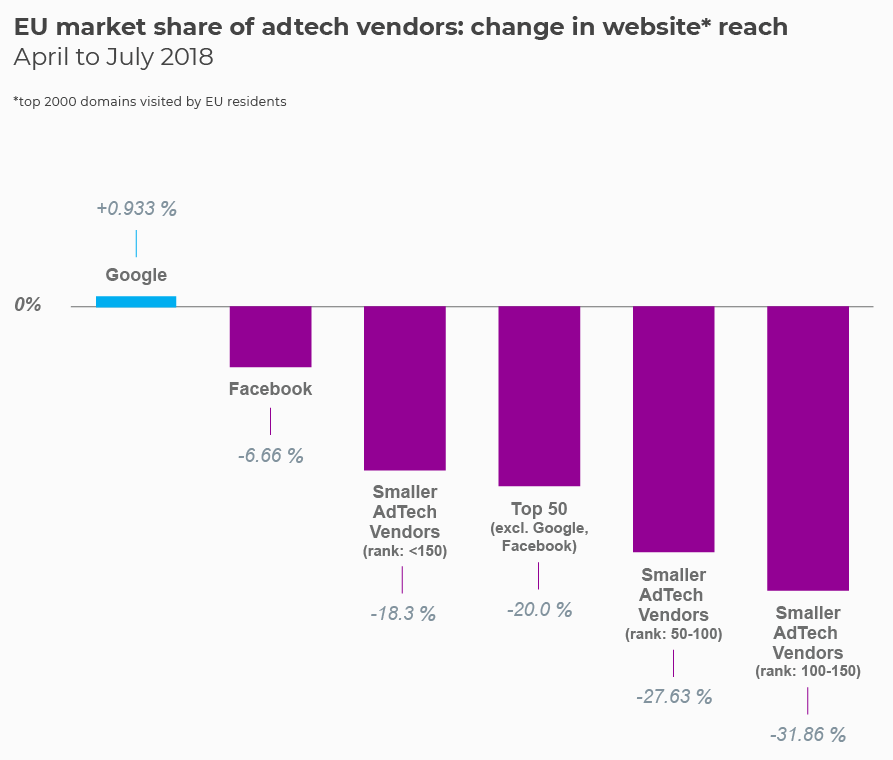
It keeps happening with their draconian regulations. After the privacy/data protection bill, I hear that the european market for online advertising imploded trying to meet regulations and Google Ads gobbled up some 30-40% more market share in Europe. It came down to the fact that Google was able to meet the regulations fastest, and achieve informed user consent across a wide userbase dramatically faster than small local outlets, so ad buyers flocked to the fastest and widest game in town.
It might actually turn out for the better. Google is a big target; they can't fly under the radar.
As for demolishing small businesses, small businesses aren't an universal, unquestionable good. In this particular case, we need less adtech business in general. It's like dumping toxic waste into rivers - not only lots of small polluters aren't better than few big ones, the desirable thing is just having less polluters.
I literally cannot imagine supporting monopolies/oligopolies over healthy competition.
There really is more than just an ocean between America and Europe, the culture is so dramatically different.
How can one honestly believe that a Google data monopoly is better for privacy and innovation? It seems to fly in the face of every lesson learned by every monopoly in history.
> I literally cannot imagine supporting monopolies/oligopolies over healthy competition.
Implicit in my post was that I don't want to support healthy competition in adtech, or any competition at all. I want this industry to disappear entirely. I have no tears for the small adtech businesses whose market got scooped up by Google; I only hope that by presenting a bigger target, Google's adtech activities will be easier to regulate.
So if I open a new small business and want to advertise it on AdWords or elsewhere on the internet I have no recourse? Word of mouth is random and unreliable even if you have a good product. Advertising is a healthy and essential signalling mechanism to broadcast the availability of a new service and there is absolutely nothing morally wrong with it in its self. The non-benneficial side-effects like extensive user tracking and practices that drastically harm user experience however are bad and a seperate issue to be dealt with.
Although I generally agree with your sentiment, please don't forget that, unlike the US, the EU also has antitrust and anticartel laws with teeth and has applied them in the past against large quasi-monopolists like Microsoft and Google.
With all due respect, America has a long history of busting monopolies, and while we haven't gone on a busting spree this generation, we're awfully close to doing the one thing that Europe would never, ever be able to accomplish: Break up companies like Google and Facebook. (As this thread demonstrates, Europeans would potentially be against us doing so, and would be pro-monopoly?)
I actually think the Google reorganization under Alphabet was done in no small part to prepare for anti-trust activity and the breakup of the Google monster.
Question because I don't know European anti-cartel history, do European regulators have a history of big bust-ups like Ma Bell?
It seems like Europeans just try fining them and letting them be.
1) There's nothing the EU can do besides fine them. They're foreign companies; they have no power to break them up, only to fine them or prevent them from operating there. They probably decided that getting billions in fines is better than just shutting them out and hoping local companies can somehow come up with similar services.
2) When your country hasn't done something in over a generation, you need to stop touting it as something your country is good at. Just like we don't continue to criticize Germany for some terrible things they did 75 years ago, we need to stop thinking we're so great because we managed to land some people on the moon 50 years ago.
Don't you recall when we got really close to breaking up microsoft? I mean, in the end we didn't, but we sure did send a lot of _very_ strongly worded letters.
Outside of tech there are a lot of anti-competitive practices that have been left to grow while the cops been off the beat - I'd love to see the Pharma industry shaken up especially with PBM & Manufacturer relationships... additionally, Walmart.
Yes, monopolies might actually turn out for the better. I can't really think of an example but in principle why not, maybe this time it will be an enlightened monopoly.
My point was more along the lines: you let Google scoop up all the adtech business and then kill Google. Or at least its adtech activities in Europe. Since the territory is already unsustaining for small adtech businesses, they won't rise back up when Google's monopoly is out of the picture. No more adtech companies in Europe, mission accomplished.
Totally agree with you. I think also that it's very possible that delivering-adverts-with-minimal-privacy-infringement is a different class of problem to just "delivering-adverts". Maybe it's a type of problem where profit can only be extracted by means of huge economies of scale and well-staffed teams of ML experts? Like deep-sea oil drilling versus drilling in the desert?
Yeah I'm sure not letting companies sell all the data about you to the highest bidder is somehow "draconian". Poor them
You're right about the market capture, though it seems to me the ad market is in a bubble and that massive retargeting and trying to sell people things they already own is going to get old soon.
Good contextualized marketing is less dependant on the profiles and more on what it's being shown right now.
* I didnt say ad business was good or bad, but from the perspective of a European I would want European firms competing against American firms and keeping money and talent in my borders to boost my communities.
* I didn't say that imploding ad business means privacy regulation is bad for small business, but I did demonstrate that big regulation chokes out small business and strongly correlates with big business success
But that's the business you chose for your illustration.
> I didn't say that imploding ad business means privacy regulation is bad for small business, but ...
... you specifically talked about ad business alone and drew the conclusion that "big regulations create big business moats ... which demolish smaller businesses."
It's a good thing that GDPR destroyed ad business that existed only by selling user data without consent. And there's nothing big about GDPR. It's very small and easy to comply with.
If your business is built upon selling and profiting from user data without user's consent, good riddance. If not, GDPR doesn't affect you in the slightest.
Yep, we see this in government contracting too: selling stuff to the government, or bidding on government contracts, means jumping through all kinds of crazy hoops. So small firms for the most part don't bother, and the only companies that do are ones (usually large ones) that are specialized for that task, but can't compete in the private sector, so people wonder why toilet seats cost $600. The only companies willing to sell toilet seats to the government and deal with the regulations are going to charge a fortune for it, and American Standard or Home Depot just don't bother.
(With the US government, it isn't just behemoth corporations; there's big incentives for some small firms too, so there's a bunch of tiny companies that are highly specialized in milking that gravy train.)
Such as, for instance, a business 51% owned by a disabled, veteran, and Native American woman, that takes a percentage and then subcontracts all their work to a public company controlled by old, able-bodied, and white men.
Working the system yields better profit than doing the actual work.
The whole GDPR thing was known years in advance and even smaller outfits would have had enough time to make changes.
An additional anecdote: we experimentally tried a smaller German ad exchange (used by quite some big-name sites here). Profits went way up compared to AdSense. What also went way up was the amount of stupid, low effort clickbait-bullshit (which as a non-lawyer I sometimes questioned the legality off considering some told outright lies). We stopped using them shortly afterward.
I'm really sorry to hear that google ads got even more, and now they're going to complain about a monopoly. Things like GDPR also make it harder to start a competitor, as paperwork and red tape always do; I have not personally worked on GDPR for any thing, but know some one who does and it's a nightmare.
If stringent government regulation got you here, maybe it will be less of that, not more, that gets you out.
The 737 MAX exists because it's so onerous to get government certification for a new airframe (and for governments to certify pilots on a new airframe). Boeing would love to ditch all the legacy cruft on the 737 and start from scratch, but doing so would not be cost-effective in today's regulatory environment.
The only reason this same issue didn't happen to Airbus is because the plane was high enough to give the pilots time to troubleshoot:
> The Alpha Protection activated forcing the aircraft to pitch down, which could not be corrected even by full back stick input. The crew eventually disconnected the related Air Data Units and was able to recover the aircraft.[1]
It is true from what I understand of the crashes that the MCAS system was created to comply with regulations.
Specifically it was created to comply with regulations surrounding a flight manoeuvre that would never actually occur on a real flight.
> Engineers determined that on the MAX, the force the pilots feel in the control column as they execute this maneuver would not smoothly and continuously increase. Pilots who pull back forcefully on the column — sometimes called the stick — might suddenly feel a slackening of resistance. An FAA rule requires that the plane handle with smoothly changing stick forces.
So, if those regulations had not existed then MCAS would not have been needed and the planes may not have crashed.
Other commenters pointed out with far more eloquence, why your accusation of absolutism is a pretty cheap rethoric trick.
But here's something else to chew on:
European regulations often benefit me, the individual, instead of corporations.
It guarantees that I don't pay 6$ a minute for a phone call from Tallinn to Tulouse. It ensures that I'm not ripped off 30 Euros for making an intereuropean money transfer, it provides my airline with a pretty good motivation not to bump me for fun and profit and it seems to work a lot better in the food safety department.
Granted, not all regulation is good regulation, but overall it seems more beneficial to society at large than to some scummy ad-tech business specifically.
It's not unrelated, it demonstrates that while unregulated markets may be a nice idea in theory, they just don't work in practice. Not that an analogy were necessary. The unregulated ad industry itself shows that an unregulated ad industry is a bad idea.
Some commentators have defended the usage of whataboutism and tu quoque in certain contexts. Whataboutism can provide necessary context into whether or not a particular line of critique is relevant or fair. For instance, in international relations, behavior that may be imperfect by international standards may be quite good for a given geopolitical neighborhood, and deserves to be recognized as such.
Christian Christensen, Professor of Journalism in Stockholm, argues that the accusation of whataboutism is itself a form of tu quoque fallacy, as it dismisses criticisms of one's own behavior to focus instead on the actions of another, thus creating a double standard. Those who use whataboutism are not necessarily engaging in an empty or cynical deflection of responsibility: whataboutism can be a useful tool to expose contradictions, double standards, and hypocrisy.
Others have criticized the usage of accusations of whataboutism by American news outlets, arguing that the accusation whataboutism has been used to simply "deflect" criticisms of human rights abuses perpetrated by the United States or its allies. They argue that the usage of the term almost exclusively by American outlets is a double standard, and that moral accusations made by powerful countries are merely a pretext to punish their geopolitical rivals in the face of their own wrongdoing.
The scholars Kristen Ghodsee and Scott Sehon posit that mentioning the possible existence of victims of capitalism in popular discourse is often dismissed as 'whataboutism', which they describe as "a term implying that only atrocities perpetrated by communists merit attention." They also argue that such accusations of 'whataboutism' are invalid as the same arguments used against communism can also be used against capitalism.
GDPR was supposed to kill surveillance adtech, and it is gradually doing its job. The regulators are not ignoring Google and friends and the enforcement actions will hurt them at some point.
Content filtering is draconian and fundamentally opposed to a free and open society.
Now, I'm not a supporter of current copyright laws as I think they are absolutely ridiculous as is, however, I disagree with your statement. It all depends on who is doing the filtering. Done correctly, content screening is a part of a free and open society. And with some care, sometimes it is required.
I am also going to assume that you are more referring to the entertainment industry than the "copyright industry" since the topic is content instead of, say, logos or toaster design.
If I had children, I'd really want age-appropriate filtering to be available and I understand someone wanting "wholesome" content for themselves. I simply don't want them choosing for me and I am not the one to choose for my spouse. In most cases, as long as I have control over what sorts of content filtering I'm good. I do think society should be free from rhetoric that puts others in danger (anti-vaxx) or that calls for dehumanizing or wiping out others or their religion in most cases (white supremacy, for example). I don't think we should be so open that our brains fall out, in other words.
But more to the point: All of that entertainment that was listed was made by someone. Likely many someones. So was the music people listen to in a store. And the art people look at in restaurants and people's homes.I completely understand people wanting to make money from their own work. When there is absolutely no screening, you get places that steal others work - music, art, entertainment, and so on - and make money from it. This might come in the form of making purses and coffee cups with art or someone getting taking your music and performing it for money. It is a real issue - and the "big industries" are not innocent of this. So yeah, if it is technologically possible for an entity to filter content based on these things, I can understand requiring it. Beethoven might not have been able to stop folks from memorising his music and playing it in a foreign land, but he would have had a chance with today's tech.
Content filtering itself isn't bad - and I post this on a site that filters content to a point - and it doesn't make the "copyright industry" bad. The copyright laws make the copyright stuff bad.
I would be cautious about defending those that have, from those that do not. The general public does not have the kinds of money and resources that the copyright lobby does.
For that is the first point to counter your argument: the copyright industry is not mainly looking out for artists, it is looking out for itself and its benefactors. Ask any musician what percentages of royalties they get from their song, it's a joke at this point. Live performances are the sustenance of musical artists today.
That is not to say that I don't defend the rights of artists to their work; I do. But that isn't what this battle is about, this is a battle against the same industry that finds it pertinent to send out mass blackmail letters to families, to single mothers, to depressed people. It is surely going to be one of those things that we look back on in decades to come and go "what the f--- were we thinking?"
Finally, you have to take a wider view in these matters than saying "there is some configuration of content filtering that I find acceptable," because once you have content filtering laws in place, people who you disagree with can co-opt this into a totalitarian state. You do not know who will have the keys to the kingdom come tomorrow.
Is the theory that this will be more resistant to copyright takedowns (given the talk about "sharing music with friends") because takedowns will have to be issued to individual pods?
They claim to specialize in copyleft content, so almost certainly not. The cynic in me thinks that in practice it'll be a fancy frontend for everybody's BitTorrent downloads folder... with an archive.org downloader script for some plausible deniability.
There was also a two year period to adapt. Everyone scrambled to do it in last week, or last few days.
there could be plenty of reasons: it didn't bring them expected revenue, that team was allocated something with higher business priority while the feature itself required updates etc.
Part of the reason for the GDPR scramble is that it deferred specifics to each country's data regulator, and some of that guidance was still being issued shortly before the deadline.
> Is there another plausible reason for Spotify shutting down direct uploads that's unrelated to copyrights?
It's a service very few people use that costs them money to maintain and support. You already need to go through cdbaby and similar services for all other distributions and being just on spotify instead of all of them is not very appealing.
>It's a service very few people use that costs them money to maintain and support.
I'm not a Spotify expert so I'm not understanding why independents artist without labels "costs money to maintain support" that isn't already spent to enable the labels to upload their artists' songs.
Let's say a Universal Music Group[1] representative logs into Spotify's system to upload Justin Bieber's latest 4-minute song. (Spotify has spent money on their backend system to enable this upload workflow.)
Why does it cost more to Spotify to let the unknown-Joe-Blow-not-signed-to-a-label upload his 4-minute song?
> Why does it cost more to Spotify to let the unknown-Joe-Blow-not-signed-to-a-label upload his 4-minute song?
Unless I'm mistaken, Spotify would get the new Bieber automagically via an ERN (Electronic Release Notification) delivery which contains asset links, artist, meta, rights information etc. Since that's from a trusted* source, it can be ingested as-is and everyone is happy. For independent uploads, there's almost certainly several steps of human review and possibly interaction - which costs money and time.
If that was the case they could have just passed some handling fees to the indie artists -that would still be much more reasonable than the fees that the artists would have to pay to a publisher. I think the record companies -still in the process of understanding and adjusting to the new business model that Spotify established- pushed for this, one way or the other, to ensure that Spotify doesn't become a competitor like Amazon became to book publishers.
> Why does it cost more to Spotify to let the unknown-Joe-Blow-not-signed-to-a-label upload his 4-minute song?
It all boils down to that Joe Blow is an unstrusted actor and big label is not. They needs to check that Joe Blow is not uploading Bieber's latest song as his own and that all the metadata is correct while they not need do that for most labels.
Your assumption that they go through the same work flow might be mistaken.
The same type of questioning applied to banks and transferring money:
Why would it cost a bank more money to print and mail checks to individual people when they already do balance transfer payments every night to other banks and branches?
"Very few people" used it because it was a beta service that was only ever available to a small number of artists.
Opening it up to everyone would have transformed the industry. Spotify could absolutely own the small artist space in the same way that Amazon owns the self-publishing space for unsigned authors, but it chooses not to for political reasons.
This has nothing to do with copyright issues. Spotify already has a copyright claim process and the major labels have their own copyright monitoring systems.
Yeah, as someone who has resisted paying for spotify, I was considering switching when they launched this service.
I make music as a hobby, and I only really use soundcloud as a result, since the barrier to entry to posting on spotify is annoying, and resultingly a pretty decent chunk of the pretty obscure stuff I like isn't on spotify, only soundcloud.
When I go to spotify right now it feels like this weird corporate arm of the archaic record industry that I view as more or less a parasite on musicians in this day and age. It lacks all of the weird community character and fluidity that I want out of a music platform, and I resist it for that reason.
Opening the gates would change the game and let it exist as a real creative community rather than just a soleless distribution platform for corporate artists and their masters.
Unrelated question. As an indy artist, why use Spotify? More than likely people wouldn’t discover your music and you lose the direct relationship with your listeners. Isn’t it better for small artists to get “1000 True Fans” who would be willing to pay $x than to get a few more fans that would pay you indirectly $x/10000?
I don't actually care about the money. I have a full time job as a software engineer, this is more for me to have something to be proud of (performance at work, to me at least, isn't as important as leaving a tangible mark on someone, or brightening up people's evenings).
Spotify is the biggest music streaming platform, and having something I created, or played a part in creating, be on the platform, would be a personal accomplishment. It's just an item on my bucketlist, really. In a similar vein, I want to see somoene sing along to a song I write at a gig :)
Eventually the algorithm might even drop the songs in people's discovery queues, etc. But for fanbase interactions, I think local gigs + a Facebook page is the most important, to be honest. Then you tour and people should be able to discover you on their streaming platform of choice.
I haven't heard of 1000 True Fans, will look into what that is actually.
How can they possibly know whether the artist licensed their samples? Or whether the artist is paying the original artist royalties for the use of their music?
I was more thinking a sort of hash value for the song, to prevent reuploads. Sample detection would be hard, considering sample pack reuse would have to be dealt with!
Youtube is built around letting random individuals upload their videos, it makes a lot of sense for them to implement clever automated filters, contentID etc... And even then it doesn't seem to work that well since I very often see videos popping up of Youtubers complaining about abusive demonetization and false-positive flagging.
On the other hand I strongly suspect that the overwhelming majority of the music streamed by Spotify comes from "the industry" instead of artists uploading their own songs themselves. Implementing complicated filters (and playing the arms race game against people trying to work around them) is probably not worth it for them.
I'd definitely be keen to hear more about this at least!
I've been thinking about hash values for song sections, and then proving ownership by claiming a sequence of hashes. Could help ensure you aren't subconsciously ripping other music off, and make finding 'related' songs easy (covers, remixes, etc).
That, there, is the hard part of the problem. You can go with acoustic hashes (like Chromaprint[1]) but even that's not 100% reliable in the face of small changes.
> Is there another plausible reason for Spotify shutting down direct uploads that's unrelated to copyrights?
My immediate thought on reading the headline was that they didn't want to deal with a ton of individuals w.r.t. payouts and etc. Company to company transactions are always easier, so restrict it to labels.
I doubt that's the case. From what I understand the beta was barely used by people enrolled in into it and Spotify has killed more popular things before.
100% agree. Distrokid makes it cheap and easy to get unto pretty much all the streaming services. (disclaimer: I am a customer in the musician with no label category)
This is most likely not related to the Article 13 (now called Article 17) as they are still most likely to be considered to be a UGC platform.
The directive [0] says:
"The services covered by this Directive are services, the main or one of the main purposes of which is to store and enable users to upload and share a large amount of copyright-protected content with the purpose of obtaining profit therefrom, either directly or indirectly, by organising it and promoting it in order to attract a larger audience, including by categorising it and using targeted promotion within it."
Considering that Spotify, Apple, Tidal, Pandora, ... get their catalogues from services like CD Baby or Tunecore, they are very likely to meet the condition above.
So my guess the shutdown will be related to some external pressure, from the major labels and/or the partners mentioned above.
The EU thing doesn't apply yet. More likely it goes against labels at a much deeper level: letting people succeed without labels.
I wouldn't be surprised if the labels didn't want to renew deals unless that avenue was cut off. That is much more concerning to them than a copyrighted upload avenue that they could DMCA away pretty easily.
This. All the major labels did not support spotify out of good will-- Spotify uses hollywood accounting to give the labels the spoils. Same exploitation of artists thats been going on for 100 years.
No it doesn't, Spotify provides line-level accounting for every stream to the rightsholders. What they then do to account to artists could be anything.
You're missing the point. Let's say Spotify pays rightholders 20% of gross revenue for streaming. Then they take another 40% of the gross revenue and pay the major labels for advertising, marketing... whatever. That's hollywood accounting-- it's not streaming revenue so they don't have to report it. Ever notice the labels don't complain that the streaming rates are so notoriously low? Why don't BMG/UMG/WMG just band together and demand an increase in streaming revenue? Because they WANT to keep it low so they make the real money on non-streaming revenue that doesn't go to rightsholders. Maintaining control is the issue and that's why they forced Spotify to make people work through their "partners"
If this is the case, why would spotify not just outright say that? It seems it would calm a lot of the backlash, and artists would be more understanding.
This makes sense up to the point about 'the human version of the "contentid" algorithm'.
The record label arrangement makes the record labels the only valid source of original music.
The government issues copyrights. Looks like "human" governance needs to catch up, and issuing agencies need to provide "algorithmic" means to verify the copyright status of any content.
If it is possible to generate music with machine learning, it should be possible to decompose a track for comparison with others, melody, arrangement etc.
The dynamics of this would be interesting, when uploading you will be told that your track is infringing, it is too similar to the following tracks by x, y and z :)
You can still upload content that infringes copyrights via various services, you can also register such content in "contentid". It is a more hassle than a direct upload but not too much and has been happening. E.g. an independent artist uploads his song to YouTube. A thief makes a copy and sends to Spotify etc and then requests take downs of original work.
I've seen plenty of copyright infringing content with videogame music. There's albums of songs claiming to be covers of games like Megaman X, but are actually direct rips of the soundtrack.
Is "thanks GDPR" the new "thanks Obama"? This spamming of anti GDPR related stuff, without any evidence support quotes or anything the like is absolute disastrous.
Yes it's possible that Spotifys decision was influenced by GDPR, it's also possible that the decision was only done because of it.
But since Spotify hasn't said so, blindly assuming that GDPR is at fault is incredible dishonest.


Yes, Spotify's direct uploading "gave opportunity for small artists to share their talent" -- but that same mechanism also made it too easy to upload copyright infringing content.
Since Spotify does not have a machine learning AI copyright filter like Youtube's ContentID[1], shutting down the direct upload was their best course of action. Restricting uploads to their distribution partners (record labels) is the human version of the "contentid" algorithm.
[0] https://www.google.com/search?q=eu+"article+13"
[1] https://www.google.com/search?q=youtube+"contentid"