I quickly went through the 10 largest European/American biomedical companies by revenue in Google Finance (Johnson & Johnson, Roche, Merck, Pfizer, AbbVie, Bayer, Sanofi, AstraZeneca, Novartis, Bristol Meyers). AFAICT the only one that beat the SP500 in total returns in the past 5 years was AbbVie. Many even trailed short government bonds or savings account returns. So for all the eye-watering gains in tax havens the owners/shareholders didn't seem have much to show for them.
Away from the discussion of the last 5 years being the years of LLM and AI boom and those mega caps exposed that hype driving the SP500, you didn’t list Europe’s largest company by market cap: Novo Nordisk increased 7 times in value in the last five years…
Yeah, I didn't do a full blown analysis, just went trough wikipedia's top 10 biochemicals by revenue (Novo Nordisk was no.14) and picked 5 years since that's the longest 1-click option from Google Finance to get a consistent time span.
If you didn't predict Novo Nordisk's hit weight loss drug ahead of time, but just held a big portfolio of large pharmas, the returns seem pretty disappointing to me. Or put differently, if you have a lot of extra money to invest today, would you significantly overweight big pharma based on what we learned from this article?
For an individual investor who wants unopinionated exposure to “Big Pharma” it’s hard to buy more than, say, the ten largest stocks as in your example. They’d probably also focus on American stocks only since European are typically harder to buy. And then they miss out on Novo Nordisk.
But an index fund that buys (for example) the top 100 global companies in this vertical would have benefited from the rise of Novo.
If you had invested one million in a fund that held Novo at only a 2% weighing five years ago, there’s now a 100k gain from that stock alone. That makes up for a lot of middling big caps, and you didn’t have to actively pick Novo or any other stock.
Why would have shareholders get extra returns from this scheme? Lowered taxes is a one off event.
If you had constantly lowered taxes, like we had constantly lowered interest for a couple of years, then that could have been expected to be reflected in the share price.
Or if you could isolate a short time period when they started doing this, then that would have affected earnings and likely the share price. But once that is the way the business operates, why would shares continue to rise? It does not make sense.
These things are already priced in, the stock traders has known these things for decades so the returns are about the same as most other things as you would expect.
High returns comes when stocks do better than expected, these companies are expected to fleece people to hell and make massive profits so when they do that it is just the expected thing happening meaning normal return on investment.
Profits (the money the company makes) are not the same as total return (the money one makes by trading that company's stock on the second hand market plus the arbitrary value distributed to stockholders, usually close to 0), are they?
I’m an American citizen, and no matter where I go, I owe the IRS taxes on what I make, even if the USA isn’t involved otherwise.
Question: why can’t we do the same for corporations in the USA? The equivalent action might be to only allow a company to expense money spent inside the USA and thus they can’t just license themselves all their own technology and patents which are held in a one person office in Ireland.
I’m sure I’m simplifying things too much, but I’m tired of the two tiered tax system where regular people pay for everything and corps reap the rewards.
You can probably dodge the taxes too by incorporating a company in a tax haven, "working" for that company, and then selling your services through that company. The company can pay you a minimal wage, which would be taxed, but everything else can be stashed in that company tax free.
That’s called a Controlled Foreign Corporation and it won’t work, because its earnings & profits need to be included on the Subpart F income of the shareholders.
Uncle Sam will get his share. Unless you’re a large corporation, that is.
Controlled Foreign Corporation: a non-resident company, fund, institution or other entity in a low-tax country that is at least 50% owned or controlled, directly or indirectly, by resident taxpayers.
Because you have to put actual substance in the entity. If OP ditched his US citizenship, moved to the Caymans, and then started consulting for international clients - it would work.
and do they? if your money is in a tax haven, you don't pay income tax there. if your ghost company from the tax haven buys a private jet, you don't pay any tax on it. if you then rent it from yourself, you can call it a business expense, and deduct it from your company's profits. if you get a loan from yourself in the tax haven, that's also tax free.
where does the paying income tax come in? rich people are always, legally speaking, on the brink of bankruptcy, and can't afford to pay tax.
> If you are a U.S. citizen or a resident alien of the United States and you live abroad, you are taxed on your worldwide income. However, you may qualify to exclude your foreign earnings from income up to an amount that is adjusted annually for inflation ($107,600 for 2020, $108,700 for 2021, $112,000 for 2022, and $120,000 for 2023). In addition, you can exclude or deduct certain foreign housing amounts.
i.e. if you make <$120k in a foreign country, you don't need to pay taxes on it (though you will need to declare!).
(I don't think any of this detracts from the OP's main point, but if you're an American living and working overseas, I hope you aren't paying taxes on all of your income)
A) Last year's FEIE was 120k. When I was looking at teaching English as a second language abroad, US income tax wasn't a factor, but I could see it being one doing tech work. The annoying part is the paperwork and presence requirements. I did meet a couple ESL teachers who did have to worry about it in UAE.
B) A smaller piece. I pay no more than 15% on my capital gains, I think they're capped at 20%, and I get to write off losses. It's wild to me that this is taxed at a lower rate than employment.
> The structures helped the company [Bristol-Myers Squibb (BMS)] reach an effective corporate tax rate of 4.7 per cent, far below the US statutory rate of 21 per cent.
The real answer to all of this is scrap the corporate tax rate entirely. It’s only 6% of the total revenue the government takes in anyway.
The main payers are not these large corporations, it’s the little guy who can’t retain earnings year over year without paying that statutory rate. The little guy doesn’t have offshore entities and transfer pricing. And these little guys are 75% of corporate tax receipts!
Scrap the whole thing and this shell game disappears.
i generally think we should tax people, not corporate entities. if we want to extract money from corporations, probably should just tax capital gains directly.
So I can park money in a corporate entity and then use it to buy everything for me? This seems like an amazing loophole. Never extract your cash from a company and you never pay tax!
Spending corporate money on non corporate expenses would be fraud. You can’t do that regardless of the tax rate.
What this does allow for is carrying over profits from year to year for small businesses that operate on a cash accounting basis. Which in turn allows multi year planning without taking a 22% hit.
Never extracting the profits would lock them away in the corporation with no means of spending them. It’s definitely a possibility, but it’s not really an issue for public corporations because the shareholders wouldn’t want a company just sitting on cash.
> Spending corporate money on non corporate expenses would be fraud
Where does it say that? And what are non-corporate expenses anyway? Keeping the founder happy surely is a corporate expense otherwise this guy would rot in prison
> but it’s not really an issue for public corporations because the shareholders wouldn’t want a company just sitting on
What if my company just held on to the cash but every share had some ownership of that cash. Sure, it probably wouldn't trade at par, but it would also be silly for it to trade at the payout rate considering it's non taxable.
Could the paper backed by my corporation become a new currency?
No, don’t you see, removing those burdensome taxes will spur corporate investment and grow the economy. You may Laff, but I can draw a curve that shows eliminating corporate taxes is the right thing to do. Just don’t ask Kansas.
It is a sad example the one they give, being Irish though makes me think a bit deeper.
Citizens from EU not being the Netherlands or Ireland have to witness how international big corporations pay taxes in countries different to the ones they are doing their business and big local companies moving their headquarters to neighbor countries. Which benefits their citizens.
It’s way worse. Mediterranean countries have free education system that produce engineers, doctors, etc that they can’t keep, because they can go to the Netherlands or the UK for bigger career opportunities and salaries. At a personal level is “an amazing opportunity” at a country level it’s a vicious cycle that increases the gap, a real tragedy.
Then they end up in the hospital systems in the US that the domestic talent passes over, after having to repeat their residency requirements of course trying to keep up with the 80 hour work weeks in residency with fresh out of school mds who might have 10+ years of youth on them. Circle of life I guess.
From UK go to USA, from south EU to UK, from south America to EU, from central America to south America, from Africa to central America. The whole circle.
Theres even a side pipeline out of the US where you don't have the grades or mcat for american medical school and go to an american expat tailored program in the carribean, faring mostly the same as you would have anyway after a period of time.
And Eastern European engineers and doctors go to Mediterranean countries for bigger opportunities and salaries. Looks like the biggest culprit is the “free education”, no?
No. There is no one that will come to the Greek public sector simply because they can go to Central Europe. Their passport is just as good. Greek doctors do not leave Greece out of spite, the working conditions are terrible: low pay, very long hours, exhausting conditions.
Every time I took a vacation in Greece (and I took plenty in the last 20 years) and I had to visit the doctor (for the kids mostly) it was either Romanian or Bulgarian. Same in Italy and Spain. Also other people working in the turism industry: cooks, chambermaids, reception and so on and so forth.
Pay is not the only criteria. Some select for the culture, lifestyle, similar language, etc.
All the doctors I know from ex-soviet countries are married or have family established in Greece and they are old. Many are of Greek heritage, but their culture is Russian, Ukranian, Bulgarian because they grew up there. Like, above 45.
However, you're correct that salary might not be the only criteria. That said, the Greek healthcare systems is already too thin, in ten years there will be a huge crisis due to lack of personnel. Most islands go by without doctors. During the summer these islands get flooded with ppl.
Well if mediterranean countries were not so business-hostile, and by that I mean, not hate on a daily basis the guy who works the most, that would surely renew the love for the homeland.
It’s ok to blame things on the taxes or free college, one also has to take a mirror and wonder “Can I change something in my attitude?”
Like every firm in every sector, in other words. Writing this from a computer designed in california, built in china, marketed by a company incorporated in ireland.
At any time we could have a change of circumstances and need the products of the big pharmaceutical companies for the rest of our lives.
I feel morally obligated to keep myself fit and healthy as a personal boycott of the pharmaceutical companies. This means taking care of nutrition and being physically active. This provides no guarantee of not needing their products, however, not doing this makes it inevitable that I will need their products.
It is no accident that Western democracies allow companies to park their profits in tax havens, tax havens that are typically provided security and defence by the likes of Great Britain due to former colonial ties. Sanctions should apply to countries that have these tax loop holes.
Aren’t these just standard practices that basically all multinational companies do? I’m not saying it is the right thing, but I think it is broader than just pharmaceuticals.
It is more clickbait-y when the title alludes to a conspiracy by one or a small group of "evil" organizations, instead of a title that allude to tax policies implemented by democratically elected leaders, which make people's eyes gloss over.
"Investigate Europe can reveal that the 15 largest European and US drugmakers, including BMS, publicly disclose over 1,300 subsidiaries in tax havens and low-tax territories. These jurisdictions offer corporations low taxes or ways to shift profits (sometimes both). In Europe, researchers and activists generally agree that they include Ireland, the Netherlands, Switzerland and Luxembourg."
The nasty secret is called "transfer pricing", which is permissible under OECD rules, which permits companies to claim their headquarters are whereever they want (so they choose a low tax jurisdiction), when everybody knows that their "real headquarter" is not there (including their own Website, which names an entirely different place as their HQ). One such loophole the "Double Dutch-Irish Sandwich" was closed two years ago, but plenty of other ways remain.
It is a bit unfair to "Big Pharma" (or Apple) to single them out, because lots of other corporations do the same. For example, just check the Canton Zug (CH)'s ratio between companies registered there (29k?) and people living there (25k?).
I have not seen a single political party offering in their manifesto to fix this... meanwhile large corporates create shell companies owned by other shell companies licensing brands to third shell companies while receiving loans from fourth parties etc. etc. - typical money laundering patterns like organized crime, yet entirely legal at the moment.
In my opinion, everyone who is a Director of >50 companies should be investigated for fraud to begin with, and rules for determining companies' true headquarter should be changed so they cannot be freely chosen "only for tax purposes".
There is some interest in trying to fix this. Mainly with a global minimum corporate tax rate in the OECD as this can’t really be fixed by individual countries.
> this can’t really be fixed by individual countries.
This can't be fixed by most individual countries but there are a few individual countries that could do it. The US could easily do it, easily from a technical point of view that is; unfortunately it is politically impossible.
European private companies do. Even Canadians have it that easy. The TCJA and being publicly listed in the States means tax-minimization strategies require a lot more creativity.
>The little-known structures in tax-friendly destinations have contributed to the 15 pharmaceutical firms amassing profits of €580 billion in the last five years.
>This amount outweighs their research and development (R&D) costs, despite the industry's frequent claim that high drug prices allow them to innovate and design new drugs.
R&D is one thing, but most drugs fail at the clinical trial stage. This money (hundreds of millions per drug) is just gone, unlike R&D which might result in new tech or at least a patent. For Oncology its even worse, its close to a 95% failure rate. Simply taxing companies won't make their drugs successful. Large pharma companies rely on a few blockbuster products for their profits and they milk them dry. This is standard corporate greed/behavior, but it certainly seems offputting because we're dealing with peoples lives. Personally, I think its inevitable that there is going to be some form of nationalization for a protected class of life-saving medication.
> R&D is one thing, but most drugs fail at the clinical trial stage. This money (hundreds of millions per drug) is just gone, unlike R&D which might result in new tech or at least a patent.
Are you saying the clinical trial stage is somehow not part of R&D spending? It sounds like quite obviously research to me, but I'm not familiar with how it's actually reported.
The industry may learn from failures, but the shareholders of private companies want a return on their investment. I sure as heck don't want my 401k tied to oncology.
The WTO/TRIPS treaty already allows for governments to issue compulsory licenses in case of a national emergency. This also explains why some firms where so "nice" during the pandemic, as they feared it.
See https://www.wto.org/english/tratop_e/trips_e/public_health_f... for details.
Obviously, it does not suffice but at least it's something.
You could concentrate on patent expired drugs that cost the most on an annual usage basis. Yeah, that leaves out the newest meds, but you'd still make a dent, and every year, you get cooler stuff to make that's already been market tested.
No, because patients deserve the best or most effective drug, not the cheapest.
Unless you'd like to put a price on human life that is.
Also, meds don't hit the market before they are tested...
Testing meds is part of the resource allocation problems because cheap & effective off-label use won't be researched & tested because there is not enough money to be made...
The best or most effective isn't always in consideration. At least outside of the US, you get what has been approved for care and only if it's not too cost prohibitive.
If governments were making their own generic drugs and sold them at cost then it would help avoid situations like Martin Shkreli. The drug wasn't protected by a patent, it's just that nobody else produced that drug. In my opinion this seems like a reasonable thing for governments to do.
Also, the best treatments aren't always available in this first place. Eg (at least a few years ago, don't know today) Adderall was illegal as a treatment here. Some EU countries, until recently, even treated methylphenidate like that.
> Unless you'd like to put a price on human life that is.
It's been put at about $10 million, for the purposes of EPA regulations. Insurance companies have their own formula, from a couple hundred thousand into the millions, and healthcare users QUALYs - quality-adjusted life years, and those are priced at $50,000-$150,000.
I'd say non-optimized government corporation running on cca 0 profit churning out safe generics is still a massive good for all mankind, its type of inefficiency we can all somehow live with, compared to usual governmental fubars left and right.
Triple that in places like US (not for fubars but the costs).
And now it would be a political issue which drugs get manufactured for cheap and for whom. You can probably see how that would go in corrupted countries (i.e. all of them)
Profit is what is left over after R&D - they can choose to invest those profits into future R&D, or far more frequently, just pay out the profits to owners as share buybacks or dividends.
Much of the early development of novel new treatments is funded by venture capital and early IPOs. The big players buy them out when most of the risk is gone and it’s time to scale up.
The reality is that the brits realized they could no longer maintain hard power and Lionel Curtis was the primary pusher of the psyop transition to "commonwealth" soft power while maintaining all the real vestiges of empire under a false name.
I'm not really upset about this for a few reasons:
* Taxes are excessive and out of control in the US
* Most taxes just end up in lawmaker's buddy's pockets
* Programs in the US get created, and never garbage collected
* Literally every business is doing this
Really the only thing that upsets me is that these tax havens aren't accessible to common people like me, as I'm not blood or marriage related to a US Senator or Congressional Rep.
This is an ahistorical take.
Looking only at a handful of tax rates and not tax policy is incredibly misleading.
Tax as a percent of the economy has gone through the roof, both as a percent of GDP, and as inflation adjusted dollars.
If you compare to a benchmark like the 1940s, tax% of GDP has more than doubled[1], and GDP has increased ~4.5x[2]. This means someone today pays about 10X the taxes (controlling for for inflation!). State and local taxes have grown even faster than federal taxes.[3]
Put another way. Taxes/Real GDP has gone from 2% o
Your first chart actually shows that federal tax as a % of GDP has remained essentially unchanged since the 1940s, despite the significant changes in tax rates since then. What has changed in the amount of spending as a % of GDP.
Federal spending has indeed Grown faster than receipts, but I dont want to muddy the water with debt spending and inflationary effects, and dont have to because Taxes per GDP is fractional and accounts for inflation.
The main point I want to drive home is the change in total tax amount, controlling for inflation. People tend to focus on percent tax burden and over look the total tax payment in inflation adjusted real dollars.
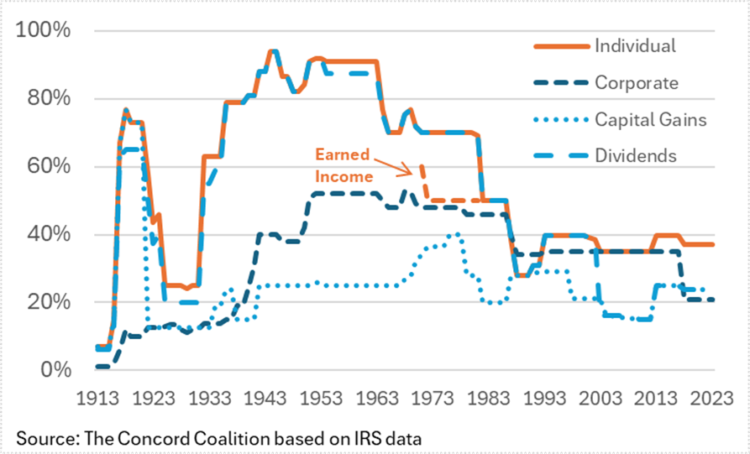
Given that the income tax didn't exist in the US before 1861, and even when it was introduced it was 3%, and in 1913 the highest bracket was 7% (on income over $11 million in todays's money) and the lowest was 1%, I seriously doubt that.
You also have to account for GDP growth. IF the same services are provided, one would expect the inflation adjusted cost to remain the same, and the % of GDP to go down, not up.
the reality is that Americans pay 10X taxes than in 1930. Surely government services have growth since then as well, but I question if the public is getting 10X the value.
While effective tax rates are lower than historic averages (measured since the time the federal income tax was reintroduced in 1913), they are not at "historic lows" as the lowest statutory and effective tax rates were the 1913 rates, when approximately 97% of the U.S. taxable population was not subject to income tax, and the lowest statutory/effective rate was 1% on those earning $3000/year or more ($95k in 2024 dollars).
> * Programs in the US get created, and never garbage collected
That is demonstrably false.
In fact garbage collection is so common I'd bet I can just stand here and do nothing for 5 minutes until my brain finds an intersection with my own circumstances...
Found it...
Look up the used PHEV federal tax credit. While you're at it, look at the tax credit for new electric and PHEV vehicles. That one even has a little built-in ramp to decrease the incentive over time.
It's as if the government has somehow gained practical knowledge and experience over time with various garbage collection routines...
Id love the sources on our taxes just going to fill a politicians buddy. Id also love this source showing that corporations and pharmaceutical companies taxes are both excessive and out of control.