I'm not really upset about this for a few reasons:
* Taxes are excessive and out of control in the US
* Most taxes just end up in lawmaker's buddy's pockets
* Programs in the US get created, and never garbage collected
* Literally every business is doing this
Really the only thing that upsets me is that these tax havens aren't accessible to common people like me, as I'm not blood or marriage related to a US Senator or Congressional Rep.
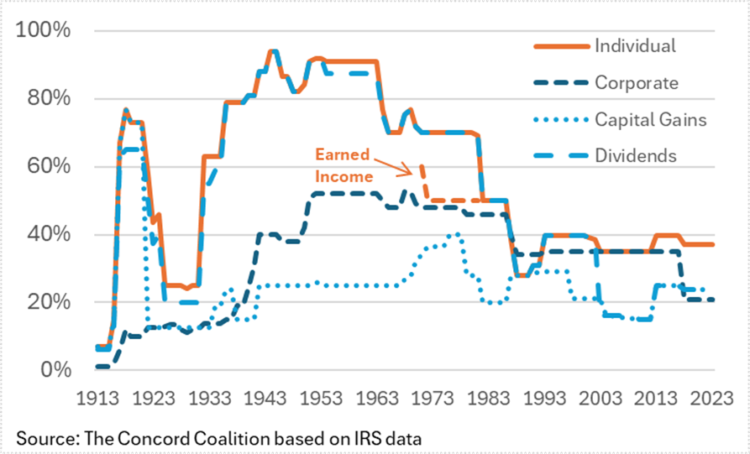
This is an ahistorical take.
Looking only at a handful of tax rates and not tax policy is incredibly misleading.
Tax as a percent of the economy has gone through the roof, both as a percent of GDP, and as inflation adjusted dollars.
If you compare to a benchmark like the 1940s, tax% of GDP has more than doubled[1], and GDP has increased ~4.5x[2]. This means someone today pays about 10X the taxes (controlling for for inflation!). State and local taxes have grown even faster than federal taxes.[3]
Put another way. Taxes/Real GDP has gone from 2% o
Your first chart actually shows that federal tax as a % of GDP has remained essentially unchanged since the 1940s, despite the significant changes in tax rates since then. What has changed in the amount of spending as a % of GDP.
Federal spending has indeed Grown faster than receipts, but I dont want to muddy the water with debt spending and inflationary effects, and dont have to because Taxes per GDP is fractional and accounts for inflation.
The main point I want to drive home is the change in total tax amount, controlling for inflation. People tend to focus on percent tax burden and over look the total tax payment in inflation adjusted real dollars.
Given that the income tax didn't exist in the US before 1861, and even when it was introduced it was 3%, and in 1913 the highest bracket was 7% (on income over $11 million in todays's money) and the lowest was 1%, I seriously doubt that.
You also have to account for GDP growth. IF the same services are provided, one would expect the inflation adjusted cost to remain the same, and the % of GDP to go down, not up.
the reality is that Americans pay 10X taxes than in 1930. Surely government services have growth since then as well, but I question if the public is getting 10X the value.
While effective tax rates are lower than historic averages (measured since the time the federal income tax was reintroduced in 1913), they are not at "historic lows" as the lowest statutory and effective tax rates were the 1913 rates, when approximately 97% of the U.S. taxable population was not subject to income tax, and the lowest statutory/effective rate was 1% on those earning $3000/year or more ($95k in 2024 dollars).
> * Programs in the US get created, and never garbage collected
That is demonstrably false.
In fact garbage collection is so common I'd bet I can just stand here and do nothing for 5 minutes until my brain finds an intersection with my own circumstances...
Found it...
Look up the used PHEV federal tax credit. While you're at it, look at the tax credit for new electric and PHEV vehicles. That one even has a little built-in ramp to decrease the incentive over time.
It's as if the government has somehow gained practical knowledge and experience over time with various garbage collection routines...
Id love the sources on our taxes just going to fill a politicians buddy. Id also love this source showing that corporations and pharmaceutical companies taxes are both excessive and out of control.


* Taxes are excessive and out of control in the US
* Most taxes just end up in lawmaker's buddy's pockets
* Programs in the US get created, and never garbage collected
* Literally every business is doing this
Really the only thing that upsets me is that these tax havens aren't accessible to common people like me, as I'm not blood or marriage related to a US Senator or Congressional Rep.