A different take: Microsoft, Oracle, et. al. waged a war against OSS in the 90s. They went as far as using mental illness as a weapon against the community (equating participation in the commons as an equivalent to mental illness).
It’s not a coincidence the class of human that weathered the storm looks like Stallman, Linus, ESR, et. al. That’s what it took. The toxicity in these communities is a result of what was leftover. These humans grew up amongst OSS activists that also weathered the storm.
They carried the flag when no one else would. Vilifying them now, at a time where Microsoft just purchased the two largest infrastructure/tooling providers for the commons (npm, GitHub) is concerning to me. Without them, the commons wouldn’t be what it is today.
That's a fascinating take, but I don't think it's particularly related to what actually happened. I wasn't toxic because of some Microsoft FUD, I was toxic because I was a teenager with low empathy who hadn't learned things yet. I grew out of it.
Lots of people in open source were never particularly toxic, and there's no reason they should have been. Even granting the existence of the external stress (and it really was NOT that big a deal), not everyone reacts to stress by treating people badly. Furthermore, people who didn't grow up around those OSS advocates have exactly the same problems sometimes, for the same reason that people in every field of human endeavor have those problems sometimes.
>I was toxic because I was a teenager with low empathy who hadn't learned things yet. I grew out of it.
Participation in political mobs can serve as a surrogate replacement for empathy. A change in political allegiance is far easier to enact in an individual than a change in personality.
Be skeptical of any actions that are hateful on their face, regardless of how impeccable the argument justifying them is. Judge people by whether they actually make your project nicer to be part of, not some theorycrafted definition of inclusivity. Common sense and human judgement are an infinitely better way to decide who to welcome, who to tolerate, and who to exclude (because some people have incompatible cultures, so any space will exclude some people), than any amount of political theory.
>Would you agree then that participating in the 'anti-anti' mobs is also a possible form of feigned 'empathy'?
You have misread the comment twice over. I wrote nothing that would preclude your scenario from being a possibility, and I also wrote nothing about assuming a false pretense. In my opinion, wrt "empathy", most of the mob participants are just fooling themselves, and the cynical drivers of these controversies tend to lean on empathy as an explanation less often, in favor of more opaque theoretical constructs.
> I wrote nothing that would preclude your scenario from being a possibility
That's kind of my point: there's a lot of questioning the motivations of the 'cancel culture mob' around these parts recently, but very little questioning of the motivations of the 'anti cancel culture mob'. It almost feels like there's a gaping blind spot there.
Unsurprisingly, a significant percentage of the 'anti cancel culture' controversy seems to be driven by a tiny fraction of people. One could even argue that both the 'cancel culture' and 'anti cancel culture' mobs are tiny. And yet, somehow, Hacker News seems to heavily favor the 'anti cancel culture' angle.
I just don't agree with the symmetry you're drawing here. Pointing to a group of people and saying "I think they're engaged in a moral panic" doesn't make me part of an equal and opposite panic. If I were going around saying we've gotta ostracize the cancellers before they cancel us, that would certainly deserve some serious introspection - but I'm not, and neither is the original commenter.
While you might not be calling for ostracizing the cancellers, plenty of people out there are calling for exactly that.
There's a number of terms being used ('SJW', 'woke', 'cancel culture', 'cultural Marxism', etc.) to denigrate and quell any kind of discourse that goes against conservative talking points. I'd suggest you go and watch any of the self-described 'conservative comedians' to understand the level of otherization and systematic invalidation of any views that don't match theirs. Then come back here and tell me their behavior isn't as much of a moral panic as the supposed 'cancel culture'.
The fact that it is majorly powerful self-described Christian conservatives politicians that are constantly pushing the 'cancel culture' narrative should be a hint, don't you think?
Looking in at the US from abroad, most people I know locally have been highly upset by US 'cancel culture'. Why? The lack of courts, the fact that people's lives, careers, and works have been ruined with "mob like" mentality, is horrifying.
Couple that with what you've just said, that the 'cancel culture' is a 'left' thing in the US, and this becomes more and more clear. As a Canuck, US / Canadian politics often do not align, and we have no political divide on these lines, so I did not even realise that 'cancel culture' was a 'left' thing until now.
It can often be difficult to decipher things from afar.
We also do things differently. Note, I'm not saying "better", just "differently". I honestly have no idea if this sort of behaviour is literally required, for change in the US, but it isn't well tolerated here by any one I know. Note that, fortunately, we have many political parties. And as a result, this ends up with people not aligning themselves with "just this or that party", as a general rule.
Sure, people will pick a party during an election, but even then people generally think 'this mostly matches with me, but that other party kinda does too, but I'll vote for $x...'. Further, we don't even elect our Prime Minister directly.. which also helps.
My point in all this rambling, is just to give a bit of insight into 'things are different', and how it seems to dull the sharp edges on 'us versus them'. And also because I know this next bit is somewhat sensitive, however?
Most people here, see little difference between US 'cancel culture', and 'what your prior US president did'.
Both? Decided to appeal to mob mentality. Both, decided to disregard courts. Both, claim there is 'no other way', but to take direct action.
The concept of people massing in DC, and storming political buildings, like some banana republic, or alternatively, hearing rumours and using it to destroy people's lives -- without trial, evidence, or all that 'nonsense', are two sides of a coin.
It's all the same method. It's casting aside process, rule of law, belief in the system, and more.
So I'd urge anyone, anywhere, with whatever politics in the US to think hard on this.
There's no case, ever, no matter what, where throwing out the concept of due process is right and correct. Ever.
Due process for calling someone to resign is deciding that you personally feel they should resign, and saying so.
If you don't see a difference between the things called "cancel culture" and the mob rule with violence, that's not because they're not different. It might be because you're uncritically accepting the lies people tell because they don't like any kind of accountability at all for their actions.
This is why we have US Senators on TV and publishing articles in major newspapers about how they're being silenced because a company decided not to work with them on something. You don't see these posts from the people who actually got silenced, because they were actually silenced. But if you believe someone who is using multiple media channels with international distribution to tell you that they are being silenced without recourse, that's sorta on you. You can do better than that.
When I wrote that I was unaware of some of the Sort Of Creepy stuff. I recognize that some of the allegedly creepy stuff is sorta misquoted. I think that matters. But I don't think it changes my overall conclusions, which is that RMS was acting in a way that he could reasonably predict would hurt or distress people, and he didn't think it was important to change this.
But I also note that, completely unaware of any of the allegations now being discussed, I thought he was bad for the development of free and open source software because he was bad at treating people in ways conducive to positive outcomes, and I knew many people who worked on free or open source software, or worked with the FSF or on FSF projects, who also felt that way. I believe quite a few of them had told him of these concerns.
It is perhaps worth noting that, maybe thirty years ago, I had some run-ins with Thomas Bushnell, and I thought he was sort of a jerk at the time, but when I called him out on an example of that, he acknowledged it and apologized and said he'd try to do better. Nothing external to RMS was preventing RMS from doing that if people said his behavior hurt or distressed them.
The idea that we couldn't try to do better because we were being threatened by Microsoft is honestly sort of condescending and insulting in and of itself.
I don't know about "particularly" famous but I know that I've talked to people whose family members were programmers who reacted with "wait you know SEEBS!?!" when they mentioned me, so apparently some people have heard of me. I used to be fairly active in Usenet discussions of C, and I've published some stuff, most of it now lost to the mists of time.
I think that this is just an attempt at explaining away toxic behavior without taking responsibility for it.
People in the OSS community can, at times, glorify toxic behavior. I know people who take it as a badge of honor to "speak the truth", "speak directly", or "have no filter". Speaking directly and speaking the truth are good ideals to have, but if you really want to PROVE that you speak the truth and don't fear social pressures, what better way to do it than to be rude or insensitive to people?
Take Mr. X, who is outraged by Microsoft's behavior and refuses to buy Microsoft's products, tells other people about his problems with Microsoft, and tells everyone to use FOSS alternatives? Now, Mr. X also thinks that it's stupid to believe in god, and is not afraid to say it to everyone he meets. He's suddenly changed from "FOSS advocate" to "toxic workplace on legs".
This is by no means exclusive to the FOSS community. Think of the product manager who styles himself a Steve Jobs type, who abuses his staff in the style of Steve Jobs. These aren't examples I'm picking out of a hat; these are real people.
That may be but there is something to the OP's point. The big 5 personality test which is the only personality test rally taken seriously in clinical psychology, has an aspect called agreeableness.
Having high or low agreeableness has a tremendous correlation with all kinds of outcomes. It's highly tied to success in corporate, church, and government settings. It's very likely that to be set enough to go against the majority in your field and build an alternative infrastructure in the face of a great deal of obstacles is going to attract a higher amount of diaageeable people. Now if you ask me, it's possible to be quite diaageeable and remain polite but I wouldn't be surprised if these sort of outsider niches often have an abrasive personality edge.
And when the elites start telling you to tilt you moral compass a certain way, you probably start bumping into some oppositional defiant disorder which correlates with low agreeableness.
A similar thing can be seen when substances are prohibited. People who normally would not do a more serious crime begin doing them because their desire for a drug already brings them outside the law.
Obviously finding ways to build alternative communities with a welcoming and conciecous spirit would be a great problem to solve. But I believe we will always bump into this.
"The reasonable man adapts himself to the world: the unreasonable one persists in trying to adapt the world to himself. Therefore all progress depends on the unreasonable man."
So expressing sincerely held beliefs in a personal forum like his own website is in and of itself "toxic"? Many of RMS's beliefs are indeed well outside the mainstream, but as far as I'm aware nobody has ever accused him actually doing anything abusive to anybody.
>I recall being told early in my freshman year “If RMS hits on you, just say ‘I’m a vi user’ even if it’s not true.”
The idea that Stallman would only violate women who use emacs is cartoonish levels of absurd. Personally, I'd expect he'd be thrilled they're at least using free software.
Besides that, the door thing seems to have been graffiti. And though I agree the dating anecdote makes him look bad, but also sounds like the actions of a person suffering from some mental illness.
There is a big difference between what's reasonable and acceptable in random people and what's reasonable and acceptable in people who are established or establishing themselves as Community Leaders. We expect leaders to model good behavior and take additional steps to avoid modeling harmful behaviors, because other people will emulate them.
He's been accused of things that are at the very least Somewhat Creepy. "Abusive" is a pretty high standard to reach, but I also think it's irrelevant. The way he treated people, coming from a person with power or authority, was likely to make people feel unsafe, and he was unwilling to recognize that the desire to have that position of social authority implied an obligation to mitigate such behaviors.
I think the community would be richer and better (and probably noticably more diverse in a number of ways) if either he'd changed his behavior and recognized the importance of these effects, or he'd been considered a non-leader of the community and merely an active contributor with strong opinions.
It's easy for people not familiar with these dynamics to massively underweight how much implied social pressure comes with being hit on by a person in a position of power within an organization. My usual assumption for someone with as much implied social authority as he had at MIT would be that it would basically be generally inappropriate for them to be hitting on anyone who wanted to be in or work in the lab or department they were affiliated with, because even if this specific person genuinely wouldn't abuse their power, many other people in comparable situations would and it's not really reasonable to expect people not to react to the possibility when it's such a widespread problem. (And yeah, that can sorta suck if you're lonely but in a position that makes it hard for you to hit on people without making them uncomfortable or afraid. One alternative is not to pursue or remain in such a position if it's a problem for you.)
> So expressing sincerely held beliefs in a personal forum like his own website is in and of itself "toxic"?
That's a loaded question... it looks like you're making some wild assumptions about whether I think Stallman is toxic, and the reasoning for that.
> Many of RMS's beliefs are indeed well outside the mainstream, but as far as I'm aware nobody has ever accused him actually doing anything abusive to anybody.
> RMS’s loss of MIT privileges and leadership of the FSF are the appropriate responses to a pattern of decades of poor behavior.
Speaking of the FSF / GNU project leadership itself... I think it's clear that the GNU project needs a code of conduct, and if the leader is opposed to the idea as much as Stallman is, then it's correct to replace him. He has a vision for software freedom, but he's to averse to good community management (which is what the GNU project needs).
>> RMS’s loss of MIT privileges and leadership of the FSF are the appropriate responses
> I think it's clear that the GNU project needs a code of conduct
Why? It seems from your quote that people can be removed without a code and, as the FAANGs show us, a written criteria just gets gamed. A code of conduct is redundant and problematic. It victimizes the trustworthy.
> if the leader is opposed to the idea as much as Stallman is, then it's correct to replace him
The ultimate crime - even above anything in a code of conduct - is not wanting a code of conduct? Is anything else an absolute?
> Why? It seems from your quote that people can be removed without a code [...]
Just because someone can be removed from a position of power without a code of conduct does not mean that the process was correct. You can also throw people in jail without a trial, but you shouldn't.
The code of conduct provides a process for people to address grievances. I believe this makes it more likely that grievances get addressed, and reduces the amount of personal bias.
> ...as the FAANGs show us, a written criteria just gets gamed.
I don't think it's easy to game a code of conduct. Could you explain, or give an example?
> The ultimate crime - even above anything in a code of conduct - is not wanting a code of conduct? Is anything else an absolute?
You're confusing "crime" with "not doing a good job". I said that he should be replaced because he wasn't doing a satisfactory job.
His job was to run the FSF and the GNU project. He was doing that job poorly. Therefore, he should step down and let someone else run it.
Honestly, I think that some of these problems could have been avoided if he made a stronger distinction between the GNU project and the FSF. He could have handed management of the GNU project off to someone else and focused more on the FSF, which is where his strengths lie.
Not wanting a code of conduct is not a "thoughtcrime". It's just bad policy for large projects. "Bad" as in "incompetent", not as in "morally wrong".
> The code of conduct provides a process for people to address grievances.
No, that's the general procedure for handling adding and removing board members. It's the same procedure you'd follow if someone was arrested in the middle of the meeting.
A code of conduct is about the specific conduct. Picking your teeth, insulting tall people, etc.
> I don't think it's easy to game a code of conduct. Could you explain
If there is a written code it has to declare where the lack of gender recognition offense is compared to screaming at someone, for instance. If the code lists your pet offense above screaming, which they all do, then you can scream at people about your pet issue all day with zero risk.
If none of this is mentioned then it all falls back to the law. This is better because more skilled people have done more work on it, and because it's outside of the group's mandate so they can let members deal with it outside of the group. I can't follow you through a 7-11 yelling at you so you can apply the same rules to our official interactions and call the police if I act unruly in a meeting, no vote required.
Also, how does voting work when not only the level of offense, but the standard of offense itself is subjective. Does an accused director get to vote on whether the claimed offense falls into a listed class, but then have to recuse themselves for the vote on the seriousness of the specific claim? Or are they expected to recuse themselves from everything? How many directors do you need to accuse at once before quorum is you alone?
Generally nobody sees why you can't tell people about the specific anti-fraud rules until they work in a fraud-rife industry and watch the arms race. If you haven't been involved with multiple non-profits you might not have experienced this yet.
> I said that he should be replaced because he wasn't doing a satisfactory job.
But the thing he wasn't satisfying you by doing was enacting a code of conduct?
> I think that some of these problems could have been avoided if he made a stronger distinction between the GNU project and the FSF
Good point. I think everyone running things should try not to co-mingle their jobs. But this isn't a code of conduct issue, it's more appropriate as one of the basic requirements for a director. No conflicts of interest.
> Not wanting a code of conduct is [...] just bad policy for large projects
No, a code of conduct is a kiss of death. It adds nothing that honest members of the group need but gives trolls and ideologues a field day.
A group should never have rules about things outside of its core tasks, unless it wants 90% of its time to be spent arguing about things outside of its core tasks.
I'm asking you a genuine question. I note you didn't call RMS out by name, but you certainly seem to be imply it.
Re: the article you shared, I didn't really see much evidence either way there? It's clear that RMS is, to put it mildly, "difficult to like", but there's a big difference between that and being straight up abusive, particularly given that it seems quite obvious that the mens rea is missing: as far as I can tell, most of the time RMS genuinely has no idea when he is being offensive.
> I'm asking you a genuine question. I note you didn't call RMS out by name, but you certainly seem to be imply it.
I don't think the question is interesting or relevant, so I'm not answering it. I explained that I considered the question to be a loaded question. If you want me to answer a question, you will have to ask a different one.
> ...as far as I can tell, most of the time RMS genuinely has no idea when he is being offensive.
Someone who genuinely has no idea when he is being offensive should not be at the head of an organization like the FSF. "Mens rea" is a term from criminal law. It's used for figuring out the difference between murder and manslaughter, for example. It's not relevant to figuring out whether you are good or bad at your job.
The problem is that the meaning blends together subjective offense and a desire for professional sanction in a way which makes the term very hard to actually engage with. Challenging whether some particular behavior is toxic comes across as nitpicking, while challenging whether people should get in trouble for toxicity comes across as minimizing legitimately bad behaviors.
> Challenging whether some particular behavior is toxic comes across as nitpicking, while challenging whether people should get in trouble for toxicity comes across as minimizing legitimately bad behaviors.
There are strategies to challenge accusations of "toxic behavior" without coming across as nitpicking. These strategies can be learned, and if you are worried about this scenario, I suggest you learn them. It is a great tragedy that dispute resolution and effective communication are poorly taught in school. These strategies are not difficult to learn, but it is much more effective to learn them in person. If you know someone who is effective at mediation and dispute resolution, see if you can ask them to demonstrate techniques and strategies for you.
There are also books. I personally recommend Nonviolent Communication by Marshall Rosenberg and Crucial Conversations by Patterson, Grenny, et al. Nonviolent Communication may seem a bit hokey and the book is a bit padded out but I vouch for its effectiveness.
In the context of organizations like the GNU project, one of the ways to keep discussions about behavior sane is to have some kind of formal dispute resolution process. This can be done with a code of conduct. Here is the Python project's code of conduct as an example: https://www.python.org/psf/conduct/
Asking whether people should get in trouble for "toxicity" is kind of vague, because the term "toxic" is vague and mired in opinion. That is okay. We need vague words because we need the ability to communicate vaguely. "Vague" is not the same thing as "meaningless".
> People in the OSS community can, at times, glorify toxic behavior.
I wouldn't go so far as to glorify toxic behaviour, but some of what is seen as toxic by some is IMO just frankness or a tactic to bring the conversation back into a realm of technical discussion.
In my experience, people who have technical discussions are often blind to their own emotions and the effect that their words have on the people around them. In good this can be solved. In bad cases, people talk about "discussing technical issues" and "directness" as a shield for their poor behavior.
An example from real life: A student, Y, was having a problem with her CS lab assignment, and talked to her professor, Prof. Z. She described what she had done and he said, "Well, that was stupid." In his mind this was just something that you say about bad code you've written. However, he was a professor, and he was saying this about a student's code, and he didn't think of the incredible negative impact that his statement made on his student.
In real life, this interaction took the "good path". They had a conversation, he apologized, and he changed how he spoke to students.
The "bad path" (which didn't happen) is where he justified/defended what he said or minimized/ignored the student's feeling.
Everyone comes to these decision points over and over again in their lives. It's inevitable. We all hurt other people. If we always defend our actions as being in the interest of "technical discussions" or state other reasons why our behavior is correct, is it likely that we are simply good people who never say bad things? Or is it likely that we are ignoring/justifying our poor behavior, and failing to learn and grow?
The "bad path" you're describing is what I and many others like about working in software. When I'm meeting with other technical people, we can have a frank discussion about problems we're facing and solutions to them, which comes much more naturally to me than constantly analyzing the feelings and relative status of everyone in the room. I completely understand why other people prefer more empathy-driven conversational norms, and I try to meet them halfway when I can, but I can't support the idea that their preference is fundamentally superior to mine.
> The "bad path" you're describing is what I and many others like about working in software.
This is not true of software in general. Software companies are diverse, and they are run in diverse ways. (Maybe not as diverse as other industries... but there is still a lot of variation.)
> When I'm meeting with other technical people, we can have a frank discussion about problems we're facing and solutions to them, which comes much more naturally to me than constantly thinking about the feelings and relative status of everyone in the room.
There are a few things I'd like you to consider.
1. Software companies face problems with people. Good managers shield engineers from people problems as much as possible, but if you are only having discussions about technical problems and not people problems, then you are probably not having frank discussions.
2. The fact that it does not come natural to you to constantly think about the feelings of others is not unusual nor is it a fundamental part of your job to constantly think about the feelings of others. If that were the case, there would not be so many good software engineers on the autism spectrum. I have worked with several.
3. It is not expected that you intuit when people are hurt, never say anything hurtful, or think about people first when you are having a technical discussion. However, it is expected that you are aware that your behavior can have a negative impact on other people in the organization and that you make reasonable attempts to correct your behavior if necessary.
> ... but I can't support the idea that their preference is fundamentally superior to mine.
This isn't a dichotomy. An organization needs a combination of strong technical skills and strong people skills in order to succeed. Those skills are, of course, not distributed equally. There is no expectation that a software engineer have the same people skills as an engineering manager.
However, consider this.
An engineering manager primarily works on people problems but would suffer greatly if they had zero technical skills. An engineering manager with zero technical skills is a liability. Likewise, a software engineer with zero people skills is a liability.
And the faster you learn how to give good criticism, the better for you. Being cavalier about other people undermines your ability to effectively communicate.
> Take Mr. X, who is outraged by Microsoft's behavior and refuses to buy Microsoft's products, tells other people about his problems with Microsoft, and tells everyone to use FOSS alternatives? Now, Mr. X also thinks that it's stupid to believe in god, and is not afraid to say it to everyone he meets. He's suddenly changed from "FOSS advocate" to "toxic workplace on legs".
What's toxic about this? Two perfectly sensible points of view and you think Mr. X is dangerous to be around?
> What's toxic about this? Two perfectly sensible points of view and you think Mr. X is dangerous to be around?
Not sure where the word "dangerous" comes from.
Just to explain things. If you tell people at work that it's stupid to believe in god, you are probably going to get fired, and rightly so. It's not dangerous, but it is toxic (belittling people for their religious beliefs).
It's like how when I "execute" a program, you understand that I am not killing the program as punishment. Even though the word "execute" has that meaning, it only applies in other contexts.
Toxicity is a serious thing. We label toxic chemicals with labels and warnings because they're dangerous. Serious business.
When we apply "toxic" to a person or his behaviour, we borrow that seriousness. That's why we choose that specific, strong words with a well-known meaning.
I oppose calling "I disagree with your world view" toxic. A serial killer might deserve the term.
> When we apply "toxic" to a person or his behaviour, we borrow that seriousness. That's why we choose that specific, strong words with a well-known meaning.
So, you knew what the meaning of "toxic" was all along, but you pretended to not know what the meaning was in order to make some kind of point? I would prefer a direct discussion.
> I oppose calling "I disagree with your world view" toxic. A serial killer might deserve the term.
Mr. X isn't toxic for his world view, it's his actions--his actions are to call people stupid over their religious beliefs.
Stallman isn't "toxic" for writing a couple essays or emails, but you could argue that he's toxic for the way he treated people over the past decades.
> So, you knew what the meaning of "toxic" was all along, but you pretended to not know what the meaning was in order to make some kind of point? I would prefer a direct discussion.
Yes, I knew all along that "toxic" means "dangerous". When we're not talking about eg. plutonium, we at least borrow the seriousness of that use. It's a very strong word.
> [...] his actions are to call people stupid over their religious beliefs.
I think it's a stretch to call speaking an action. Hitting religious people would be an action, calling them out really isn't.
Stallman is apparently not the most agreeable person, and possibly he's been nasty and hostile. Some people have chosen not to work with him, others have worked a lot with him. He's not killed anybody, he's not made of plutonium, there's no danger.
For this reason, verbally harassing people for their faith is IMO more toxic than "I disagree with you" or even "I disagree with you and I think you're stupid".
The UN humans rights are not law in the USA. The first amendment says that the government can't make laws about religion. In the USA, people are free to have whatever religion they want, which is great.
Pointing out that all available research points to some religious claim being wrong is not harassment.
All available research also points man and women are different physiologically, neurologically and psychologically. Yet if one goes around pointing that out to women for no good reason, some people will view such speech as discriminatory and will act accordingly. I don’t necessarily agree with these people, but that’s how it works in practice in many places.
According to US federal laws, religion is a protected class just like gender. You can’t discriminate people based on that, no matter whether you related to government or not.
That depends on the facts, context, audience and other human-related things.
As an employer or anyone at all really, ideally, you should do the right things, where “the right things” is only vaguely defined.
Some of these things are written in laws, regulations, and court decisions. They help when one doesn’t know how to handle certain citations (like this case about religious beliefs of other people): looking for that stuff and simply doing what’s written there is a good strategy to not screw up human interactions too much.
However, many other of these right things aren’t written anywhere, adult people are supposed to already know them somehow. Probably, that’s what called “cultural context”.
All that stuff is weird and often illogical, but that’s how all modern societies have been working for centuries if not millennia.
>When we apply "toxic" to a person or his behaviour, we borrow that seriousness.
what makes you think so?
words means in theirs contextes whatever people attributed to them, and I've never seen toxic used in other context than somebody trashtalking somebody and being called toxic, so definitely not dangerous.
This hypothetical Mr X is going to take all of a week to get the entire helpdesk & IT procurement team (and every religious coworker) to avoid him and his need to criticize some aspect of their lives.
That's "toxic" because now you have a staff member who people won't communicate effectively with.
Now you're inventing more personality for Mr X. He doesn't like Microsoft and doesn't hide it. He thinks Santa Claus is for children and doesn't hide it. He's not the problem here.
He is, though, because his opinion on Santa Claus should be completely irrelevant to his interactions with his co-workers. But if he prioritizes being hostile by correcting and insulting people over being humble and accepting that others might believe differently, he is being toxic -- he's poisonous to be around.
There are different ways to stand by one's beliefs. One is to keep them to yourself and let them guide your decisions silently, but defend them vigorously if they are actively challenged. And one is to feel the need to rub them into everyone's face constantly, because there is only Right and Wrong and you can't deal with somebody being wrong (i.e., of a different opinion than you) without feeling personally attacked and going on the offensive.
I can agree. But this means that we can never talk about anything other than specific, technical issues at work. We can never reveal any opinion or outside fact about anything. I suppose that's a solution.
In this scenario, our guy wouldn't accept that others might believe differently, because he'd never know, because they never say. Fine by me.
> being wrong (i.e., of a different opinion than you)
That's not what wrong means. Opinions are personal and subjective and can't be wrong or right. Religious ideas a not opinions, they are fact claims about the universe.
I think the agreed-upon way of handling this is revealing personal opinions on difficult subjects very carefully to gauge the reactions, and only proceeding if doing so wouldn't disturb the peace more than what the discussion would be worth.
There are of course a ton of potentially difficult subjects, as the ever expanding "Culture War" Wikipedia article shows[1].
But after thinking about it for a bit, this approach of "tread carefully and don't disturb others" is still problematic.
Because, where do you draw the line about things that you should or should not speak up against?
My intuitive example would have been an anti-vaxxer at work, that I probably would have felt the need to criticize and correct, because their opinion might kill my grandma.
But then, militant atheists might also feel like they have to criticize believers, given the huge number of people killed in the name of one god or another.
I think a fundamental factor here is the level of confidence in one's belief that is warranted. Challenging others (especially publicly) on what they believe should only be seen as a sensible thing to do when the confidence in your opinion that leads to to that criticism is warranted.
For things like vaccinations, we thankfully have scientific evidence that would indicate that anyone who outright believes they are ineffectual or "give people autism" is, in all likelihood, simply wrong.
On the other hand, a belief in god ultimately can't ever be shown as wrong[2], so being very confident in your belief that there is no god still doesn't justify putting down others for believing the opposite.
> That's not what wrong means.
Yes sorry, that was meant fairly tongue-in-cheek, because I assumed that for a person like our Mr. X, the distinction between "of a different opinion" and "wrong" would be very blurry.
> Religious ideas are not opinions, they are fact claims about the universe.
Isn't that just a really wide-spanning opinion though? Maybe we're using the word differently and mean the same?
2: Unless we talk about ridiculous stuff like creationism, which would at least be very hard to defend if you simultaneously want to use the scientific method for anything.
Treading carefully is probably our best bet, but it's very difficult and error prone.
There are no militant atheists, in any reasonable sense of the word. If mentioning facts about the world is seen as criticism of religious people, that's a big problem. We know vaccines work, because our best research shows that. It's not controversial and we should be free to mention it. Huge parts of many religious text are factually incorrect, we know that from enormous amounts of research -- this is also not controversial and we should be free to talk about it.
> Isn't that just a really wide-spanning opinion though? Maybe we're using the word differently and mean the same?
In that case everything is opinion and we have no real knowledge of anything.
Virtually no one is an atheist, if you take the Sapiens definition of religion: “a system of human laws and values, which is founded on a belief in a super human order." (Super human orders are not the product of human whim or human agreements, unlike e.g. the laws of soccer)
https://sites.google.com/site/taborsapiens/home/10-the-law-o...
If you read the book it’s clear communism, fascism, democracy and capitalism are really religions too. They require belief in a super human order - a set of laws that exist without backing in science or human agreement. E.g. “All men are created equal”
> If you read the book it’s clear communism, fascism, democracy and capitalism are really religions too. They require belief in a super human order - a set of laws that exist without backing in science or human agreement. E.g. “All men are created equal”
I don't agree with that interpretation, someone who champions democracy just has a set of moral values they want to apply, they don't think the universe is inherently democratic or anything like that.
Likewise for your other examples. They're ideologies, not religions.
TBH, I has been participating in open source since the 1990s, and I never seen the actual stigma like you describe. Yes, OSS projects were laughed at, dismissed as hobbyist and unserious, insinuated to be low quality and "worth exactly how much you pay for it" - all that happened all the time. But implying OSS people are mentally ill... maybe somebody did it, but I've never seen it. And I did work with people from Microsoft, Oracle, etc. - albeit from the parts that were more OSS-friendly. But I think if it was indeed that widespread I'd hear about it. RMS certainly had a reputation to be an unusual character - even in OSS circles - but I didn't see it wielded as a weapon agains OSS - at least not until the cancel culture started.
And yes, there were plenty of assholes in OSS (as there were outside) and it was mostly young people, many of whom confused being rude with being honest and direct, but I don't think it had anything to do with either Microsoft or mental illness. It had to do with being young and unexperienced and trying to form a new culture online where none existed before.
I know there was a concerted FUD effort and much dirty playing, including all the stuff you are pointing out. What I specifically didn't see is usage of mental illness as a weapon against OSS.
I would like to thank you for the efforts you have made in writing this article. I am hoping the same best work from you in the future as well. In fact your creative writing abilities has inspired me to start my own Blog Engine blog now. Really the blogging is spreading its wings rapidly. Your article is a fine example of it.
https://www.sevenmentor.com/angularjs-training-in-pune.php
Hmm. I think RMS’s anti-establishment push was so much earlier (mostly against Bell Labs, etc.) that “the 90s” don’t really apply.
If anything, it’s just his personality: he takes hardline positions and holds onto them. You might be right about hardliners being the only folks who have enough persistence to come through (vis a vis survivorship bias), but then you’re also just including the leaders of those companies you mentioned: Bill Gates and Larry Ellison were famously combative, competitive, and all sorts of other words.
“What was left” certainly applies. These are predominantly the personality types, and socio-economic groups, that made it through this time period in open source.
On the other hand, following that logic, in times of peace the soldiers of yesteryear are out of work.
I'm not a fan of cancel culture, but it might be just a sign that priorities have changed for people. Maybe the basic software liberties are enough for most, and it's no longer enough to fight for OSS, but instead time to consider "how" to fight for it. In a sense, it could be seen as a victory.
I'm always curious about this line of thinking. What exactly do you think people are gaining by - say - denouncing sexism or other kinds of awful behavior? What's so wolfish about that?
People who denounce sexism because they've got a moral framework or intuition that tells them sexism is bad are principled actors. People who denounce sexism because they're trying to get likes on social media, because it grants them social approval, or because they've made a job out of it are acting out of self-interest. Not everyone who is in the second group knows what their motivations are: people usually come up with seemingly altruistic reasons for self-interested behaviour, and genuinely believe those reasons, even though they wouldn't behave that way if they weren't getting anything out of it.
As per the article, "punishment should be proportional to the offence", and punishments should ensure the offender will "constructively come to understand, repent, and make amends for an infraction". The first group can be relied upon to see transgressions in light of their broader moral principles. They won't always seek punishments that are proportional and restorative, because those are moral principles in themselves, but they'll at least be trying to do what they believe is a good thing.
The second group is scary because they just don't stop. They'll keep doing things in order to get the reward of social approval or social media, for as long as that reward lasts. Even worse, because they don't have good introspection about the underlying rewards that incentivise them, they'll reward each other for escalating. They'll tear people's lives apart without a shred of guilt, because they're getting something out of it, which is why they're seen as predators.
I understand your argument, but wouldn't be the opposite be true too? Aren't RMS's comments defending Minsky just a form of 'clout seeking' and being argumentative for arguments sake?
If people are making the case that RMS is neurodivergent and therefore his behavior should be tolerated, shouldn't we be making exactly the same argument about the people you put on the latter group? Or is it only people we agree with that get the benefit of being 'neurodivergent'?
The argument was explaining why Twitter mobs form and what they're getting out of it, not in favour of RMS. I think the general principle of scepticism towards people who benefit from the stance they hold applies to you and I, to RMS, and to his detractors.
That being said, I don't think he expected to benefit socially from the opinions that got him cancelled in general, or from complaining about the term "assaulting" in particular. His autism is less relevant than there being no real gain for him. It being a costly opinion for him to express is evidence he genuinely believes it. Whether or not he should be tolerated is another question, but I don't think he's the metaphorical wolf here.
This seems like a very arbitrary and capricious partition between those doing something for 'clout' and those doing it because they can't help themselves.
Do you think the people now being attacked in this thread because they originally called for Richard Stallman to face consequences are being 'canceled'? I see a lot of people claiming nobody should take them seriously ever again, blah blah blah. Sounds like 'canceling' to me. Is this mob any better than the supposed 'cancel culture' mob?
In other words: should we stop using the term 'cancel culture' only in one direction?
It's not a partition between the things you said, it's a partition between beliefs that would be held absent any reward vs beliefs that are only held due to a reward. RMS doesn't gain anything from arguing that the age of consent should be lower, since it just makes everyone call him a paedophile, therefore he's probably making it in good faith, therefore he's making a genuine attempt to do the right thing and should be engaged in good faith. His autism is only relevant insofar as it makes him more likely to say things without understanding the social consequences.
Additionally, nobody in this thread has been removed from any boards, fired, barred from attending conferences, or in any way cancelled, to the best of my knowledge. If that happens it will be bad. It hasn't happened. Donglegate got both parties fired, and that was also bad. I don't think cancel culture is used only in one direction, it's just that tech industry workers don't cancel the left very often. Steve Klabnik is allowed to go around calling himself a communist without getting removed from anything, for example.
> It's not a partition between the things you said, it's a partition between beliefs that would be held absent any reward vs beliefs that are only held due to a reward.
You keep implying that the only possible reason people would denounce RMS's behavior is because they 'get rewarded' for it. I'm surprised you can be so certain about it, when it's perfectly possible they are doing it because they've suffered abuse themselves or have a genuine concern that certain arguments - even when made in good faith by a supposedly autistic person - might make other people feel uncomfortable or unsafe.
Imagine being a young freshman woman at your alma mater and someone starts waxing philosophical about whether a 50 something year old man having sex with a minor is assault or not depending on whether 'they presented themselves as willing'. Would you feel safe? What if the same guy is known around your alma mater as somewhat of a creeper? What if he's defending someone who is associated with a guy who owns an island where people go to have sex with underage girls and is now accused of having had sex with one of them? How safe would you feel then?
> Steve Klabnik is allowed to go around calling himself a communist without getting removed from anything, for example.
Weird that you'd somehow equate being a self-declared Communist (a political ideology) with defending pedophiles (a literal crime).
I don't mean to imply that all criticism of RMS is invalid at all. If that's what you got from my explanation that his detractors fall into two separate camps, then I must not have explained it very well. Let me be absolutely clear, then.
Some people criticise RMS because they don't like the things he said for moral reasons, whether intuitive or explicitly thought through. Those people mostly act in a way that they believe is effective at stopping the thing they don't like. I support these people, even though I don't agree with them all the time.
Some people criticise RMS because they've been trained by the Skinner box that is social media to dogpile onto anyone who's the target of criticism, or because all their friends don't like RMS and they want to fit in, or because they've made a career out of outrage. I don't like these people and view them as pack-hunting predators.
With regards to the rest of the post, I feel like you're fishing for things to be angry at me for, on the basis of a fundamental miscommunication.
> Some people criticise RMS because they've been trained by the Skinner box that is social media to dogpile onto anyone who's the target of criticism, or because all their friends don't like RMS and they want to fit in, or because they've made a career out of outrage. I don't like these people and view them as pack-hunting predators.
Sure, but this behavior isn't any different from people dogpiling on attacking perceived 'SJW' behavior. Somehow Hacker News seems to be very sensitive to one kind of dogpiling while completely ignoring the other.
For example, I didn't see anyone here screaming about Timnit Gebru's being forced out of Google because her research didn't align with the company's vision. Most of the comments about the topic were people either defending Google or accusing her of being 'too lefty' and therefore deserving of the outcome.
So it seems that Hacker News isn't so much concerned about 'free speech' in the work place, but rather about certain kinds of free speech being allowed, while others... they are pretty ambivalent about.
> With regards to the rest of the post, I feel like you're fishing for things to be angry at me for, on the basis of a fundamental miscommunication.
Nah, I just thought your example was a bit apples and oranges, but no bad feelings.
They improve their social status, which potentially makes them more powerful and influential within their tribe.
Unfortunately this can be entirely orthogonal to making genuine improvements in how humans relate to each other.
You're dealing with some deep seated flaws in human social psychology, and the polarised morality of cancel culture doesn't leave room to explore potential solutions which are based on that uncomfortable truth.
You're either an insider who agrees with The Cause or an outsider unbeliever who must be reeducated or destroyed.
This can feel great for participants, in a slightly manic way. But there's no space for a more nuanced view, and that makes stable solutions unlikely.
> You're either an insider who agrees with The Cause or an outsider unbeliever who must be reeducated or destroyed.
This can be also said of the 'anti-anti' crowd. Their whole objective is to moralize about how bad the 'anti' crowd is and telling them to shut up, while throwing a number of perfectly valid concerns out the window in the process. While most people in HN might leave it at denouncing the behavior, people have been doxxed, harassed online and in person for 'canceling' someone or something before.
BTW, I hate the 'cancel culture' term. I hate how it is used by people who - given the opportunity - would 'cancel' LGBT rights, immigration, etc. Every time I see someone using the term, I can't help but feel they've fallen for Propaganda 101.
> The toxicity in these communities is a result of what was leftover
Toxicity relative to what? I have worked in a number of places much more toxic than Stallman's GNU project, or Linus's Linux kernel etc.
As has been said before - the difference between open source communities and closed source companies is that open source communities are open - we can see the flamewars on public mailing lists. There are plenty of toxic Jira pull request code review comment threads out there, resulting in lots of meetings with managers over turf wars or whatnot, which the world will never see because it's private.
> They went as far as using mental illness as a weapon against the community (equating participation in the commons as an equivalent to mental illness).
They went as far as fantasizing about associating those who used competing tech with mental deficiency.
Here is the quote from page 55 of the document you cited [0]
> Ideally, use of the competing technology becomes associated with mental deficiency, as in, "he believes in Santa Claus, the Easter Bunny, and OS/2." Just keep rubbing it in, via the press, analysts, newsgroups, whatever. Make the complete failure of the competition's technology part of the mythology of the computer industry. We want to place selection pressure on [people who use the competing tech]...
Do people really need a plan to talk this way though? I remember how Linux, Mac and Windows enthusiasts used to talk about each other in the 90s, early 2000s and even today. Even right here on HN. Is it all Microsoft's fault? I don't think so. This is how people behave, especially online.
In fairness, I overstated. They used “mental deficiency” as a weapon. Equating use of a competing product, the commons, as a sign of mental deficiency. Not necessarily illness.
A different take on your different take: it might not be coincidental that said current wave of villification coincides with large technology corporations (ostensibly) embracing "open source". The causality is unclear - it could be some nefarious attempt by corporate interests to weaponize public sentiment against "obstacles" to said corporate interests, or it could simply be corporate interests becoming more 21w/illing to dip their toes in "open source" as its more fanatical figures get pushed out - but the correlation is plain as day.
What's especially concerning to me is that such an alignment with corporate interests has somehow managed to successfully brand itself as "leftist" here in the US, both among right-wingers and among people who sincerely believe themselves to be advancing leftist causes by aligning with these large corporations against people with fairly strong anticapitalist leanings. Like with the FOSS movement, I strongly suspect that the ownership class is engaging in its own form of EEE against leftism: paying lip-service to it to appear to "embrace" it, while intending to "extend" it with things outright antithetical to workers' rights (like, you know, celebrating when large corporations terminate employees as long as it's for the "right" reasons, or celebrating when workers are prevented from acquiring arms and ammunition) until it's weak and fragmented enough to "extinguish".
We're approaching a new age of wealth consolidation, be that wealth in the form of real estate, money, intellectual property, you name it. A new gilded age, with all the monopolism that entails.
Not much tinfoil: big corporations successfully coopted the Free Software movement into Open Source and finally into unpaid labor for SaaS corporations.
Then, they start banning GPLv3.
Next, the same "Linux is cancer" microsoft now "loves Linux" and buys GitHub.
Who do you think is behind cancel culture? Social justice is like the Anti-Life Equation for bigcorps and other established institutions who are incensed that somewhere nerds are having fun without their official sanction.
My eyes were opened when I heard a podcast in which a prominent cancelista put forth the idea that federated protocols were a Bad Thing because by requiring implementations to be protocol compatible, federated services caused "vendor lock-in" and stifled innovation. I thought, what in the seven hells is this? It's like something a professional propagandist for single-vendor services (think Slack, Salesforce, etc.) might say. Up there with Steve Ballmer declaring the GPL a cancer.
Then the burblings of other open-source SJ types began to make more sense. Coraline Ada Ehmke declaring that the Open Source Definition made sense when the enemy was corporations, but now that the enemy was the fascist Trump administration it needed to change. The implication being that bigcorps were no longer the enemy, even though a hallmark of fascism is a corrupt collusion between the state and industry. "We have always been at war with Eastasia" tier cognitive dissonance. Anyway, open source was intended to protect users' freedom, not to fight a particular enemy.
There was another one, I forgot who, who said something like in order to be "real open source" in $CURRENT_YEAR you can't just put the code out there, You need to have a code of conduct, and a code of conduct enforcement board. He lamented the fact that open source projects did not implement the standard practices used by corporate HR departments. Which, if you need to have an HR department to be legitimate open source then that limits legitimate open source participants to corporations only. I'm counting nonprofits like the Linux Foundation as "corporations" because they require (large amounts of) money, infrastructure, a legal team, and yes, an HR department in order to function. No Linus Torvalds could come along and start a project used by billions in the environment they want to create. It would have to go through the Proper Channels and be certified as anti-racist and free of toxic masculinity by the Proper Authorities. Like many forms of regulatory compliance, it's a filter to ensure only the big players can play, but unlike regulation there isn't even a nominal accountability to the public. Scientology style "dead agenting" tactics will suffice when governments are too slow to act.
I want to believe that SJ in open source is for the greater good, but it looks far too much like a weapon to be wielded by the powerful against the users and developers open source was supposed to protect.
Amen! There doesn't even need to be an explicit motive driving the colonization, rather just an influx of people from the bigcorps who can't imagine a world without the bigcorp authoritarianism they've thrived in.
There is an overwhelming number of them due to the profitability of the surveillance industry. They're focused on source availability rather than software freedom, because that matches the business model of their employers. And their coup is couched in the language of progress, so it's easier to just go along with at first.
I don't know how to push back, except for publishing your own projects such that you can't get doxxed, avoiding middlemen like Github, developing technology that isn't interesting to authoritarians, etc. For the greater landscape, Corporate HR seems here to stay.
Personally, RMS bugs me because he seems to miss the forest for the trees on some things. But this doesn't mean I think the organization RMS founded needs a new leader, rather it means I need to do the work of convincing others where he is wrong. And I'd be lucky if I accomplish one tenth of what RMS has.
> Sarah Mei then went through the board members involved one by one, digging into each of their histories, and tweeting what she viewed as fire-worthy infractions. The crimes included: “being super involved with Wikipedia,” retweeting a “hideous” New York Times editorial, and being friendly with famed democracy activist and law professor Lawrence Lessig. Publicly calling out each board member in turn with a clear implication: associate with a thought criminal and you too could be in jeopardy.
She spends a considerable fraction of her day turning non-issues (such as the term "domain driven design" [1]) into major issues. I really empathize with her coworkers; it must be really difficult to work with a person like this.
> Last night I posted about the term “domain driven design,” frequently abbreviated “DDD” - which is a common large bra measurement in the US, & often part of dirty movie titles.
...wow.
Also, did she just call human sexuality "dirty"? I would have thought that was a cancellable offense these days.
> The fourth @fsf board member is Benjamin Mako Hill - @makoshark - seems super involved with Wikipedia, which is also known as an extremely hostile community towards women.
What a leap! Just make crazy allegations and move on to the next name on the list!
I always post online knowing someone might come digging, but I didn’t realize the bar for extortion-worthy material was this low.
It's also amazingly stupid because a lot of Benjamin Mako Hill's work is in maintaining communities. He used to post about them: https://mako.cc/copyrighteous/
And how laughable, given wikipedia's heavy progressive bias. These people seek out and peddle victimhood as currency. Truly McArthy-esque, to see villains (in our times "oppressors") behind every shadow...
Even manufactured self righteousness must be addictive.
It seems to me that being fact-oriented, especially when preferring facts from authorities and institutions, tends to get a source labeled as liberal-biased.
The trouble is that even if these facts are unambiguously correct, their reporting can be misleading, by interpretation, implication, conjecture, selective reporting, and/or omission. That's how bias is injected even into "factual" reporting, and why reality's "liberal bias" may just be a reflection of the predominant institutional bias in popular media.
All Sides has an article noting the left leaning bias of Wikipedia, including references to five different studies. It also mentions how the cofounder of Wikipedia has called out the site’s liberal bias: https://www.allsides.com/blog/wikipedia-biased
Personally, I see it in articles on any topic that is controversial, particularly along the axis of the left-right divide in America. Wikipedia is a theater for activism/ideology just like every other space (like our work places) has been opted into the same war in the last 5 years or so. It is most apparent to me when I read an article about influential or popular figures who are moderate or right wing.
No, not every conjecture has been researched. But if you're at all familiar with editorial policy on wikipedia, you'll know that only mainstream sources are typically treated as WP:reliablesource (e.g. wapo, huffpo, cnn, nbc, occasionally salon and vox tier) and the vast majority of right leaning sources (aside from fox) are effectively blacklisted. Not to mention the regular editorial bullying on politically sensitive pages that reinforces the bias by chasing away neutral or non-progressive leaning editors with alternative points of view.
Also if the allegation is that wikipedia has an editorial bias, I wouldn't necessarily trust wikipedia's own evaluation of it's bias.
> … the vast majority of right leaning sources (aside from fox) are effectively blacklisted.
This reminds me of a past blog post, a few weeks ago or so, from a journalist who spoke about how strongly right leaning "journalists" often think of their writing as political influencing and counter-acting the left journalism.
I don't know how true that really is but such a tendency could be a good faith explanation for such a rule (as long as it has exceptions).
Nope, she is the character that needs to be ignored. That's the proper way to deal with trolls - not feeding them, not fighting them but starving them of attention they so desperately crave.
> Nope, she is the character that needs to be ignored. That's the proper way to deal with trolls - not feeding them, not fighting them but starving them of attention they so desperately crave.
That solution to trolling has never worked and never will. The reason is that it requires near complete agreement and coordination between uncoordinated individuals, which is impossible for any but the smallest groups. There's always someone who's too new or who doesn't want to get with the program who will engage.
It doesn't require complete agreement - it does require same level of agreement and cooperation that allows us to have common language, common culture, common laws, Open Source projects, charities, etc. Just a common understanding that empowering people that thrive on tearing down and destroying others is bad for everybody, and we should not fall for any noble words they veil themselves with and see through it to the core of power lust and zeal for destruction.
Yes, there will always be those who do not abide for the societal convention for one reason or another. Cultures have dealt with this problem for millenia, it's not something new. As soon as we succeed in developing a common norm of not enabling the cancel trolls, we will have cultural mechanisms of maintaining this norm, as we maintain many other societal norms that allow us to exist as a culture and a society.
> It doesn't require complete agreement - it does require same level of agreement and cooperation that allows us to have common language, common culture, common laws, Open Source projects, charities, etc....
> Yes, there will always be those who do not abide for the societal convention for one reason or another.
I mean, as far as I can tell, the "societal convention" you're advocating for doesn't exist as such, so you lack even the minimal "some level of agreement" that your tactic requires.
Yes, it does not exist yet. It needs to be created, if we don't want our society to be consumed by attention-hungry trolls. I think a lot of people - whether right-wing, left-wing or neither - are starting to realize that.
The very uncoordinated cooperation you’re talking about happens a lot in the other direction these days, and is perfectly possible in this direction as well. The problem is that “free” ad-based social media (Twitter, Facebook, etc.) feeds on user engagement, and the more of their users feed the troll the higher their ad revenue.
While not feeding the troll is perfectly reasonable and there’s enough people with sufficient common sense, we all are quite vulnerable to letting GUI patterns slip past our logical thinking and speak directly to system 1. The GUI is powerful in this way, and arguably it’s never really neutral. In case of “free” social media, it promotes action, it makes the “like” action the most effortless, it feeds likes into recommendations, and so on. Not feeding the troll goes against everything it stands for.
I’ll probably never shut up about it, but I believe making social media paid rather than ad-driven is what has the power to address this issue in the most reasonable way. Paid social media should be normalized.
TL;DR: Find your friends, Know what to expect, Don’t back down, Don’t let them make it about you, Hold the moral high ground, Mock them mercilessly, Don’t let their narrative outrun yours, Goad them into overreaching, Turn their weapons against them, Use the courts, Bring administrators around
He has had some success in dealing with Anima Anandkumar and her mob on Twitter.
I am still in shock at what Anima Anandkumar attempted and cannot believe that she is still employed by Nvidia. It’s hard for me to view them as anything but safe harbor for aggressive totalitarian ideologues when someone like that is permitted to remain in a highly visible position. For those who aren’t familiar, Wikipedia has a brief summary: https://en.wikipedia.org/wiki/Anima_Anandkumar#Public_Contro...
This is why you should just ignore “people on Twitter.” People like this only have power if you pay attention to them. I’m not on Twitter and have never been. People could be “canceling” me there right now and I’d have no idea, and it wouldn’t affect me in the slightest. We give people power by paying undue attention to them.
I know someone (no friend of mine) who said some indefensible things on social media. He ended up losing his job not because of what he said, but because people found where he worked and called up threats against his employers. That wasn’t enough. They also found out where he lived, graffitied and egged his house, made personal threats. I don’t know whatever happened to the guy but the last I heard he had his roommates lying, claiming he had moved.
If you get canceled, it doesn’t happen on Twitter.
I was on Twitter once, and one day I logged out of my account and threw away the password. I never regretted it so far. I had to tell people several times that I do not use twitter, but it never been any problem whatsoever. Unfortunately, there is still some content that is exclusive to Twitter, because some smart and otherwise reasonable people insist on putting it there. I wish they would choose any other platform.
I think Twitter in general is such a harmful thing. There's very little worth saying that can be compressed into 280 characters beyond "I'm right, you're wrong, anyone who disagrees with my subjective opinion is scum" yet somehow it's become the platform of choice for journalism in general.
either the reason is weak, or you're just not important enough to cancel.
cancel culture is not just mean comment. Affecting real life in every possible way is also one of its goal. Its basically modern day witch hunt. No way ignoring Twitter gonna solve that problem
Honest question, is that attention is seeking or is it overload (various forms of pain, sadness, frustration) turning his/her brain into a distorted accusation machine ?
I just took a look at her recent Tweets and TBH she doesn't seem much different from Stallman. Confrontational and set in her ways -- her mission just appears to be different from Stallman's mission and they crossed paths in an unfortunate manner. Both have great missions, and she shouldn't be "cancelled" either. (Stupid word, surely there had to be a better one)
Ironic that even that rant could be characterized as misogynistic in how it dispenses its ire:
One person in the list is a former chair of the Wikimedia board (and wikipedia arbitration committee member), the another is an academic whom among many other things has written some papers on Wikipedia.
Yet it's the second person-- a man-- the author uses "seems super involved with Wikipedia" as a smear against, the first -- a woman-- is ignored.
While I'm sure she welcomed dodging that harassment, it's kind of sad that even when supposedly defending women this speaker seems doesn't take them seriously.
Equality should include equality in being targeted with rediculous smears. :)
Has anyone done any investigations whether she had a profit motive doing what she did? Did she get paid by someone? Did she just do it out of spite to RMS? Or just to get plain attention?
She's been doing this for the last ~4 years or so.
Everytime I stumble upon her name, it's never for a good reason, it's always some sort of controversy or attack against someone, so I would say no, it's not money, she actually is that way.
This is how societies work when there's no rule of law (or no respect for it, or insufficient coverage or enforcement of the issue). Things get really ugly really fast.
> Luckily, another co-author on the book has spent a lot of time pondering inclusion, women’s rights, children’s rights, and free speech. Her name is Nadine Strossen and her credentials run deep. She served as the first female President of the American Civil Liberties Union (ACLU), America’s largest and oldest civil liberties nonprofit, from 1991 to 2008. When she stepped down as President, three Supreme Court Justices participated in her farewell luncheon (Ruth Bader Ginsburg, Antonin Scalia, and David Souter). Strossen is a Professor Emeritus at New York Law School and currently an advisor to the EPIC (Electronic Privacy Information Center), FIRE (Foundation for Individual Rights in Education), the ACLU, and Heterodox Academy. She is the author of the widely acclaimed books HATE: Why we should fight it with speech not censorship (2018) and Defending Pornography: Free Speech, Sex, and the Fight for Women’s Rights (1995). She has far too many awards, publications, and prominent appearances to name.
A credential sheet of PC accolades long enough to whip a horse shouldn't be required to publicly disagree with the ideology of Google and ACLU without being fired.
It shouldn't be, but it surely helps to not be eaten by piranhas immediately. Somebody without this kind of shield - especially somebody, say, having a misfortune of being a male and of European descent - might be. I personally have been told many times that I do not get to have opinion about cancel culture and ideology because of my identity. Having credentials that even PC zealots can't deny surely helps to make it harder to dismiss her.
> I do not get to have opinion about cancel culture and ideology because of my identity
That works both ways, you can ignore them back because they are of a different identity (as they insist) and they are biased against your own identity.
I have already begun to doubt the papers of woke scientists in the last year. If they are not inclusive they are not worth my time. For example a researcher raising scandal on racial bias had a paper where she excluded the Asians, not even a mention. She was only watching for her own and the token whites for baseline. Why should I take her seriously? She's not fighting for my good. It would have been a different story if she was including everyone's good in her agenda.
Well, as a private matter I am certainly going to ignore their claims that my identity somehow automatically makes my opinions invalid. The sad truth, however, is that they have much more clout currently in many of our society's institutions - like the academia, the education, the press, the administrative state - that people, who, like myself and many other, smarter and more prominent people in the past, thought that identity is not what defines right or wrong. Now, in many cases, it does, at least when the political and institutional power is concerned.
> Why should I take her seriously?
You and I may not. But people who distribute grants, academic positions, book deals, who compose curricula and who make political decisions - would. That's the problem. And until the cultural norm is forged to make this not happen, the problem will continue.
I don't think academics like this one somehow convinced wealthy donors to support their work and starve all other work. I think the people who have come into wealth recently are pushing their agenda for political reasons independent of what academics discover.
> I personally have been told many times that I do not get to have opinion about cancel culture and ideology because of my identity.
Yeah, what's up with that? I guess people are supposed to shut up, stop thinking about this stuff and just accept whatever they say as gospel because they are right and just and can do no wrong.
Working with the Foundation for Individual Rights in Education is definitely not a “PC allocade”. They are the main organization that tries, from a legal perspective, to protect people from being canceled for their speech at colleges in the US.
Nor is heterodox academy (I'd categorize it as essentially the opposite). She's certainly well credentialed, and worth listening to, but not, at all, because she's "PC".
Yup I recently donated to FIRE as they're an organization that seems more important now than ever. If anyone else is interested go to thefire.org/donate.
We have to stop feeding the trolls. I think someone like Stallman probably made the choice to resign "for the good of the FSF". He probably reasoned, like so many people in this situation, that staying on would be detrimental to the goals of the organization at this point, and he cares more about free software than he does about personally leading it. I think that's admirable, but I think it's wrong-headed.
It may be true in a narrow sense that caving was what was best for the FSF in that moment, but it was bad for the larger world of free software, because of the precedent that it set. It was bad because it fed the trolls. These mobs feed on success. When they see themselves getting people fired, that is incredibly energizing, and that energy points only in one direction: more. Who are we going to cancel today? The trolls are hungry.
Internet communities have been dealing with trolls for decades now, and it is actually a fairly well understood problem. The only way to kill the trolls is to starve them. Don't engage with them, and most of all, do not cave to them. When they see that their tactics aren't working anymore, they'll stop doing it. Unfortunately that may mean a temporary rough period for your organization, if you are the victim of something like this, but it will pass, and it will probably pass more quickly and with less harm than you think.
Now, to be clear, I am not suggesting that organizations ignore serious abuse. If something is reported and your board actually believes a real transgression occurred, it should absolutely be dealt with. But I don't believe that's what happened in the Stallman case. I don't believe for one second that the FSF board wanted him to resign. I think they felt they had no choice, due to mob pressure. And that's the situation in which I implore people to resist. Do not give in to mob pressure that you don't agree with.
My Lord. If Stallman truly is the reason that this Sarah Mei character didn't participate in Open Source for over a decade, I think the best thing we can do as a community is to make as many clones of him as possible.
I wonder if maybe we need age segregated social media sites. I wonder if twitter/facebook/reddit segmented their content so that teenagers and young adults could run amok, without it being visible to the adults on the site - if that would stop companies from taking all this bullying seriously.
Sarah Mei herself isn't a teenager, but looking at the comments that she got, a huge percentage of the people that liked/shared/upvoted are.
Teenagers and young adults amplify irrational voices on social media. We need to give them their own playground.
Well worth reading. Lucid, clear. Didnt make me like Stallman more, but articulated some of the issues well.
On the whole, I think the cancel/trigger thing has got out of hand. People need to be accountable for what they say, not what people believe they think.
Stallman clearly has issues as many have attested. But reading these specific excerpts of his now... they just read like tone-deaf pedantry. Sarah Mei's response to someone else who pointed this out in a leveled, non-confrontational manner, of
> That means you are also racist, misogynist, and a colonial apologist. Nice job
just comes off as needlessly toxic escalation intended to shut down dialogue.
I have several autistic friends and see this sort of interaction now and then. They will state some observation or make an argument rooted in logical pedantry, not pushing any political agenda (or, supporting certain politics but trying to cast it in a more logical framework). Someone takes offense at this and accuses them of being racist/misogynist/whatever. They are hurt. The conversation is not advanced. Both sides lose. Chalk it up to "normies" just... completely not understanding the autistic approach to the world I guess. I wish political activists were less reactive against those who just want to explore -- and ultimately strengthen -- ideas.
I think its because the point is not understanding - the point is gaining power, in this case - power over who leads the OSS movement. If you want to use one's words against them, you do not look for understanding, you look for maximally uncharitable and hurtful meaning possible, and declare this is the only meaning that matters. That's why political activists do it - because it gives them power.
Nadine's point was that people should not be unduly punished for making intellectual arguments for or against anything. "Being punished for what they say" is precisely what happened to Stallman.
No, I don't agree. He was partly punished for what people THOUGHT he had said, and for past transgressions, and in large part for what people were TOLD he had said. Not for what he actually said.
Yes. important distinction. Things he said and did in the past, which people got upset about, which are completely unrelated to the current Epstein context.
You're allowed to revoke consent to an interaction or business relationship at any time. It's not a punishment to anyone else to say "this situation (employing rms) isn't for me and I don't want to be in it any longer".
If Nadine means this absolutely, she opens herself up to easy counterpoints in the extreme.
Ex:
What if I work at a hospital and make an intellectual argument in favor of eugenics?
What if I have Jewish coworkers and publish statistics about the percentage of media executives that are Jewish?
In these cases, "punishment" may also just mean that you've made people unwilling to collaborate with you, or you've done something that undermines your neutrality in your work.
When working or living with others, there are still social consequences for things that are intellectually defensible.
This argument doesn't seem applicable to Stallman, since his problematic arguments had nothing to do with his work, and since many people were willing to collaborate with him. The argument against him seemed to be that it's wrong, "exclusionary", to have a community figure who anyone finds too offensive to collaborate with, even if the community members are largely okay with him.
The point Nadine is making is that society and liberals, in particular, have become hypocritical and extreme in their willingness to "unperson" anyone with an unacceptable viewpoint. Even as they make the argument that criminals should be re-integrated into society over time, they simultaneously will dredge up old tweets or decades old comments and use them to get someone fired from a job. Even in the case of contemporary statements, modern liberals have become almost puritanical or inquisitional in their approach to root out people with unacceptable viewpoints and to shame them until they're forced off a platform, a job, an organization, or sufficiently scarlet lettered to satisfy their bloodlust for all non-compliant thinkers. It is opposite of the classical tradition of liberalism, as Nadine pointed out, and it really doesn't make sense.
Neither of your examples are good ones. Society has become too sensitive and exerts too much energy, counterproductive at this point, into rooting out the impure among us and not allowing colorful personalities like Stallman to 'just be'. Unless Stallman has willful intent to harm someone in particular, and not just that someone has chosen to take offense to his statements, it's a disproportionate response. It's also an impossible slippery slope to satisfy. It's becoming increasingly draconian and regressive and making the world a much more miserable place than just sometimes accepting that some people in the world are going to think differently than you, and that it's generally ok, and you can still get along if you try and if both parties are willing (generally true!).
> People need to be accountable for what they say, not what people believe they think.
I disagree. What people believe what someone thinks, even if incorrect, is a legitimate basis for someone's choice of free association.
It's entirely legitimate for someone to avoid someone else (including fire them) on the basis of false beliefs about that person, due to failing to spend enough time understanding the nuance of the situation or person.
I would never hire rms, for example, because he is a drama llama, and I find constantly creating controversy (intentionally or otherwise) to be mostly unproductive, even if all of the things he is saying are accurate and correct and true.
Freedom of association does not require fairness or due process. Our time and attention is our own, to allocate unfairly, incorrectly, or on any other unscientific, inaccurate basis we feel is best.
Yes, this is entirely permissible by society and people who know them. Violence undertaken by the state to enforce the law is a different matter, where the maxim
of the law is "innocent until proven guilty".
The topic of this thread is not law enforcement by the state, however.
There are people I know who have been credibly accused of crimes. No trial occurred. I still treat them as if they were guilty of the crime: I assiduously avoid them.
>People need to be accountable for what they say, not what people believe they think.
This sounds like a very Orwellian way of saying people shouldn't be fired for wrong-think if they profusely apologize afterwards. Is that what you mean?
What the poster is saying is that people should be accountable for what they actually say, not what other people assume they must have meant.
It's subtle, but let me try to highlight the difference:
Take as an example, Stallman saying "...it is entirely possible Minsky could have been unaware of the coercive dynamic [between Epstein and the young womem] going on at the time. We'll call this P.
Also take,
"We should wait for the facts and evidence before jumping to conclusions". We'll call this W.
What Stallman said is just " We don't know if P or not P, therefore W".
There's nothing wrong that was said there. People read things though that were not said; i.e. that since Stallman said P, it must mean he thought that the young women must have been voluntarily doing it. (We'll call this V).
Much of the hulabaloo around the time came from people, (and journalists) adding in context that simply wasn't even there, which a quick perusal of CSAIL quickly made evident. Stallman never said it was the case that anyone involved was doing it of their own volition, merely that Minsky may not have picked up on the fact there was coercion going on, because if someone is being coerced, odds are they have been specifically instructed to hide the coersion. The fact is, one presupposes the knowing complicity of an individual by doing otherwise. Stallman cautioned that one should wait for evidence before coming to a hasty judgement.
Communication is hard. One must transmit, and another must receive, and both people be able to demonstrate they took from the exchange a shared understanding of a common arrangement of circumstance and subject, mapping to the same circumstances and subjects in the real world. The clincher though, is that there is so much low stakes communication that goes on in our lives where errors in reception or coding of meaning don't have readily tangible effects that become apparent within a short enough time for people to recognize a miscommunication happened, or that even if they recognize one happened, that it will adversely effect the outcome of the attempt at communication as a whole. As a result, there is a tendency to chronically underestimate the difficulty of communication overall.
>Progressives are right now advocating for the release of criminals, even murderers. To then have exactly the opposite attitude towards something that certainly is not committing physical violence against somebody, I don’t understand the double standard!
Any writeup of this that concentrates on external responses and ignores the strong response from many within the communities that RMS led is failing to tell the complete story. There's no shortage of people extremely familiar with his work and behaviour who felt his continued involvement was inappropriate, but instead we're exposed to story after story about how a group of people pushing a one sided narrative unjustly silenced RMS. Which is ironic, given that they're only presenting one side of the events in question.
I wonder what you are talking about? He got a ton of bad press that no one wanted to be associated with, but when it came down to the communities he leads, they were largely supportive of him. GNU is a collection of programs that publicly ascribe to ethical principles he advocates for and helps define, but when it comes to the actual work of development, they are lead by their individual maintainers, not RMS. A small minority wanted him to step down, largely because they wanted someone who would lead GNU on issues like technical direction and marketing, and they were told new leadership is welcome, there's no need to remove RMS for that, and wanting a leader doesn't make one magically appear and so it didn't go anywhere. He is a maintainer of Emacs, no one there wanted him gone, and he is a leader of a couple people who are called the GNU webmasters, and none who were active wanted him gone.
Nadine doesn't know all that, but the opinion of an outsider who doesn't have personal involvement skewing their views is extremely worthwhile.
This may well be true, but it wasn't the centerpiece of his cancellation. And if it is true, it hasn't been publicly articulated in any coherent way, as far as I can tell. I'm not saying that it isn't the case, it's well known that RMS can be abrasive. But if he was actually forced out for that reason, it seems like someone familiar with it should have written that up in some way.
I've seen a few off-hand accusations that he made women uncomfortable in non-specific ways. I can certainly believe that might be true, and may indicate some greater transgression lurking behind the scenes. But to my knowledge nobody has actually said what that is.
In 2019 I read a statement that within the MIT media labs every women actively avoided him. That is maybe not enough to "cancel" him but speaks a clear message also.
I think RMS' documented behaviour within communities over the years absolutely justified consequences of some sort.
I also think the blatant lying about him by people outside of those communities should have attracted consequences as well, and the fact that it largely didn't makes it annoyingly easier for people to make those stories look plausible.
> Activists quickly found his reputation for asking women out and making jokes about “EMACS virgins."
I'm all in favor of believing victims of sexual harassment and assault. Those claims are so very rarely made falsely that they should be taken very seriously.
But what about claims that a man/woman made sexual jokes or "inappropriate" innuendo? Certainly they can be cause for concern if the accused is someone who has responsibility over the victim. But what if they're peers? How can we righteously distinguish between flirting that results in the furtherance of a relationship and flirting that's not reciprocated? Or just plain boorish behavior?
You also should not tell racist jokes, sexist or other off color jokes etc at work. However everyone is able to discuss how they loved the new Chappelle skit.
How does that make sense? Context maybe, but I'm not sure.
It doesn't. The rules people claim are the rules aren't the rules. There is a different set of rules, but they change all the time so you have to be on top of it and follow those. It sounds hard, but really you just do what everyone else is doing and you will be fine. Step outside what everyone else is doing and you are at risk.
> really you just do what everyone else is doing and you will be fine. Step outside what everyone else is doing and you are at risk.
This, sadly, is exactly the correct advice. The path of least risk for most people is to just be like everyone else. Don't try to be more pure, or more boorish, just be alike. Conformity is almost always more beneficial than not.
It's not that simple. Do that today and you're not in trouble today. You may be tomorrow, though, because the rules change overnight. And when they do, there's no forgiveness based on "it was within the rules at the time I did it".
He was actively avoided by the women of the MIT media Lab. That speaks a lot just by itself.
Flirtation is game around boundaries. When you overstep once, society/the woman will look over it. If you do all the time you will be labeled and avoided. Maybe he applies his stubbornness to everything in life. Which can have outcomes from the awesomeness of a FSF, to isolation or to a lifelong sentence in a prison. Depends a lot on what you are stubborn on.
The fact that a person was ostracized does not make them guilty of some unforgivable transgression. Without concrete accusations, we really can't evaluate what the truth is here, and afaik nobody has made any concrete accusations other than some socially inept jokes.
Please don't repeat unsourced vaguely remembered third party accusations as fact.
[I'm aware from your other comments that you believe you are remembering a post you saw in 2019, but someone could easily mistake your comment as an independent source or repeating an established fact.]
The dude absentmindedly eats toe jam. He's um... touched. It really shouldn't be a surprising he lacks social cues, and probably has no idea how to interact with women besides blurting out the first dumb thought that comes to his head. If he isn't sexually or physically assaulting people, cut the guy some slack, and realize some of our genius are kinda nuts.
(Above is a piece by someone who worked with RMS for years, explaining why it was not this one event that got him canned, but a long pattern of poor behavior, which he partially bore witness to)
> And, I think, some of those focusing themselves on careful parsing of RMS’s words are falling into the same pitfall as he. His intentions do not matter nearly as much as his actions and their predictable effects. ... I was around for most of the 90s, and I can confirm the unfortunate reality that RMS’s behavior was a concern at the time ... To my shame I didn’t recognize the dynamic myself when I was around it.
So it doesn't matter what he said, or what his intentions were, all that matters to the author is what they now believe, 30 years later, some people were feeling around RMS in the 90s.
I kinda feel like I'm giving the benefit of the doubt by disregarding that side of the argument. The linked article argues that everyone should avoid Stallman because he's smelly and rude and ate his toe jam one time - this is schoolyard bullying, not a serious argument.
> “Stallman… is a hard man to like. He is driven, often impatient. His anger can flare at friend as easily as foe. He is uncompromising and persistent; patient in both.”
I advocate for the four freedoms. I think a large chunk of open source development and a large chunk of free software development are essentially a programmer's take on the scientific method.
However-- and bear with me here-- I don't want to be an insufferable asshole to my friends.
Finally-- and again, bear with me-- I don't want to regularly communicate with core allies who are insufferable assholes.
Ms. Strossen's response is actually quite well argued and uses principles of mainstream American Liberalism that cannot be dropped without significant modification to the school of thought itself.
Anyway, no one is stupid enough to talk about lots of interesting problems in public anymore. The Internet isn't a safe place to do so. That's okay.
But I wonder if there is a safe way with a discovery medium built in. Maybe Reddit since the anonymity keeps you safe and you can discuss on each topic as a different identity.
It can be perfectly safe again once PR departments realize they can ignore the vocal minorities of Twitter without negative consequences to their bottom line.
The article goes out its way to ignore the allegations of Stalman's behavior, choosing the easier to defend ground of ambiguous, or easily misunderstood, posts, so that it can mount its premise on the "wrong-think!" criticism of cancel culture.
I suspect it's less meant to be "persuasive" than it is meant to be defensive.
As an often brow beaten defender of liberalism in the face of progressivist cancel culture and zeal for censorship, I’m glad Strossen is standing up for liberalism. On the other hand, I’m that much more disappointed in our apparent moral cargo cult that it takes a voice like Strossen’s for liberal criticisms of progressivist cancel culture to be taken seriously.
I was canceled on Twitter last year. Hundreds of people were harassed for being associated with me, my social circles were ripped to shreds, and I feared for my safety. I got into right wing shitposting and logs from a small private chat group were leaked. It was one of the worst experiences of my life and I haven’t recovered. They feel like they’ve made the world a better place.
> It sounds like you got your arse kicked for being a jerk. Oops.
People say things like this about people who get killed by cops for minor offenses and such. I think people shouldn't be jerks, and should learn from mistakes, but this sounds more like revenge than a true reckoning. If the guy did something illegal, that's one thing, call the cops. He shitposted right wing crap, that's just idiocy maybe, but not illegal.
An eye for an eye makes the whole world blind, I never got that phrase until recently.
Has Dave Chappell's (or any other comedian's) jokes led to other people being harassed and led them to question their safety? Should they be "cancelled" and erased from society?
There's a whole gaping chasm between Dave Chappelle - a world-famous comedian - making what is clearly a joke on a stage and some anonymous person posting edgy white supremacist shit 'for the lulz'. In case you haven't been following the news, that's the kind of radicalization tool that resulted in a not insignificant amount of the population believing that QAnon was real and that storming the capitol and killing a policeman were justified.
So yeah, people who are there just to 'shit post right wing stuff' should definitely consider what they are doing.
There's certainly a chasm, but is there anything in the chasm beyond mere social status? I don't want to strawman your argument, but that really seems to be the core; it's a joke if a world-famous comedian says it, but "edgy white supremacist shit 'for the lulz'" if an anonymous nobody does.
It’s not so much about what is in the chasm, but what lies at the edges. Dave Chappelle has a strong incentive to keep his jokes edgy but somewhat acceptable within the society he makes a living in. The anonymous edgelord posting neo-Nazi Pepes on 4chan has no such constraint.
It’s very easy - and indeed I’ve seen it with my own eyes when I was younger - for communities that accept jokes about minorities or LGBT people to very quickly devolve into open fantasizing about actual physical harm of such people. Back in the early 2000’s gaming forums were rife with that kind of supercharged self-radicalization.
Having grown up in South America, I take the ‘jokesters’ wearing t-shirts with slogans such as ‘Pinochet did nothing wrong’ and ‘make leftists afraid of helicopters again’ extremely seriously. Several of my parents’ acquaintances were ‘disappeared’ by the last dictatorship. My dad - a student at the time who wasn’t involved in any kind of political activism - shaved his beard because he was afraid he’d be mistaken for a ‘commie’ and jailed or worse. All you need is a small percentage of idiots actually believing the ‘joke’ for real life consequences to follow.
Alright, so only world-famous comedians can make jokes about race. How about religion? Are "normal" people allow to mock/joke about that topic without being cancelled?
> Sarah Mei then went through the board members involved one by one, digging into each of their histories, and tweeting what she viewed as fire-worthy infractions.
What a [negative adjective removed at moderator's request] human being. Worst of all, she probably views her activity as a worthy contribution to society.
"If the people who came before me--those who taught me the game of avoiding rms--had spoken up, the community could have healed before I even came on the scene. If I and others had stood up fifteen years ago, we'd have another couple generations who were more used to respect, inclusion, welcoming and safety. The FSF board could have done their job back in 2018. And perhaps if more of us had spoken out in 2019, the FSF board would have found the strength to stand strong and not accept rms's return."
Like all other tell-alls that have emerged, there is nothing of substance in that article that would condemn Stallman. The only actual offense is interrupting people on stage.
Hitting on someone by talking about emacs would be funny if it weren't for the insinuation of some sort of sexual assault that was attached to it in the article. Speechifying when talking with someone about codes of conduct is at most boorish.
It may well be a burden to have someone butt into your work and lecture you on ethics, but to conflate social discomfort with a loss of personal safety is self-serving and dishonest.
One uncharitable way to view this saga is that the people who failed to effectively argue with Stallman on his moral points have resorted to slander by misrepresenting disregard for superficial social convention as malice.
"Perhaps you discount the benefits of white male privilege. You’re wrong. Of course I cannot speak from experience, but being female in a misogynistic environment is /exhausting/. Being non-white in a racist society is /exhausting/. You may think the current pre-release crunch is tiring – but it has an end and will stop. The adverse affects of white male privilege never stop."
"Our intent is to be welcoming, but RMS’s toxicity is repellent. We might not desire that toxicity reflect upon us, but it does. Our intent may be good, but intent is not important – impact is, and /harm is being done/. Fix it."
“RMS is no longer a developer of GCC, the most recent commit I can find regards
SCO in 2003. Prior to that there were commits in 1997, but significantly less
than 1994 and earlier. GCC’s implementation language is now C++, which I
believe RMS neither uses nor likes. When was RMS’ most recent positive input to
the GCC project? Even if it was recent and significant, that doesn’t mean his
toxic behavior should be accepted.“
Individuals get canceled when their support dries up from those would previously have offered them funding and employment. How then does one go about avoiding cancel culture?
Simple. You just avoid cancel culture. Anyone who claims to support BLM or ActBlue or any liberal politician who has support cancel culture in the past should be avoided with extreme prejudice. These organizations actively fight free speech and routinely bully others into silence. If you want to avoid getting canceled, all you have to do is cancel them back. Stop listening and supporting anyone who would wantonly wield their influence to shut down others. Corporations exist to perform jobs. They should not have consciences or wield power - those roles are what we invented government for.
With the highly publicized Army–McCarthy hearings of 1954, and following the suicide of Wyoming Senator Lester C. Hunt that same year, McCarthy's support and popularity faded.
According to the theory, when articulating preferences individuals frequently tailor their choices to what appears socially acceptable. In other words, they convey preferences that differ from what they genuinely want. Kuran calls the resulting misrepresentation "preference falsification".
Now this is a system where if one of us decides for whatever reason that we’re going to call a spade a spade and say this system doesn’t work, I don’t like it, I go out in the street and I start demonstrating — a lot of other people are going to follow. So what’s happened is ultimately, when some demonstrations began, and it happened to be the demonstration started in East East Germany, these demonstrations started growing every week, more and more people found in themselves the courage to say what they believed and to come out against the regime.
I certainly agree that a high- profile suicide or equally heinous act would accelerate cancel culture into its demise but surely waiting for catastrophic disaster like that is not a realistic strategy.
The moment comes from a mortal sacrifice more often is desirable for certain. Examples of the top of my head are Thích Quảng Đức [0], and Tarek el-Tayeb Mohamed Bouazizi [1].
>For many, the conclusion was clear: Richard Stallman must be “cancelled.” Many failed to make any distinction between what Stallman had done, question age-of-consent laws, and an actual pedophile or child rapist.
These discussions about cancel culture truly have taken a strange turn. I hope the author is not suggesting that the barrier for getting fired is to be an 'actual child rapist'. The response to that is prison.
Firing someone for holding views that go as far as defending sexual predators (Minsky/Epstein mentioned in the article), defending pedophilia, having a history of misbehaving towards students and so on has nothing to do with cancel culture. That is just responsible behavior because we should expect basic moral standards from people in leadership positions.
I won't give money and I wouldn't want my company associated with institutions that put people in charge who trivialize child abuse. You don't need to be a literal sex offender to be unfit to run a public-facing organisation. These contrarian cancel culture blogs have become bizarre.
Yeah you said it best. RMS shouldn't be the head of FSF. I say it as someone who does't think he is malicious at heart. He's got a string of behaviours towards women that would drive them away.
Maybe someone should email him these classic papers on sexism in tech. They are old but still relevant. Seems like many here need to read them too:
[1] Why are There so Few Female Computer Scientists (Ellen Spertus, 1991)
He is, and I'll quote the relevant part from Stallman's statement that is included in the article:
"The injustice is in the word “assaulting”. The term “sexual assault” is so vague and slippery that it facilitates accusation inflation: taking claims that someone did X and leading people to think of it as Y, which is much worse than X... The word “assaulting” presumes that he applied force or violence, in some unspecified way, but the article itself says no such thing... We can imagine many scenarios, but the most plausible scenario is that she presented herself to him as entirely willing."
Not only is Stallman wrong about the fact that sexual assault requires force or violence, sex between a 73 year old man and a 17 year old is not only sexual assault but statutory rape, something which Stallman in another post declared to be a 'technicality'.
It's interesting the degree to which people will claim his quotes were "taken out of context" or "mis-represented."
Some of the quotes, I suppose you could be charitable and read them as more of a discussion of the logical flaws in language, but it many cases, as is the one above, the quote is so obviously, hilariously heinous, and the mentality behind it so obvious, it's hard to understand why people defend it.
"It's not sexual assault if I thought she was game and didn't use physical force" is such a pedantic defense.
I think the biggest conflict here is the fact that most people are not actual pedophiles or sexual assault defenders; however, many may have confused, internally inconsistent or overly simplistic views on those topics. To that end, I really think you need to put on a Stallman hat to understand his viewpoint. (Not that I’m not saying this is something you should wear normally, this is just an attempt to interpret his words in good faith.)
Seeing through those lenses, I think the point being made was that Stallman believes the situation was that Minsky was unwittingly approached by a girl who had been coerced by Epstein to present herself as being of the age of consent and genuinely interested in him, and he felt that the term "sexual assault" in this case was unfair as it projected the view that Minsky had done something coercive, similarly to how someone who buys something that was stolen is unknowingly "trafficking in stolen goods". His views on statutory rape are, IMO, fairly straightforwards: he clearly subscribes to the "if the law says it is legal tomorrow but not today there is something unsatisfying about its definition" viewpoint.
Now, these viewpoints have multiple issues, the largest of which is probably that one is supposed to do due diligence in their choice of partners to ensure that they are what they seem and not underage or being coerced, especially if one is a 73-year-old man with a woman half a century younger. And the reason we have a specific age set in law is that otherwise we would have to do exceptionally difficult value judgements on whether a person is mature enough to provide consent. But I think both of these are just the failings of a rational person to make sense of the world, rather than the rants of a deranged and actively malicious lunatic as most people (including you) claim.
His argument wasn't difficult to understand, and I accepted it in good faith.
He believed the term "sexual assault" should be reserved for those cases where content was affirmatively withdrawn, and physical violence was used.
He believed that the broadening of term would lead people to believe someone accused of "sexual assault" was guilty of the most morally reprehensible version of the crime imaginable (formal withdrawal of consent combined with physical force).
In this specific case, he believed that his friend hadn't committed "sexual assault", under his preferred definition, and found it more plausible that his friend thought the victim was willing, or was lead to believe she was.
I disagree with your interpretation, so clearly it's not as simple as you are laying it out to be. I did interpret it the same as this:
> In this specific case, he believed that his friend hadn't committed "sexual assault", under his preferred definition, and found it more plausible that his friend thought the victim was willing, or was lead to believe she was.
but I disagree on how I think he is describing sexual assault. I think he brings up violence and withdrawal of consent as what he believes most people think when they imagine sexual assault (without actually defining it as limited to those categories). He seems to believe that it is possible that his friend was mislead, which he then laments is not the situation most people think of when they hear "sexual assault" (which conjures up active malice). This is kind of what you are saying, but the big difference here is that I think his main point was more "I think the words being used describe Minsky as doing something he did not do" and less "I think what he did was right".
Neither of those things happened according to our current, best knowledge, or at the time of the statements.
At best, we can say a third-party did the threatening beforehand. A third-party that was neither Minsky or Stallman.
To clarify further, assault does not mean... "ooh, I did something bad and failed to verify something I'm required to, but didn't want to, because reasons…". Expanding the definition of assault to include any poor behavior under the sun (in order to score virtue/outrage points) does not help anyone.
IANAL, and until we know more, I'd say a more accurate term for Minsk's misdeeds would be statutory-rape and perhaps "negligence."
You're making the exact same argument the RMS made, using the same logical construction that I laid down as being the argument RMS made, while arguing that I do not understand RMS's point.
I understood his point. I understood your point. I find the point to be pedantic.
You're not the only one here? And pedantry is rather immaterial in the long run.
Stallman certainly fits the bill, but when it is time to render a judgement we all need to focus on the details. We need to render a judgement on what actually happened, not what quick-to-outrage folks imagined happened. Details matter here.
A few people appear to believe that when something very bad happens we need to expand culpability to include everyone in the neighborhood who's not sufficiently condemning. I hope it is a minority viewpoint.


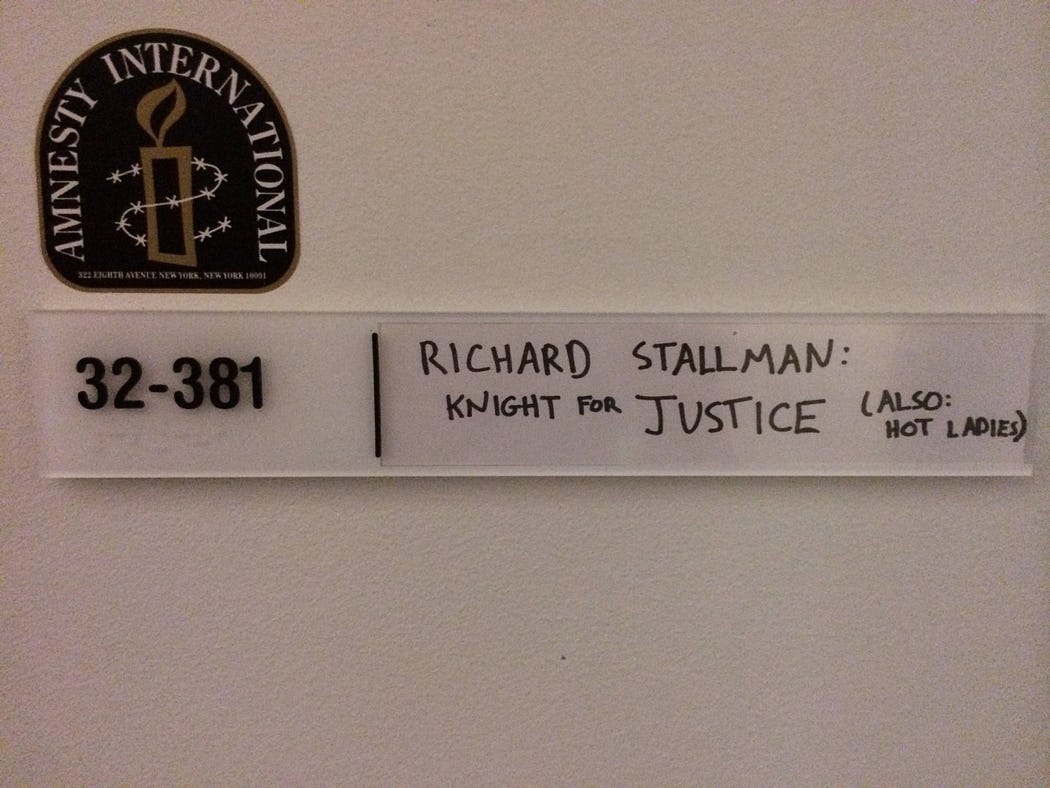
It’s not a coincidence the class of human that weathered the storm looks like Stallman, Linus, ESR, et. al. That’s what it took. The toxicity in these communities is a result of what was leftover. These humans grew up amongst OSS activists that also weathered the storm.
They carried the flag when no one else would. Vilifying them now, at a time where Microsoft just purchased the two largest infrastructure/tooling providers for the commons (npm, GitHub) is concerning to me. Without them, the commons wouldn’t be what it is today.